Hotel influencer partnership models: finding your best fit
A hotelier in Lisbon called me last spring, frustrated. She'd been running the same playbook for three years — invite a travel creator for a complimentary two-night stay, hand over a welcome amenity…
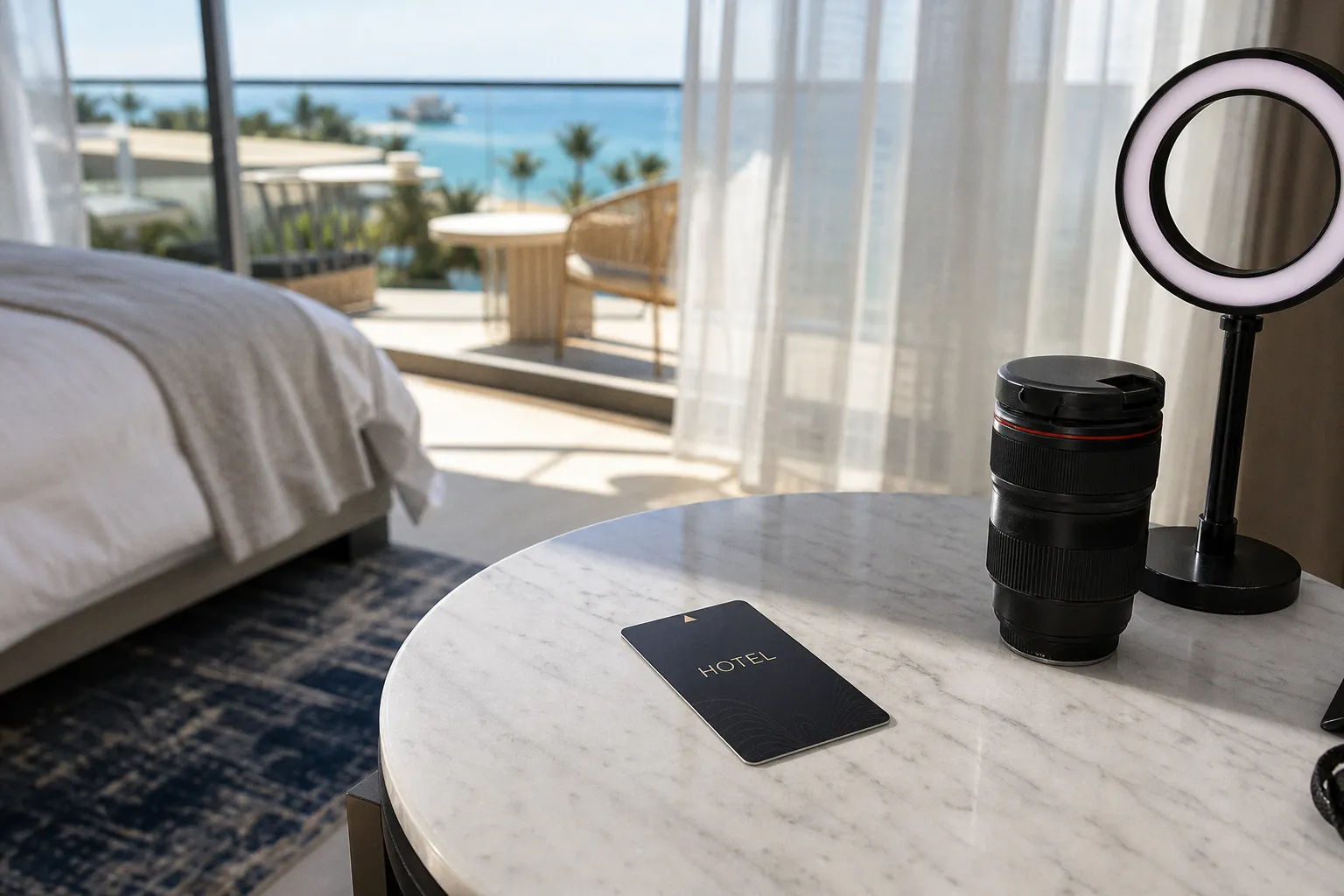
A hotelier in Lisbon called me last spring, frustrated. She'd been running the same playbook for three years — invite a travel creator for a complimentary two-night stay, hand over a welcome amenity, and hope the content landed well enough to nudge bookings during her soft shoulder months. The reach looked decent on paper, but her direct booking numbers hadn't moved in eighteen months. Meanwhile, Booking.com and Expedia were quietly siphoning 18 to 22 percent off every reservation that did come through. She wasn't opposed to influencer collaborations — she just couldn't tell whether they were paying for themselves anymore, or whether she was subsidizing a creator's content calendar with empty rooms.
Compare car rental deals in United Kingdom
See available offersPartner link — DiscoverCars comparisonThat conversation is the same one I'm having with properties from Marrakech to Charleston right now. The era of the loose barter arrangement — a free stay, a couple of posts, a handshake — hasn't disappeared entirely, but it's no longer the engine most independent hotels want to rely on. The smartest operators I work with are rebuilding their influencer playbook around three structures: paid agreements, hybrid deals that blend a modest fee with commission, and tiered partnerships that match creator size to season and segment. The goal isn't to spend more on creators. It's to spend in a way that actually moves the direct booking needle — and to keep the content, the rights, and the data afterwards.
The free-stay era isn't dead, but it has grown up. The properties winning with creators now treat partnerships as media investments, not favors.
What barter still does well — and where it quietly leaks value
Let me be direct about something the industry sometimes papers over: barter collaborations still work, and for certain properties they remain the right tool. If you run a small B&B in a market you haven't cracked yet, if you're testing a creator for the first time, if your budget genuinely can't stretch to a paid fee — a complimentary stay in exchange for a defined content package is a legitimate starting point. I've placed emerging creators in boutique properties on barter terms and watched those partnerships mature into paid relationships over six to twelve months.
What has changed is what "barter" actually means. The informal version — a DM, a vague agreement, a follow-up that's never quite answered — leaves both sides exposed. The creator isn't sure whether they can repost your content in paid amplification. You're not sure whether the deliverables you discussed in a voice memo will actually appear. And when revenue does trickle in, neither of you can trace it.
The modern barter isn't a favor. It's a contract with shorter terms, clearer deliverables, and — crucially — usage rights spelled out from day one. Even when no money changes hands, you're licensing content, and you should treat that licensing with the same seriousness you'd treat any other media buy. I'll say this again later, because it's where most hotels leave money on the table: if you don't write the usage rights into the agreement, you don't own the assets in the way you think you do.
Paid agreements: what the fee actually buys you
Once a property decides to move beyond barter, the first model most operators encounter is the straightforward paid fee — a flat rate negotiated for a defined content package, typically one or two posts, a Reel, a Stories series, and usage rights for a specified window. The pricing scales with the creator's audience, niche authority, and production scope, but in my own client work I've seen paid fees for micro-tier creators land anywhere from a few hundred dollars for a single deliverable to several thousand for a campaign built around a hero asset.
The reason paid agreements have become the structural backbone of hotel influencer partnerships isn't the fee itself. It's the contract that comes with the fee. Paid deals give properties leverage to negotiate three things that barter arrangements usually can't secure:
- Content usage rights — the right to repost, reuse, and repurpose the creator's photos and video across your own channels, your paid social campaigns, your email marketing, and your website for an agreed window, commonly six to twelve months.
- Whitelisting rights — the right to run the creator's content as a paid ad under their handle, which typically outperforms branded ads because the audience still sees the creator as the trusted voice.
- Exclusivity windows — a defined period during which the creator agrees not to feature competing properties in your destination or category.
Each of those clauses has a real dollar value attached to it, and most creators know it. That's why a paid fee feels heavier than barter — you're not just paying for posts, you're paying for a small media package. When I sit with hoteliers to scope a paid deal, I always walk them through what those rights are worth to their annual marketing budget, because that's how you size the fee honestly rather than guessing from follower count.
Comparing the three models side by side
Before going deeper into hybrid, it helps to lay all three structures next to each other — because the choice between them isn't ideological, it's operational. What fits a 24-room inn in Vermont is rarely what fits a 180-room resort trying to break into a new feeder market.
| Element | Barter | Paid | Hybrid |
|---|---|---|---|
| Cash outlay | None (room + amenities) | Flat fee, scales with creator tier | Reduced fee plus 10–15% commission on tracked bookings |
| Best fit | New creator relationships, limited budgets, content seeding | Hero assets, peak-season campaigns, content rights priority | Driving direct bookings while still collecting usable content |
| Content usage rights | Often informal or absent | Negotiated, typically 6–12 months | Negotiated, tied to campaign window |
| Whitelisting rights | Rarely included | Standard add-on | Standard add-on |
| Attribution to direct revenue | Weak — hard to trace | None — fee is the cost | Strong — promo codes or UTM links tie bookings back |
| Time investment for the hotel | Lowest | Medium | Highest (tracking, reconciliation, reporting) |
| Risk profile | Low cost, low control | Predictable cost, high control | Variable cost, high upside on bookings |
This is the snapshot I keep on a single page when I'm scoping a new creator program with a client. It's not a verdict — it's a working map of which questions each model answers well, and which it leaves open.
Hybrid partnerships and the OTA math
Here's where the conversation usually lands for independent hotels and small groups with real revenue targets but tight marketing budgets. The hybrid model combines a reduced base fee with a performance commission — typically somewhere between 10 and 15 percent of bookings generated through the creator's unique tracking link or promo code. Some affiliate structures extend the upper end toward 30 percent when the creator is delivering meaningful volume, but the 10 to 15 percent range is the working number I've seen negotiated most consistently across independent properties.
The arithmetic makes the appeal obvious. If an OTA is going to charge you 15 to 25 percent on a booking that came through their platform, a creator driving the same booking at a 12 percent commission — and giving you the guest's email, the direct relationship, and full control over the remarketing — is structurally a better deal before you even account for the content you're receiving on top. That's the comparison I walk hoteliers through when they're trying to decide whether an influencer program is worth standing up at all.
A few practical notes from the field. First, the tracking has to be real. A creator's "swipe up" or "link in bio" only counts as direct attribution if you're using a unique UTM, a dedicated landing page, or a promo code that ties cleanly back to the partnership. Most booking engines and PMS systems handle this now, but I've still seen hotels launch hybrid campaigns without that infrastructure in place, and the moment the report lands they'll never know whether the creator actually moved anything. Second, the commission should be paid on net room revenue, not on the total folio — otherwise the F&B and spa spend gets attributed to the creator and the math stops making sense. Third, build a window. A 30-day cookie window is standard, and it keeps both sides honest about attribution without letting the commission linger forever.
For hotels spending around 3 to 6 percent of total revenue on marketing — the band I see most often for independent properties — a hybrid program can sit comfortably inside that envelope while still leaving room for the brand campaigns, the metasearch spend, and the OTA listings that are doing the heavy lifting on demand capture.
Tiering creators across the calendar
No single creator size fits a full year, and the hotels pulling the strongest results are the ones matching creator tier to season and segment. The structure I've helped several properties build looks roughly like this:
- Nano-influencers (roughly 5,000 to 20,000 followers) for shoulder dates, midweek stays, and local staycations. These creators tend to have the highest engagement rates, the most direct trust with their audience, and the lowest cost per acquisition. They're also the easiest to work with on hybrid terms, because a small fee plus a meaningful commission is genuinely transformative income for them.
- Micro-influencers (roughly 10,000 to 100,000 followers) for shoulder-to-peak transitions and destination storytelling. They carry enough reach to move the needle on a specific campaign window but still feel close enough to their audience that recommendations read as personal rather than sponsored. Most of my hotel clients find their best cost-per-engagement here.
- Mid-tier and macro creators for peak season brand value, press moments, and the hero asset that anchors your annual visual library. These deals are nearly always paid, the contracts are heavier, and the rights conversation starts on the first call.
A boutique hotel in Miami — I'll keep them anonymous, but their owner has been generous in letting me reference the case — restructured its entire creator program around this tiered logic and moved away from a single mega-creator partnership that had been delivering reach but almost no direct bookings. Within three months, the shift to targeted micro-influencers specializing in luxury weekend getaways produced a 5:1 return on the creator spend, tracked through dedicated promo codes. That's not an outlier; it's what happens when audience fit replaces audience size as the planning variable.
The contract clauses that decide everything
I won't pretend contracts are the most exciting part of this work, but they're the part where partnerships quietly succeed or quietly fall apart. Five clauses deserve explicit attention in any hotel influencer agreement, whether the deal is barter, paid, or hybrid.
1. FTC-compliant disclosure language. The agreement should specify that the creator will use #ad or #sponsored in a way that meets current FTC endorsement guidelines, and that the disclosure is the first thing visible — not buried after the hashtags. Creators who resist this clause are telling you something about how they intend to handle compliance on every other property they work with.
2. Content deliverables with specificity. Not "a Reel" but "a Reel between 30 and 60 seconds, featuring the suite, the pool, and the breakfast service, delivered within 14 days of checkout, in two rounds of revisions." Vague deliverables are how you end up with content that doesn't actually show your property in any usable way.
3. Usage and whitelisting rights with a defined window. Spell out where you can run the content, on which platforms, for how long, and whether paid amplification is included. If the window is 12 months, say 12 months. If it's perpetual, price it accordingly.
4. Exclusivity in your category and geography. A 30-day category exclusivity in your destination is standard; anything longer should cost the creator (or you) appropriately.
5. Payment terms tied to deliverables and verification. For hybrid deals, commission should reconcile monthly against your booking data, and the agreement should specify who pays for any tracking infrastructure.
If the contract doesn't define how the content can be used after it goes live, the partnership ends the moment the post is published.
Bringing the models together
The right hotel influencer partnership model isn't the one that looks best on a case study. It's the one that fits your property's revenue cycle, your team's capacity to manage creator relationships, and the kind of content you actually need to fill your channels for the next twelve months. The structures overlap, but the priorities don't — and a 24-room inn with a tightly defined brand voice will run a meaningfully different program than a resort trying to crack a new international feeder market.
What I tell every hotelier I work with is this: stop treating influencer collaborations as a single bucket called "creator stays" and start treating them as a portfolio. Some partnerships exist to fill your content calendar with high-quality assets you fully control. Some exist to drive specific booking windows through tracked affiliate commissions. Some exist to seed long-term relationships with creators who'll come back season after season and become a credible voice for your property over time. The hotels winning on this channel aren't spending more — they're being more deliberate about which model they reach for, and which clause they refuse to leave out of the contract.
If you're rebuilding your creator program this year, I'd start by mapping the three models to your revenue calendar, then work backward into the contract language. The free stay isn't gone. It's just no longer the whole strategy — and the operators treating it as one piece of a larger plan are the ones whose direct booking numbers are starting to move.