How Sony’s New Multi-Camera Workflow Simplifies Hospitality Event Production
According to SVG Europe, Sony has outlined its IBC 2026 showcase in Amsterdam around synchronized multi-camera production, virtual production, PTZ capture, switching, and cloud orchestration.
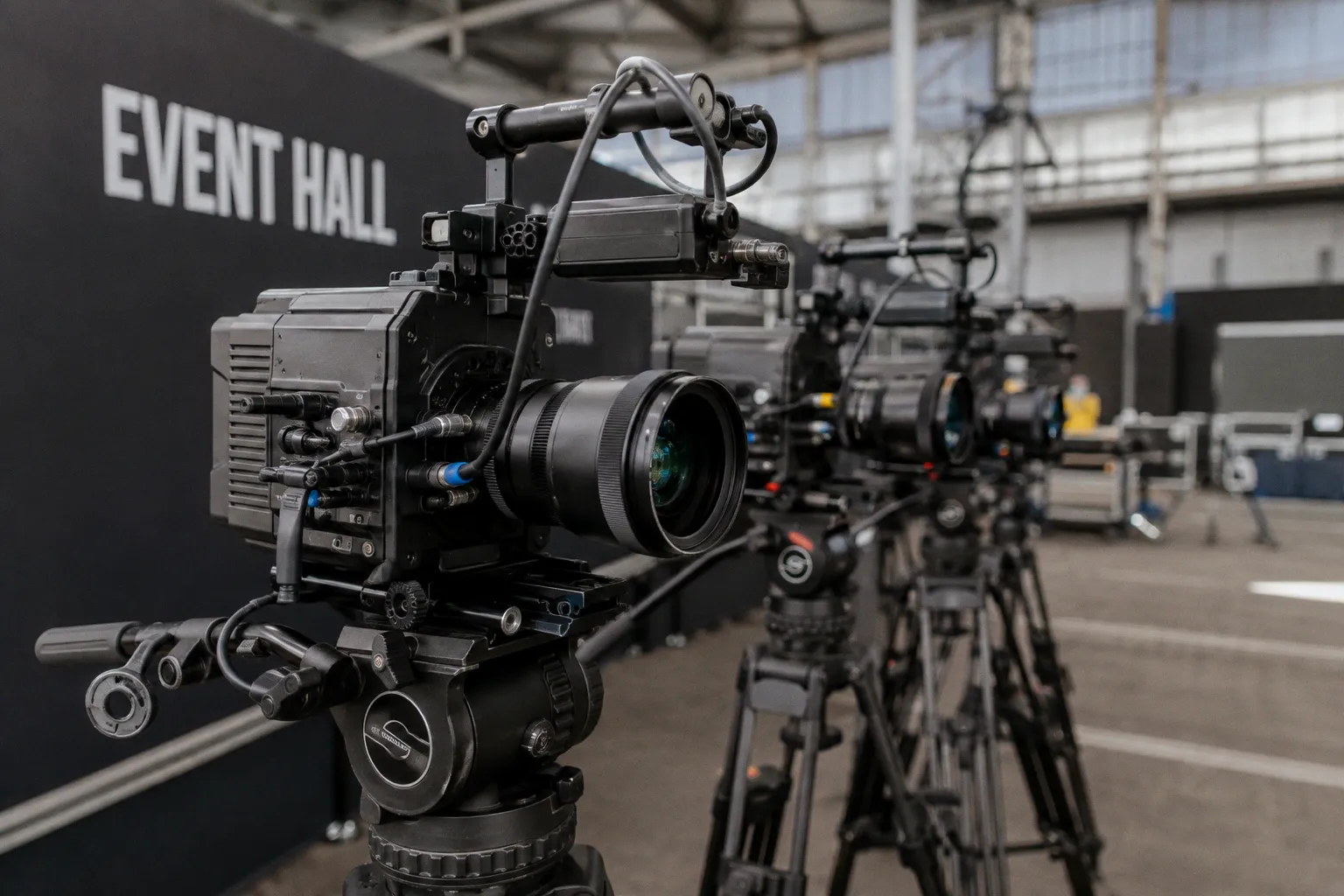
The lineup matters to hospitality teams because it targets the part of video production that usually creates friction: keeping several cameras, feeds, operators, and delivery systems aligned. For hotels producing live events, property launches, training content, or branded experiences, the relevant question is not whether the cameras are new. It is whether the workflow reduces operational failure without forcing a full infrastructure change.
Sony is selling workflow control, not a single camera
Sony’s HDC R series uses 2/3-inch global shutter 3-CMOS sensors, extended dynamic range, and multiple sensitivity modes. The cameras support simultaneous HDR and SDR production and can operate wirelessly for 4K content creation. The HDCU-3500R camera control unit adds IP readiness, 12G-SDI, and 4K output for outside-broadcast production, with 4K available through an optional licence.
That configuration is aimed at controlled, multi-camera environments. In hospitality, the closest use cases are live conferences, staged brand events, culinary demonstrations, and large property presentations where camera movement, switching, and exposure consistency affect the final edit.
The PTZ options are more directly relevant to smaller production teams:
- SRG-AS10 and SRG-XS10 support 4K 60p imaging, native IP integration, and automated video capture.
- BRC-AM7 combines 4K 60p output, 20x optical zoom, and AI-based auto-framing.
- The BRC-AM7 supports ITU709, S-Cinetone, and S-Log3.
This is a useful distinction. Automated framing can reduce operator load. It does not remove the need to test camera positions, subject tracking, lens coverage, and background movement inside the actual venue. A PTZ system can be technically synchronized and still produce weak booking content if the composition is poorly mapped.
The production stack extends from capture to cloud
Sony is also presenting the FX5 compact cinema camera with 5K open-gate imaging, internal RAW recording, a 16.6MP sensor rated at more than 15 stops of dynamic range, 4K 240p and 5K 120p recording, 32-bit float audio, and dual USB-C connectivity.
For hospitality video, that points to a mixed workflow rather than a replacement strategy. A production may use PTZ cameras for fixed coverage, a cinema camera for controlled hero shots, and system cameras for live delivery. The risk is the handoff between these devices. Different colour profiles, frame rates, audio paths, and recording formats can create friction during post-production.
Sony’s switching and orchestration products address the same problem at infrastructure level:
- MLS-X1 is a modular live production switcher with reconfigurable architecture and scalable processing.
- Nevion Moxela is a cloud-native platform for low-latency processing and transport of live video, audio, and data.
- Moxela supports HEVC, JPEG XS, NDI, and ST 2110 across on-premises and cloud deployments.
- Nevion VideoIPath combines broadcast control, network orchestration, cloud orchestration, and monitoring across hybrid SDI/IP workflows.
These capabilities are most relevant when a hospitality brand operates more than one production location or needs repeatable live delivery. The practical audit should be simple:
- Confirm which feeds need live switching and which only need recording.
- Map where HDR, SDR, RAW, and compressed formats enter the workflow.
- Test whether the venue network can support the intended IP architecture.
- Identify the manual steps that remain when a camera, link, or operator fails.
Do not treat “cloud-native” as a conversion metric. It describes deployment architecture. It does not prove lower production cost, faster turnaround, or higher booking performance.
Virtual production is moving closer to venue content
Sony is also updating its Burano full-frame cinema camera and Ocellus camera-tracking system for virtual production. The company will participate in an IBC Showcase panel on synchronized multicamera workflows in virtual production on 11 September 2026, from 17:15 to 17:35.
Other IBC announcements reinforce the direction of travel. RED Digital Cinema is presenting V-RAPTOR cameras with dual-fisheye lenses for real-time 8K 50fps immersive streaming to Apple Vision Pro headsets through RED Connect. Dell is showing local workstation rendering of Gaussian-splatting drone reconstructions into Unreal Engine LED volumes, alongside real-time 8K Blackmagic RAW workflows in DaVinci Resolve 21.
For hotel and real-estate teams, these are not automatic purchasing signals. They are indicators of a more complex capture pipeline. LED volumes, immersive output, tracking, and 8K finishing can expand production options, but each layer adds technical dependencies.
The correct next step is a controlled split-test, not a full-stack upgrade. Compare the current workflow against a synchronized multicamera setup using the same property, same message, and same distribution channel. Measure production time, failure points, edit friction, and the resulting engagement or booking-path behaviour. If the new system does not reduce measurable friction, the specification is decoration rather than ROI.