Why Hospitality Brands Must Shift from Creator Volume to Conversion Logic
According to Kompas.id, the rapid expansion of the creator economy is saturating consumers with product and service recommendations. The issue is directly relevant to hospitality brands: another creator post is not automatically another booking opportunity.
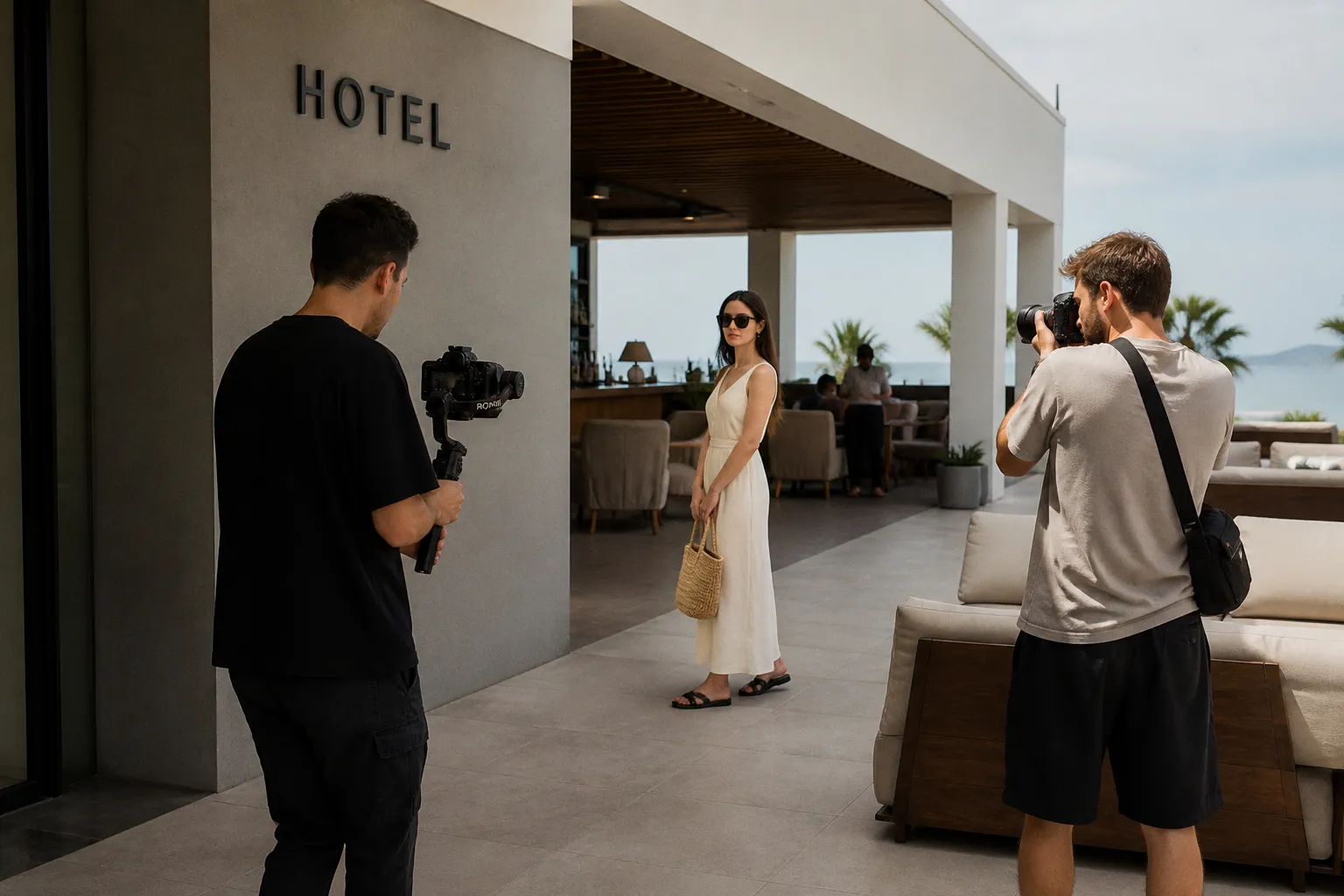
In a crowded feed, production quality and measurable conversion logic matter more than creator volume.
Reach is no longer a sufficient filter
The practical risk is selection friction. A hotel can commission more videos, publish more frequently, and still create no measurable lift in bookings. Saturation changes the task from “find a creator” to “prove that this creator can reduce uncertainty for a specific guest.”
That requires a tighter brief:
- Define the booking action before production starts.
- Match the creator’s audience to the property’s actual offer.
- Separate awareness content from conversion content.
- Record the baseline for traffic, enquiries, and bookings.
- Use a consistent tracking method across creator placements.
Follower count is not a conversion metric. It is a distribution signal. It does not confirm that viewers understand the room layout, trust the pricing context, or know what to do next.
For hospitality, the visual audit should be equally strict. Does the video show the arrival path? Does it establish the relationship between the room, bathroom, workspace, and shared areas? Does it remove the questions that cause a viewer to leave the booking page? A polished sequence with no spatial information can produce attention while increasing bounce rate.
The content must carry evidence
The Kompas.id report describes a market filled with recommendations. That makes generic endorsement a weak asset. “You should stay here” is interchangeable. A useful property video must show evidence that a guest can evaluate.
Prioritise scenes that answer operational questions:
- What does the room actually look like from the entry?
- How much usable space is visible?
- Which features are central to the stay?
- How does the property move from public areas to private ones?
- Is the call to action clear and consistent with the booking path?
This is where architectural photography and creator video should be treated as one system, not separate campaigns. The still image controls the first click. The video controls expectation. The booking page must then preserve the same framing, focal priorities, and spatial sequence.
Any mismatch adds friction. If the creator presents a wide, readable room and the booking page opens with a tight crop, the viewer has to reconstruct the offer. That is a preventable failure. If the video relies on personality while the property page provides no equivalent factual detail, the campaign may generate interest without improving booking confidence.
Audit the partner before scaling output
The reported saturation is a reason to reduce uncontrolled volume. Start with a split-test, not a large creator roster. Keep the property, offer, landing page, and booking path stable. Change one content variable at a time: creator, opening frame, room sequence, or call to action.
Track the result against the business objective. Depending on the campaign, that may be qualified traffic, booking-page engagement, enquiry quality, or completed reservations. Do not use views as a substitute for ROI unless views are the stated objective.
The creator market is also becoming more complex. Dailyhunt reports the rapid growth of an individual regional creator, while a separate Philnews.ph headline reports that the Philippines’ Department of Labor and Employment requires working permits for content creators below 15 years old. These headlines do not establish a universal market rule, but they are a reminder to check the creator’s operating context before commissioning work.
Technical checklist:
- One defined conversion event.
- One documented baseline.
- One controlled test.
- A visual brief built around spatial proof.
- Clear disclosure and usage terms.
- A booking page that matches the campaign’s framing.
- A post-campaign review based on conversion data, not applause.