Why Virtual Reality Is Becoming a Critical Pre-Booking Tool for Hotels
Industry research compiled by The Traveler puts a number on the shift: roughly six in ten surveyed travelers say they would use VR to explore a destination or hotel before booking.
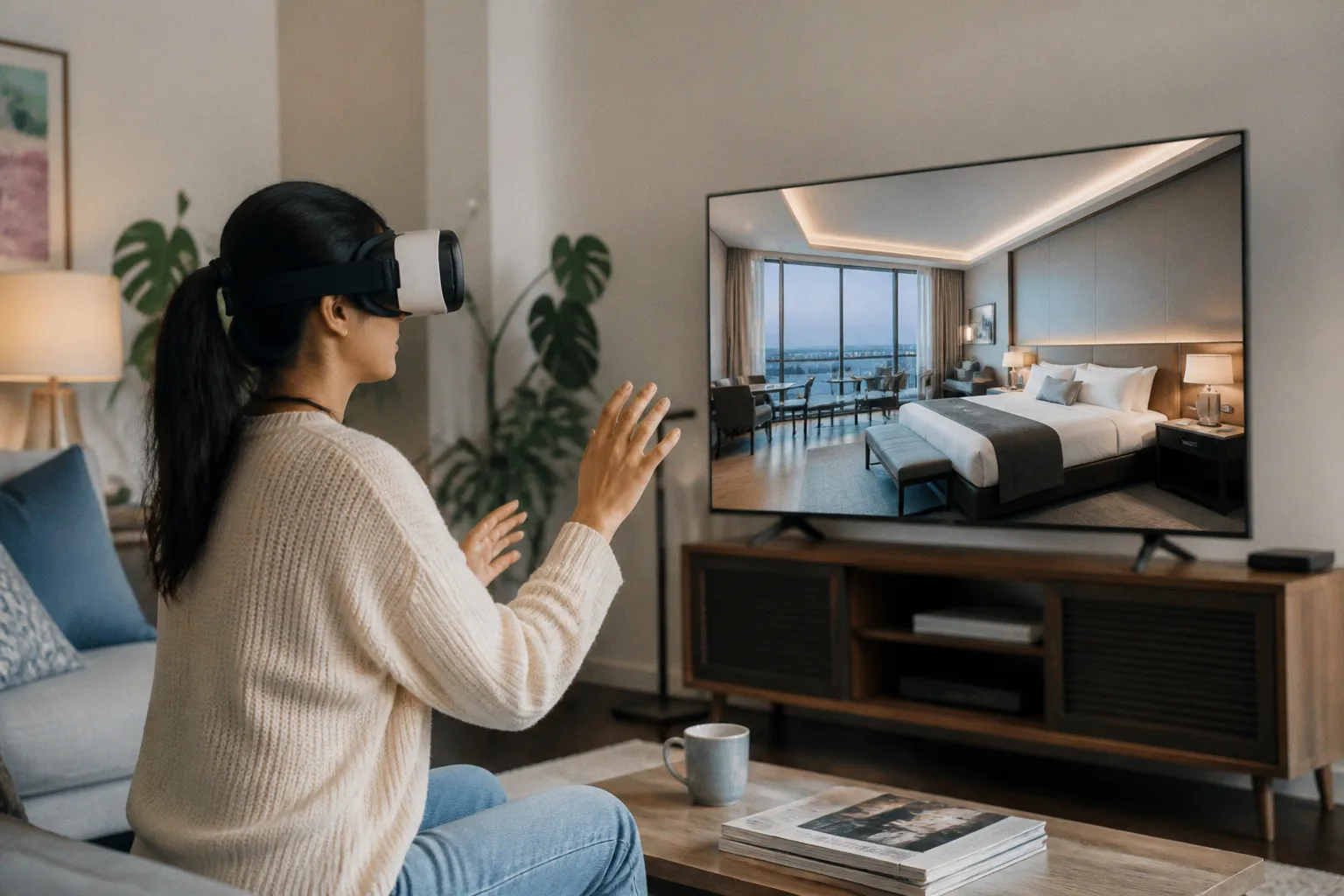
Previews Cross the Booking Funnel
That figure comes from a global trends report by a major reservations and distribution company. For accommodation brands, the signal is clear. Virtual reality tourism is no longer a showroom gimmick. It is a pre-purchase tool now wired into the funnel.
What the Data Actually Says
The same research stream documents three operational changes worth tracking:
- Hardware crossover. Lightweight mixed-reality devices launched over the past two years now deliver resolutions that hold up at room scale. Consumer-grade headsets have removed the in-store dependency.
- Funnel integration. Hotel groups, OTAs, and airlines embed 360° tours, room-scale scans, and 3D neighborhood walkthroughs directly into the booking path. Walkable beachfronts, aircraft cabin interiors, and cruise route previews are already live.
- Booking uplift, replicated. Earlier in-store VR pilot campaigns produced measurable increases in bookings for featured destinations. Current deployments scale that model through consumer headsets and mobile.
Academic analyses on telepresence and metaverse tourism, also cited in the report, identify the mechanism. Immersive environments produce a convincing sense of "being there." That perception shifts purchase intent before the user reaches a reviews page.
Production Implications for Hotel Teams
For properties still relying on a flat hero gallery, the gap is now quantifiable. The static grid answers one question: "does this thumbnail sell?" A 3D scan answers several more — room proportions at eye level, view orientation from the bed, light quality at check-in hour. Those are objections a still image cannot compress into a single frame.
From a conversion standpoint, the priorities reorder:
- Capture once, render twice. A photorealistic room scan feeds both an interactive VR tour and a high-resolution still set for the booking page. Capture cost is shared. Split-test branches are not.
- Focal length parity. Wide-angle VR scans and tight architectural stills resolve different objections. The scan answers layout and spatial feel. The still answers thumbnail conversion. Both must be present.
- Dynamic range parity. Lighting captured for a still has to survive compression into a real-time 3D viewer. Mismatch here is where visual trust breaks.
What to Track
If VR previews enter the funnel, three metrics separate signal from novelty:
1. Drop-off rate between the 3D tour entry and the room detail page. Navigation friction kills the conversion lift.
2. Time-on-tour per user segment. Honeymoon, multi-generational, and long-haul itineraries are flagged in the research as the highest-value use cases. Segment the data accordingly.
3. Bookings attributed to VR-entering sessions versus image-gallery sessions. Without the split, the ROI claim is decorative.
The consumer intent is documented. The hardware is accessible. The remaining variable is whether the visual production pipeline treats VR as an asset class or an experiment.