Should hotels use video popups in the booking engine?
Here's the deal: the question is dead. The real question is whether you'll be among the hotels using video to lift conversion, or among the hotels using video to torch their own booking funnel.
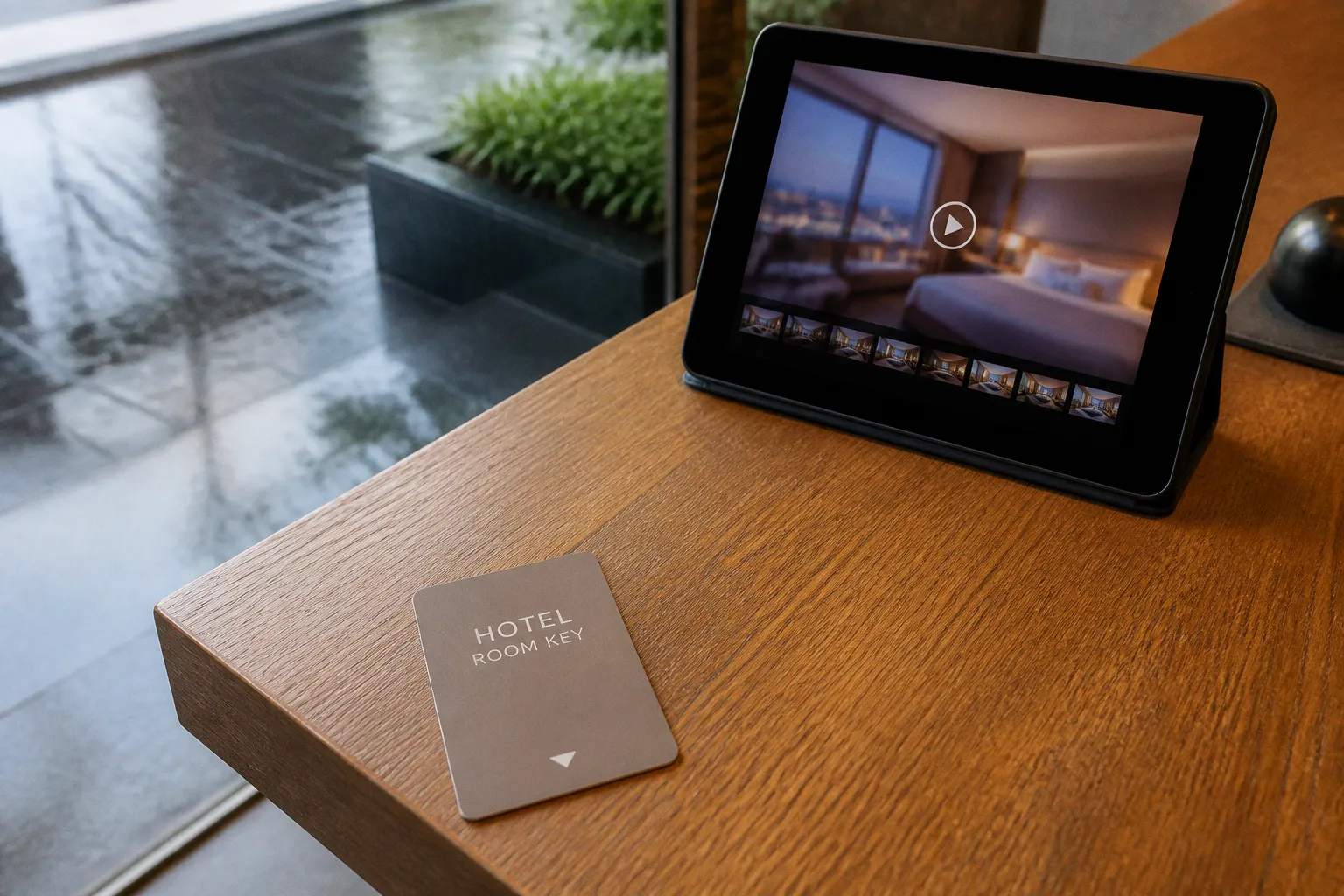
Because both camps exist — and the distance between a well-placed video popup and a funnel-wrecking one can mean the difference between capitalizing on a potential conversion uplift or watching your direct revenue quietly drain.
Industry data shows video content on hotel websites can increase conversion rates by up to 80%. Meanwhile, the average hotel site converts at 1.5% to 2.5%, and mobile sits at a brutal 1.4%. Those numbers aren't competing — they're telling the same story. Video moves the needle. Video also breaks the funnel when you misuse it. Choose carefully.
A video popup is a conversion lever, not a decoration. Levers break things when you grab them wrong.
The Conversion Paradox: Engagement vs Friction
Let me be blunt. The hotels winning with video aren't the ones with the prettiest B-roll. They're the ones who figured out that video is a conversion lever, not a brand flex. A lever transfers force from where it's wasted to where it counts. Your booking engine is where it counts. Everything else is decoration.
The paradox is simple. Video holds more attention than any other format on the web. Attention is intent. Intent is bookings. But the second a video blocks, hijacks, or distracts from the booking widget, you've converted that attention into friction. Friction is the silent killer of direct bookings. Every second the user wonders "what's this?" is a second they're not confirming dates.
Three numbers anchor this conversation:
- 1.5%–2.5% — average hotel website conversion rate. That's the baseline you're either lifting or dragging.
- Up to 80% — the lift video content can deliver if you deploy it without breaking the funnel.
- 1.4% median mobile conversion vs 2.9% desktop — and 62% of your traffic is mobile. Read that twice.
The paradox isn't a contradiction. It's a precision problem. Get the placement wrong and the same tool that wins bookings loses them. Get it right and you're operating with one of the highest-leverage onsite assets hospitality has access to — without touching your rate strategy, your OTA commission structure, or your PMS.
Think of it this way. Your booking engine is the checkout lane. A video popup that orients, reassures, and nudges is like a well-placed sign that says "upgrade available" — it adds value at the moment of decision. A video popup that covers the date picker is someone stepping in front of the register to show you a commercial. Same content, opposite outcome. Context is everything.
Quantifying the Impact of Onsite Video Campaigns
Let's get specific, because "video works" is the most useless sentence in hospitality marketing.
Here's what actually moves numbers:
- Embedded booking widgets beat external redirects by up to 37%. If your "Book Now" button kicks users to a third-party engine, you've already lost a significant chunk of your conversion ceiling before video enters the chat. An embedded widget with a complementary video preview — a room walkthrough, a 15-second amenity highlight — sits on the same page as the rate. No redirect. No context loss. No opportunity for the user to second-guess.
- Booking-intent conversion (sessions reaching the booking engine) runs 8%–15%. That's the funnel stage you actually get to optimize. Most sites never even measure it. If you don't know what percentage of visitors reach your booking engine and what percentage convert once there, you're flying blind. Video popups are one of the few tools that can influence both stages — driving more users into the engine and converting more of them within it.
- Welcome popups with signup fields convert at 4.65% on average — top performers hit 19.77%. Same principle: capture intent, don't hijack it. A welcome popup that offers a 10% discount for an email address works because the user made a conscious decision to engage. A video popup that plays automatically on page load and covers the content — that's the opposite of conscious engagement. It's ambush.
- Booking-engine popups offering discounts convert 8%–12% of visitors into subscribers. Discount-led, post-engagement, never pre-engagement. The timing matters. The video popup appears after the user has started interacting with dates or room types — not before. The video offers something tangible: a rate reduction, a complimentary upgrade, a late checkout. The user has already invested attention. You're meeting them where they are, not dragging them somewhere new.
- Hospitality brands running onsite segmented overlays (think Wisepops-style campaigns) attribute roughly 10% of total site revenue to those campaigns. A tenth of revenue, sitting in tooling you probably haven't turned on yet. And that's across all overlay types — not just video. Video overlays, when layered on top of behavioral segmentation, can punch above that average because they carry more emotional weight than a static banner.
The pattern is obvious once you stop romanticizing it. Onsite, behaviorally triggered, non-blocking video outperforms static page decoration by every metric that matters. It outperforms badly placed video by a mile. The difference between a video popup that lifts conversion and one that tanks it is almost never the video itself — it's the trigger, the placement, and whether it gets out of the user's way.
Why Intrusive Video Elements Kill Booking Intent
Now the cynical part. Because most hoteliers — even the "modern" ones — still treat video like a 30-second TV spot. Autoplay. Sound on. Full-bleed. Centered over the page. That's not conversion design. That's a way to make a guest feel ambushed.
Four things kill the booking decision, fast:
1. Autoplay video. Especially with sound. Especially on mobile, where 62% of your traffic lives and users are one tap away from the back button. Autoplay says "I don't respect your context." A user on a train, in a meeting, or lying in bed next to a sleeping partner doesn't want your lobby tour narrated at full volume. They want the rate for a king room on Thursday. Sound-on autoplay is the fastest way to turn intent into irritation.
2. Popups that cover the booking widget. The booking widget is the finish line. Covering it is like putting a velvet rope in front of the checkout lane at a store that already has people walking out. If the user has navigated to the booking engine — typed dates, browsed rooms, clicked "Book" — they're as close to converting as they'll ever get. A popup between them and the confirmation button doesn't add value. It taxes the decision.
3. Heavy animation layered with chat popups. Stacking attention-grabbers doesn't multiply attention. It cancels it. Users don't read three competing overlays. They bounce. The "support" widget, the newsletter popup, the cookie consent bar, and now a video overlay — that's four interruptions before the user has seen a room rate. Each one makes the others worse. Pick your priorities. Stack nothing.
4. Looping B-roll with no CTA. A 45-second drone shot of your infinity pool at sunset is gorgeous. It is not a booking. If the video doesn't drive toward a button, a date, a rate, or a room — it's wallpaper. Pretty, expensive wallpaper that costs you page speed and gives the user nothing actionable. Every video needs a destination. No CTA, no point.
The booking decision is fragile. The user has scrolled, compared, mentally packed, considered the price. That moment is gold. Spend it on friction and the visit ends. Spend it on clarity and you win.
Don't make me scroll past your pool drone to find the room rate. That's not branding. That's a hostage situation.
Strategic Placement: Where Video Adds Value Without Blocking the Funnel
So where does video actually pull its weight? Three placements. No more.
1. The landing page hero — for cold traffic only. First-time visitors from organic search or paid social don't know your property. A 6–10 second hero loop with muted autoplay, a clear CTA below, and a price anchor works. Muted. Always muted. Subtle CTA. Hero is for orientation, not closure. The goal isn't to sell the room — it's to sell the scroll. You want the user to keep going, to explore room types, to land on the booking engine. A hero video that accomplishes this is earning its bandwidth. One that autoplays with sound and no visible CTA is just noise in a viewport.
2. The room or experience page — post-scroll. Once a user has scrolled past the room photos, specs, and amenities, then trigger a video popup. This isn't a cold ask. They've already invested attention. A video here, with a "Book This Room" CTA, converts browsers into bookers. Behavioral trigger, not autoplay. The user has signaled interest. They've read the description, checked the bed configuration, maybe toggled between room types. A short video — 15 to 30 seconds — showing the room in motion, the view from the balcony, the bathroom they can't quite picture from photos alone — this is video doing what photos can't. And it appears at the moment when it answers a question the user is already asking.
3. Exit-intent or cart-abandonment — at the booking engine itself. This is the high-leverage zone. Booking intent conversion runs 8%–15%. That means the vast majority of users who reach the engine leave without booking. Exit-intent video popups here — offering a rate nudge, a date-flexibility hint, or a short walkthrough of what's included — can recover a meaningful slice. Done right, you're catching intent, not interrupting it. The user was going to leave. Their cursor moved toward the browser chrome. A short, muted video with a clear offer — "Flexible cancellation included" or "Breakfast and parking, no hidden fees" — gives them a reason to pause. Not a wall. A reason.
Do this, not that:
| Move | Do this | Not that |
|---|---|---|
| Hero video | Muted, short loop, CTA visible below fold | Autoplay with sound, full-bleed, no exit |
| Booking widget | Embed directly, video above as preview | External redirect with video popup overlay |
| Exit intent | Triggered video with discount or upgrade hint | Static popup with the same offer as the homepage |
| Mobile | Tap-to-play, compressed, vertical-friendly | Forced autoplay, horizontal crop, no skip |
| Room page | Scroll-triggered, 15–30 seconds, direct "Book" CTA | Autoplay on load, long cinematic, no action step |
Notice what's missing from the strategic list: video "in" the booking engine blocking the date picker. That's not strategic. That's a conversion tax on your own funnel.
Technical Benchmarks for High-Converting Booking Flows
Numbers without execution are just trivia. Here's the floor.
Page weight. Video kills load time when it's unoptimized. Slow-loading pages erode both SEO visibility and user patience — the effects compound on mobile, where connections are less predictable and tolerance for delays is lower. Lazy-load every video. Compress aggressively. MP4 over WebM for broader device compatibility. Host on a CDN. The video should appear when it's needed, not preload on every page and punish the user for visiting your homepage. A video that takes four seconds to load on a 4G connection isn't adding engagement — it's contributing to the exact abandonment you're trying to prevent.
Mobile-first everything. 62% of your traffic is on a phone. Median mobile conversion is 1.4% — roughly half of desktop's 2.9%. Every video decision should be made on a phone screen first. If it doesn't work there, it doesn't work. That means: vertical-friendly framing, tap-to-play instead of forced autoplay, compressed file sizes that don't eat a data plan, and popup dimensions that don't obscure the entire viewport. Test on a mid-range Android device, not just the latest iPhone on hotel Wi-Fi. Your guests are on the subway. They're in the airport lounge. They're on a slow connection in a foreign country. Respect that context.
Trigger discipline. Scroll-based (after 50% of page), exit-intent (cursor leaves viewport), or time-on-page (15+ seconds engaged). Never autoplay on load. Never sound-on. Never on entry. These three trigger types work because they signal that the user has already invested something — time, attention, intent. A user who has spent 20 seconds on your room page has qualitatively different intent from one who landed three seconds ago. Your video popup should reflect that gap.
CTA pairing. Every video gets a paired CTA. Period. "Check availability," "Book this room," "See the suite." If the video doesn't end in a button, you've wasted the attention. The CTA should be visible during the video, not only after — a persistent "Book This Room" button overlaid at the bottom of the player means the user can act at any moment of peak interest. Don't make them wait for the video to end. Don't make them hunt for the button after.
A/B test ruthlessly. The potential conversion lift from video is real — but it's not uniform across properties, markets, or audience segments. Test hero loops against static imagery. Test exit-intent video against static exit-intent. Test room-page video against no video. Run for at least two booking cycles — hotel booking is seasonal and a one-week test during a shoulder period tells you nothing about peak demand behavior. Compare booking-intent conversion (the 8%–15% range) against overall conversion (1.5%–2.5% range). Move on the winners. Kill the rest.
Stack sanity. Welcome popup + chat widget + video popup + booking discount overlay is not a stack. It's a hostage negotiation. Pick two. Rotate. Measure. Every additional layer of onsite interruption degrades the ones that came before it. If you're running a chat widget and a video popup simultaneously, the user isn't absorbing both — they're absorbing neither. Sequence them. Give each one its moment. A chat widget that appears after 30 seconds of inactivity and a video popup triggered by exit intent work together. The same two elements firing at the same time work against each other.
The Bottom Line
Yes, hotels should use video popups in the booking engine — when the booking engine is the destination, not the casualty. The potential conversion uplift is real, but it lives behind three gates: muted playback, non-blocking placement, and a paired CTA. Skip those, and your video becomes the most expensive decoration on the site.
Start with one experiment: a scroll-triggered, muted video popup on your top-converting room page, with a direct "Book This Room" CTA into your embedded booking widget. Measure against a static control for two full booking cycles. If your booking-intent conversion moves, scale it across room types. If it doesn't, kill it before it kills your funnel.
No mystery. No agency retainer required. Just a lever, used correctly.