Hotel Instagram Reels: three production paths for busy teams
You've posted three Reels this month — a lobby walkthrough here, a brunch flatlay there — and the metrics feel stuck.
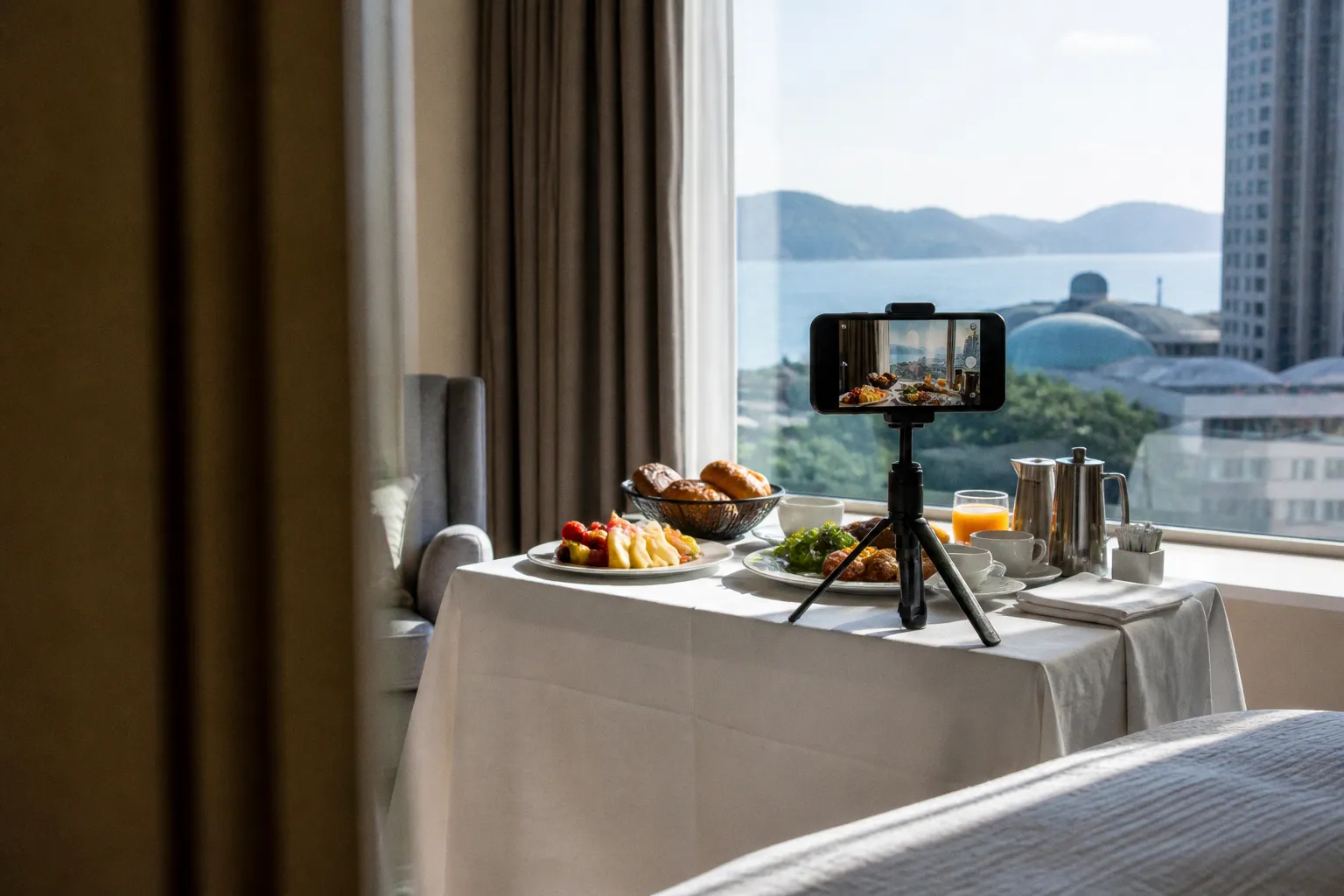
Meanwhile, the boutique down the coast is shipping vertical videos that look as though they came from a film school, and the bookings you're chasing from social still trickle in like an afterthought. If that tension is sitting on your desk right now, you are not failing at Instagram. You are facing a production problem that almost every independent hotel eventually hits: the content treadmill is real, and there is no single correct way to keep up with it.
Here is what I have learned after walking through this with hoteliers from Santorini to the Catskills: there are three sustainable paths for producing hotel Instagram Reels, and the path that wins for your property is the one your team can actually maintain. Let us walk through each — in-house batching, UGC and influencer collaborations, and professional Reels Packs from agencies — so you can choose with clarity, not pressure.
In-House Batching: Mastering Smartphone Content for Sustainable Growth
The most underestimated advantage in hospitality content is proximity. Your front desk team sees the morning light pour through the lobby at 7:14 a.m. Your housekeeping lead notices the way steam lifts off the breakfast pastries. Your chef knows exactly when the wood-fired oven hits that perfect glow. None of this is captured by a quarterly agency visit — and none of it requires a camera that costs more than your last renovation.
A modern smartphone — anything from an iPhone 11 upward, or its Android equivalent — is genuinely sufficient for Reels that perform. What matters far more than gear is how you film and, crucially, when. Batching is the practice that turns a chaotic marketing week into a calm, repeatable system. Instead of scrambling to capture something every Tuesday, you dedicate one focused session — a half-day, ideally — to filming multiple pieces at once: a chef's-eye-view of mise en place, a slow pan across a freshly made bed, a quick walk from the spa door to the treatment room with ambient sound, a 15-second behind-the-scenes moment of your concierge recommending a hidden walking route.
The structure I recommend to my clients looks like this: pick one content day per month, choose four to six distinct storylines (room reveal, dining moment, local neighborhood, guest experience, behind-the-scenes, signature detail), and shoot each in vertical 9:16 from the start. Vertical is not optional anymore — it is where the algorithm and the attention live. Plan for 15 to 90 seconds per finished Reel, which is the duration range where Instagram hospitality content consistently finds its audience. Edit on your phone using CapCut, InShot, or Adobe Express — all of which are free or near-free and built for vertical storytelling.
Consistency is a system, not a personality trait. The hotels that win on social are the ones that took inspiration out of the workflow and put it on the calendar.
Where teams trip up is treating batching as a one-off. It is not a project; it is a rhythm. Your second content day, three weeks later, will be twice as fast as the first because your eye will already be trained for the framing, the lighting, the three-second hook. The first time is always the hardest — and after that, the muscle takes over.
Leveraging UGC and Influencers for Authentic Guest Perspectives
There is a texture to guest-generated content that no internal shoot can replicate. When a real visitor walks through your lobby, fumbles with the key card, then exhales when the room view opens up — that micro-narrative carries an authenticity your branded content will never own, no matter how polished. This is the quiet power of UGC creators and travel influencers: they translate your property into the language your future guests actually speak.
The path here is straightforward in concept, nuanced in execution. You invite a creator — either a paying micro-influencer (typically 10K to 50K followers in a travel or lifestyle niche) or a UGC creator who produces content for brands without necessarily posting it to their own audience — to experience your property for one or two nights. In return, you agree on deliverables: usually a defined number of Reels, Stories, and feed posts, sometimes plus usage rights so you can repost or whitelabel the footage on your own channels.
The negotiation matters more than most hoteliers expect. A clear agreement — even a one-page document — should specify the number of posts, the platforms, the timelines, the approval process (light touch is better than heavy), whether the creator retains the rights or grants you a usage license, and what is being exchanged: complimentary stay, facility access, an experience add-on such as spa or dinner, and sometimes a modest cash fee. I have seen collaborations sour fast when this is left to a DM thread and a friendly handshake. Get it in writing.
What I want hoteliers to be honest about: not every influencer collaboration produces viral reach, and almost none of them produce immediate bookings without the rest of your funnel supporting the moment. The creator brings attention and credibility. Your job is to make sure the landing page, the booking engine, and the visual identity on your own feed are aligned so that the click converts when it comes. Choose creators whose audience demographics, aesthetic sensibility, and engagement quality match your target guest — follower count alone is the most misleading metric in this entire space.
Professional Production Agencies: Scaling Quality with Reels Packs
There is a moment in every hotel's content journey when the in-house footage plateaus. You have the rhythm down, but the Reels feel flat next to the cinematic scroll of competitors with larger budgets. That is the moment a professional production agency enters the picture — not as a permanent crutch, but as a quarterly investment that resets your visual ceiling.
Most hospitality-focused agencies now offer what the industry calls "Reels Packs" — bundled deliverables from a single shoot. A typical structure: a half-day or one-day on-property shoot with a director of photography and an editor, producing three to six platform-ready vertical videos designed specifically for Instagram, TikTok, and YouTube Shorts. Lead times run two to three weeks from shoot to delivery, which makes these packs predictable to budget around — you can plan a pack for shoulder season, for a rebrand launch, or for the moment your property earns a new accolade and needs the visual language to match.
The honest caveat: agency Reels deliver polish, but they do not deliver frequency. A pack of six high-end Reels is gorgeous and will perform well, but it will not, on its own, sustain the one-to-three-posts-per-week rhythm that hospitality audiences expect. The hotels I work with who use agencies most successfully pair an annual or biannual Reels Pack with consistent in-house batching in between. The agency sets the visual north star; your team keeps the feed alive.
| Production Path | Best For | Typical Investment | Output Cadence | Skill Ceiling |
|---|---|---|---|---|
| In-house batching | Independent hotels with lean teams who want consistent ownership of voice | Low — staff time, smartphone, free editing apps | 1–3 Reels per week sustainable | Limited by team skill, not gear |
| UGC and influencer collaborations | Hotels seeking authentic guest-perspective content and a credibility bridge to new audiences | Moderate — complimentary stay plus optional fee | Bursts tied to creator visits | High when creators are well-matched |
| Professional Reels Packs | Properties needing a cinematic reset, rebrand launches, or quarterly flagship content | Moderate to high — agency retainers or per-pack fees | 3–6 Reels per shoot, every few months | Highest polish available |
A few practical notes before you book an agency. Ask to see Reels they have made for hotels specifically — not just for restaurants or retail brands, because the rhythm of hospitality is its own thing. Confirm that vertical 9:16 is the default, not an upsell. Clarify music licensing, because some agencies use tracks that get muted or claimed when you cross-post to TikTok. And request a usage license that lets you run the Reels as paid ads if a particular piece outperforms — that flexibility is worth negotiating in advance.
Optimizing for the Silent Scroll: Essential Visual Hooks and Captions
Whichever path you choose, the silent scroll is the condition you are designing for. Approximately 85% of social media video is watched on mute, which means your visuals and your on-screen text are doing the entire persuasive work. If your Reels depend on a voiceover to make sense, you are losing most of the people who would have stayed.
The first three seconds decide whether anyone stays at all. That is the window in which a viewer decides to keep watching or to swipe. Strong hooks lean on what hospitality already does naturally: an infinity pool meeting a horizon line, a slow push through a suite door onto a sea view, a fast POV transition from lobby check-in to rooftop bar, a chef's hand hovering over a finished plate. The hook is not about being flashy — it is about being unmistakable. Within half a second, the viewer should know whether this is a luxury resort, a design-led boutique, a family-friendly retreat, or an adventure basecamp. If the framing could belong to any of those, the hook has not landed.
Captions and dynamic text overlays do more than translate audio for the muted viewer. They carry the narrative — the seasonal hook, the experience framing, the booking call. Behind-the-scenes content is where captions really sing, because BTS Reels of 15 to 30 seconds consistently achieve engagement rates in the 8% to 15% range, outperforming longer property tours. The format works because it answers a question your future guests are already asking: what does it actually feel like to be there?
One last visual consideration, and it is the trend I am watching most closely going into 2026: restorative content. The fast-cut, trending-audio aesthetic is giving way to slower pans, natural ambient sound, and digital detox framing. Properties leaning into this — a quiet morning in the courtyard, the sound of rain on a tile roof, a long still frame of a perfectly set table — are finding audiences that are tired of being yelled at. It is a genuine strategic opening for hotels with strong sense of place, because restorative Reels reward texture over tempo, and texture is something your property already has in abundance.
Strategic Scheduling: Why 1–3 Reels Per Week Beats Daily Posting
The single most common mistake I see from hotel marketing teams is the swing from zero to daily. It almost always ends the same way: a heroic sprint for two weeks, a drop-off in month three, and a guilt-silenced feed in month four. The algorithm does not reward your effort. It rewards your consistency. And consistency, at the scale most independent hotel teams can sustain, means one to three short-form videos per week.
The math is forgiving. One Reel per week, posted at the same day and time, builds more algorithmic trust than seven Reels one week and zero the next. The hotel feed becomes predictable to the small slice of followers who genuinely engage with your brand, and predictable to the platform's distribution model, which prefers feeds it can confidently recommend.
Within that one-to-three cadence, vary your formats rather than reinventing your strategy. A Reel can be a polished room reveal one week, a 20-second chef moment the next, a guest testimonial pulled from a tagged Story the week after. The mix is what keeps the feed from feeling like one note. Behind-the-scenes content, room reveals, dining moments, neighborhood vignettes, guest POV, and signature details — that rotation is the actual content engine, and it is more than enough to sustain a healthy hospitality presence.
Length matters here too. Aim for 15 to 90 seconds per Reel as your default window. Shorter than 15 and you are not giving the algorithm enough dwell time to distribute the piece. Longer than 90 and you are asking your audience to commit in a feed where most decisions happen in the first five seconds. The middle of that range — 25 to 45 seconds — is where most hotel Reels find their sweet spot for completion rate and shareability.
One adjacent tactic worth mentioning because it pairs naturally with Reels production: a virtual video tour of your property, embedded on the booking page, makes travelers 67% more likely to complete a reservation. Reels are the top-of-funnel hook. The virtual tour is the bottom-of-funnel reassurance. Together they form a coherent visual journey that most properties are still leaving on the table.
Choosing the Path That Fits Your Property
There is no hierarchy here. The three paths are not a ladder to climb — they are a toolkit to combine. A boutique hotel with a strong in-house storyteller might run entirely on batched smartphone content for the first six months, then book a single Reels Pack in shoulder season to refresh the visual ceiling. A resort leaning into a destination wedding push might bring in two UGC creators per quarter, with a Reels Pack timed to the bridal fair. A city hotel with a small marketing team and a tight brand identity might rely mostly on influencer collaborations, with internal filming reserved for last-minute seasonal moments.
The right production path is the one your team can repeat without burning out — because the algorithm rewards rhythm, not heroism.
What I would gently push back on, after years of sitting across from hoteliers who feel they are behind: the pressure to perform at the cadence of a much larger brand is the fastest path to a quiet feed. Your advantage as a hospitality property is your texture, your sense of place, your actual point of view. The path that protects that — and protects your team's energy to keep showing up — is the path worth choosing.
Start where the friction is lowest. If your team already has a phone, a quiet morning, and one good story to tell this week, that is your first Reel. The rest of the system builds from there.