Natural light for hotel rooms: is it enough?
Let’s kill the Instagram fantasy right now. Somewhere online, a hotelier is reading about how natural light is all you need and is about to spend a serious production budget chasing soft, golden-hour authenticity.
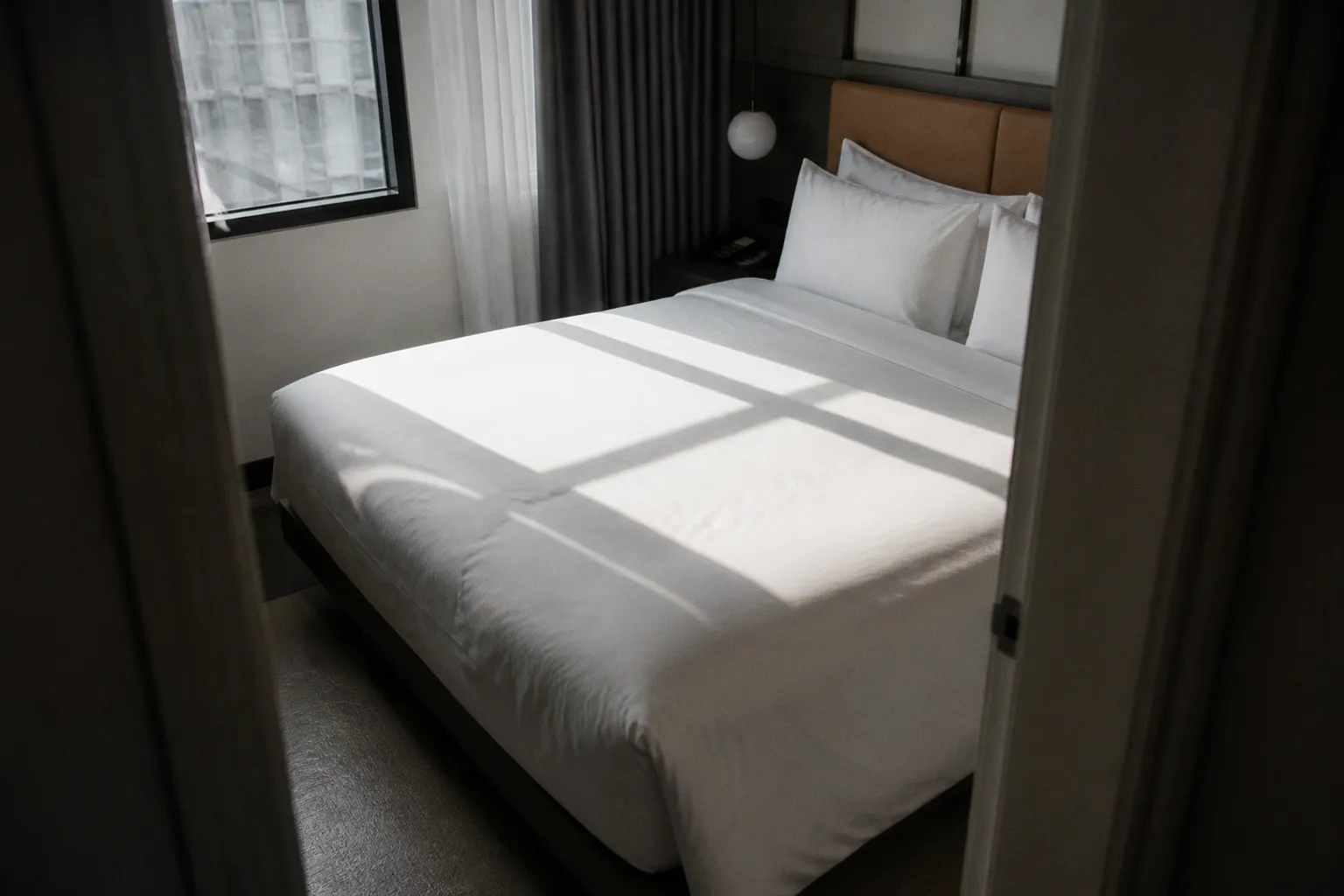
Then the room corners look like a cave, the window view turns into a milky white smear, and the finished gallery feels strangely less inviting than the room itself.
Pure daylight in a hotel room is gorgeous. It is also wildly unreliable. The promise of opening the curtains and shooting falls apart the moment your camera meets a south-facing window, a deep boutique suite, dark timber, or a bedside lamp with a warm 2700K bulb. Natural light sets the mood. It does not, by itself, carry every hotel room photo.
That distinction is at the heart of natural light hotel room photography. Daylight is often the starting point. It is not automatically the complete lighting plan.
The Aesthetic Pull of Daylight — And Where It Breaks
Daylight has an obvious advantage: it looks real. Travelers scrolling through hotel listings want a sense of I could be here. Soft, directional window light falling across a turned-down bed, a marble vanity, or a textured tile floor creates that feeling quickly. It gives the image air and atmosphere without making the room look like it has been staged under a film set.
Modern interior photographers chase this look for a reason. Daylight describes materials honestly. Linen keeps its softness. Pale timber does not immediately turn orange. A white wall still feels like a white wall rather than a surface lit by a collection of unrelated bulbs. When the room is designed around its windows, ambient light can be the most elegant source available.
But hotel rooms are not always generous lofts with a wall of north-facing glass. They often have small windows, deep interior zones, heavy curtains, dark furniture, layered textiles, and architectural features that swallow light. A room can look bright to the eye while still presenting a difficult exposure to the camera.
The moment you shoot with only the available daylight, three problems tend to arrive together:
- Contrast becomes excessive. The window moves toward clipping while the far wall, floor, and corners fall into shadow.
- Color changes during the shoot. A passing cloud, a shift in the sun, or a curtain pulled partly across the window can change the balance of the frame.
- The room loses visual volume. Dark corners and unlit surfaces make a spacious room feel compressed, even when the camera is using a wide lens.
That last point matters. The job of hospitality imagery is not to falsify the property. It is to show the space in a way that lets a potential guest understand why it is worth choosing. A room should feel open, comfortable, and considered. Relying on ambient light alone can produce an honest photograph that communicates none of those qualities.
Natural daylight is especially persuasive when it is directional but controlled. The light should give the room shape without forcing the viewer to choose between the interior and the view. If the curtains are open and the bed is beautifully illuminated but the window is an empty white rectangle, the image has lost an important part of the room’s story.
Soft daylight sells the dream. Pure daylight, left uncontrolled, can deliver the room’s bad mood.
The solution is not to eliminate the character of daylight. It is to decide which parts of the daylight need help.
High Dynamic Range: The Window Problem You Cannot Out-Argue
Point a camera from a dim hotel room toward a bright window and the sensor has to deal with two very different exposure requirements. Inside the room, you might be working around 1/30 sec at f/4 and ISO 800. Outside the window, the same ISO could call for something closer to 1/2000 sec at f/11.
Those settings differ by roughly nine stops, not eleven: approximately six stops from 1/30 sec to 1/2000 sec, plus three stops from f/4 to f/11. That is still a substantial contrast range. It is enough to force a compromise in a single exposure, especially when the window occupies a large part of the frame.
The result is familiar. Expose for the interior and the window becomes a white void, taking the ocean, garden, skyline, or architecture out of the photograph. Expose for the window and the room starts to look like a basement. Lift the shadows aggressively and you may recover information, but you also risk noise, flat contrast, and a processed look.
This is not simply a buy a better camera problem. A camera with strong dynamic-range performance gives you more room to work, but it does not remove the difference between a bright exterior and a shaded interior. The solution is a combination of composition, timing, exposure technique, and controlled supplemental light.
| Problem | What it does | Useful response |
|---|---|---|
| Bright window against a dark room | Clips the exterior or buries the interior | Bracket exposures, add fill, or reduce the contrast at the window |
| Direct sun on glass or floor | Creates hard highlights and distracting patches | Change the shooting time, diffuse the light, or reposition the camera |
| Deep corners and dark furniture | Makes the room feel smaller and heavier | Add soft, indirect fill rather than raising exposure globally |
| Several light sources in the frame | Produces competing color casts | Turn off unnecessary fixtures or match the sources deliberately |
| Moving curtains, foliage, or guests | Makes bracketed frames difficult to merge | Prefer a controlled single exposure or keep movement to a minimum |
HDR bracketing remains useful for static scenes. Place the camera on a tripod, keep the composition fixed, and capture a series of exposures so the brightest and darkest parts can be managed in post-production. A five-frame bracket at one-stop intervals is one possible starting point, but the number and spacing should follow the scene rather than a ritual. A quiet room with a moderate window contrast may need less. A room looking directly onto a bright landscape may need more.
Bracketing is less useful when the scene contains movement. Curtains shift. Leaves move outside the window. A person crosses the hallway. Water in a pool catches different highlights from frame to frame. Merging those exposures can create ghosting and unnatural edges. In those situations, a well-controlled single exposure, perhaps supported by flash or LED fill, is usually cleaner.
The window is part of the room
A common mistake in hotel interior photography lighting is treating the window as a technical nuisance instead of part of the selling point. If the room has a meaningful view, the view deserves to remain legible. If the exterior is unremarkable, the window may be allowed to become a bright architectural element rather than a detailed landscape.
That decision should happen before the camera goes on the tripod. Ask what the frame is supposed to communicate:
- Is the room valuable because of its view?
- Is the window important for showing natural light and openness?
- Does the interior design carry the image without the exterior?
- Is the light falling across the bed or seating area in a way that should be preserved?
Once the priority is clear, exposure becomes easier to judge. The window does not always need to be perfectly balanced with the room. It needs to support the message of the photograph.
A sheer curtain can reduce contrast without making the room dark. A change in camera position can keep the brightest section of sky out of the composition. Shooting when the exterior is less intense can bring the two exposures closer together. Small adjustments often do more than simply pushing the shadows in post.
The Tungsten Trap: Why Turning On Every Light Is a Worse Idea
Hotel rooms arrive pre-lit. There are ceiling fixtures, bedside lamps, bathroom sconces, concealed LED strips, decorative pendants, and sometimes a television or minibar adding a small pool of light. The instinct is understandable: turn everything on. More light must mean a better photo.
Not necessarily. More light can mean more contradictions.
Warm-white lamps often sit around 2700K–3000K, while daylight may be somewhere around 5000K–6500K depending on the conditions and the source. Those sources do not become one neutral light simply because they share a frame. A camera white balance can correct the image globally, but it cannot make a warm lamp and cool window light identical across every surface.
Set the balance for daylight and the lamps may become visibly orange. Neutralize the lamps and the window side can take on a cold blue cast. Correct one corner in post and another corner may move in the opposite direction. White bedding, cream upholstery, pale walls, and skin tones are particularly unforgiving because viewers notice the shift even when they cannot describe it.
Mixed color temperatures are not always wrong. They can be attractive when they are intentional. A warm bedside lamp against cool evening light can suggest comfort and depth. A restaurant photograph may benefit from the contrast between pendant lights and the fading exterior. The problem is not the existence of warm and cool light. The problem is allowing every source to compete without a visual hierarchy.
Experienced interior photographers often do the less obvious thing: they turn off the overhead fixtures. Daylight becomes the ambient layer, and controlled flash or LED provides the lift needed in the darker parts of the room. A lamp may stay on as a deliberate styling element, but it should have a job. One bedside reading light can make the room feel lived-in. Six unrelated warm sources can make the image look muddy.
Before the shoot, check the actual lamps rather than relying on the labels supplied by the hotel. Two fixtures that appear identical may have different bulbs. A replacement LED may be cooler than the matching lamp on the other side of the bed. Dimmers can also change the visual balance and, with some fixtures, introduce flicker that becomes obvious in video.
Match your lights when you can. When you cannot, make the contrast look intentional rather than accidental.
For a hotelier hiring a photographer, the useful question is not whether the shooter uses natural light. Almost everyone does, at least as part of the process. Ask how they handle the room’s existing fixtures, whether they assess the window exposure before adding light, and whether they have a plan for color consistency across a set of images.
Blending Daylight With Flash: The Real Workflow
The strongest hotel room images are rarely the result of a daylight-versus-flash argument. They are blends. The photographer exposes for the important exterior, measures what is happening in the room, and then adds a controlled source where the natural light is not doing enough.
The aim is not to make the room look artificially bright. It is to bring the shadow structure closer to what the eye experiences while keeping the window, materials, and practical lights believable.
A practical workflow looks like this:
1. Decide what the frame needs to show. Establish whether the priority is the view, the bed, a design feature, or the feeling of space. This affects camera position and exposure before any light is placed.
2. Set a manual white balance. A fixed setting keeps a sequence consistent. Daylight around 5500K can be a useful starting point when the supplemental source is daylight-balanced, but the actual value should follow the light in the room.
3. Expose for the window and the important highlights. Do not let the brightest part of the frame disappear before you decide that it is unimportant.
4. Place the supplemental source off camera. Light bounced into a ceiling or a neutral wall usually looks more natural than a bare flash pointed directly at the bed or furniture.
5. Keep the output restrained. The purpose is usually to lift the shadows, not to announce the position of the light. If the fill creates a second obvious shadow or makes one wall brighter than the subject, it is doing too much.
6. Review the corners and reflective surfaces. Mirrors, polished stone, glass, chrome, and lacquered furniture reveal lighting mistakes quickly. A source that looks soft on fabric may create a hard reflection in a mirror.
7. Make the adjustment repeatable. A hotel needs a coherent image set, not one spectacular frame followed by twelve rooms with different color and contrast. Record the general setup and keep the visual treatment consistent.
Choosing the right supplemental source
Speedlights are portable and useful when the photographer needs quick, controlled bursts of fill. They can be bounced, modified, or placed in several positions without running power cables through a guest room. Larger strobes offer more output and can be easier to shape in a large suite, but they also take more space and demand more careful placement.
For video, the requirement changes because the light has to remain on continuously. Aputure 300d and Godox VL300 are daylight-balanced fixtures, not bi-color models. Nanlite Forza is a product family that includes different variants, so the exact model must be checked before treating it as bi-color. If adjustable color temperature is important, choose a fixture explicitly identified by the manufacturer as bi-color rather than assuming that every light in a product line has the same capability.
That distinction matters on a mixed photo and video shoot. A daylight-balanced lamp can work very well when the room has been neutralized around daylight. It cannot be dialed from daylight to tungsten simply because the name of the series sounds familiar. A bi-color light gives more flexibility, but flexibility is not the same as quality: output, softness, control, fan noise, and the available modifiers still matter.
For video, continuous LED is not automatically mandatory for every room, but it is often the practical solution when windows are in the frame and the camera is moving. You cannot bracket a moving shot in the way you can bracket a still photograph. A controlled LED source can keep faces, bedding, and darker furniture from dropping too far as the camera changes position.
Flash and the fear of making the room look fake
The fear is reasonable. Poorly placed flash produces the familiar real-estate look: flat surfaces, hard shadows, bright patches on the ceiling, and furniture that seems to float in a different room from the window. But that is a lighting mistake, not an unavoidable property of flash.
The source can be hidden behind a doorway, bounced from a ceiling, aimed through diffusion, or feathered across a wall. It can be used at a low level so the daylight remains the dominant visual cue. The viewer should feel that the room is naturally bright, not wonder why the wall behind the bed has a suspiciously perfect pool of illumination.
In some spaces, one source is enough. In a suite with a long corridor, a dark bathroom entrance, and a seating area beyond the bed, several low-level sources may create a more even result. The photographer should still build the image in layers instead of flooding the entire room indiscriminately.
Aperture, Tripods, and the False Choice Between Brightness and Detail
Wide apertures have a place in hospitality imagery. A close detail of a bedside table, a texture shot of linen, or a lifestyle frame with a shallow background can work beautifully at f/1.4 to f/2.8 on a full-frame camera. That is not the same requirement as photographing the whole room.
For wider architectural frames, photographers commonly work somewhere around f/3.5 to f/5.6, depending on the lens, the distance to the subject, the desired depth of field, and how much of the room must remain sharp. Stopping down can help keep the bed, seating, and far wall readable, but it also reduces the amount of light reaching the sensor. When daylight is already limited, the answer is not always to open the aperture until the back of the room disappears.
A tripod allows a slower shutter speed at a lower ISO. That can preserve texture and color in the ambient exposure, provided nothing important is moving. It also makes bracketing, repeatable compositions, and careful vertical correction much easier. A tripod does not solve a moving curtain or a guest walking through the frame, but it gives the photographer more control over everything else.
The room should be built around the final use of the image. A still photograph for a booking page may benefit from a carefully aligned tripod frame and multiple exposures. A short social video may need a faster shutter, continuous light, and a composition that survives camera movement. The same room can require two different lighting strategies without either one being wrong.
When Pure Natural Light Actually Wins
There are rooms where daylight alone is enough. Fighting that with extra gear can make the photograph worse.
Minimalist interiors, white-walled boutique rooms, Scandinavian-style spaces, and concrete design properties often have surfaces that distribute natural light evenly. Neutral materials show their actual color, the shadows remain legible, and there may be few practical fixtures competing with the window. In this situation, adding a poorly controlled light source can flatten the very qualities that make the room appealing.
Pure daylight is also valuable when the creative direction depends on restraint. A room with a single chair, a linen bedspread, and a strong patch of sun may need less intervention, not more. If the mood is quiet and editorial, the slight falloff toward the corners can be part of the composition. The question is whether the darkness feels deliberate or merely underexposed.
Daylight-friendly rooms usually benefit from a leaner playbook:
- Photograph the interior when the window light is high enough to reach the back of the room but not so harsh that every surface carries a hard highlight.
- Use curtains and sheers as modifiers, not just as decorative details.
- Keep the camera position stable and correct vertical lines before the room begins to feel distorted.
- Add a reflector when the shadow side needs a small lift rather than a complete lighting setup.
- Turn off fixtures that introduce a competing color cast unless they contribute to the scene.
- Watch reflective surfaces; a room can look balanced while a mirror reveals exactly where the photographer placed the light.
- Return to the same room if the daylight changes dramatically. A consistent image set is often more valuable than forcing one difficult weather condition to work.
The same logic applies to exteriors and facade shots. A pool terrace in clean morning light does not need an off-camera flash simply because the photographer brought one. Save the strobes for the lobby bar at night, the restaurant with a high ceiling, the suite with a small window, or the room where dark architecture absorbs the ambient light.
Golden hour can add warmth to a facade, while brighter daytime conditions may describe the pool and surrounding landscape more accurately. For interiors, the best time is determined by the orientation and size of the windows, not by a universal rule about morning or evening. A north-facing room and a west-facing room do not behave the same way. Neither does a room with a view onto bright sand compared with one facing trees or another building.
The Cost of Getting It Wrong
Bad hotel photography can weaken the way a property is understood online. A blown window hides an amenity. A yellow cast changes the apparent color of the walls and bedding. Murky corners make the room look smaller. A single weak image may not decide a booking by itself, but a gallery full of inconsistent, poorly controlled frames gives potential guests less confidence in what they are considering.
It is better to describe this cautiously than to pretend there is a universal algorithmic penalty attached to one bad exposure. The practical risk is clearer: when the images fail to show the room, the view, and the material quality, the listing has to work harder to earn attention. Guests may hesitate, compare it less favorably with better-presented properties, or arrive with expectations the photographs did not establish properly.
The cost is not limited to the lighting equipment that was left in the car. A second shoot may be needed. Rooms may have to be reset. Staff time is spent coordinating access. Seasonal light or a particular view may no longer be available. If the images are being used across a website, booking channels, social media, and sales materials, the weakness spreads through every place where the property is presented.
Supplemental lighting is therefore not automatically an extravagance. It is part of production control. That does not mean every room needs a truck full of equipment. It means the photographer should be able to recognize when the available light cannot communicate the property clearly and have a measured way to improve it.
The Takeaway: Stop Romanticizing the Light
Natural light is a tool. It is a great one. It is also incomplete for many hotel rooms on many days.
The strongest approach is not to choose a side in natural light versus flash real estate photography. It is to understand what the room is asking for. Use daylight when it gives the space shape and color. Control it when the window is too bright. Turn off practical lights when they muddy the frame. Leave one on when it contributes a deliberate accent. Add flash or LED when the far side of the room needs support, and keep that support subtle enough to preserve the atmosphere.
If you are planning a property shoot, look for a photographer who can explain the lighting plan before the contract is signed. They should be comfortable with exposure bracketing, tripod work, off-camera flash, and continuous light for video. They should also be willing to leave equipment unused when the room already looks right. A photographer who says they only use natural light may produce beautiful work. A photographer who says they always use every light may also produce beautiful work. Neither slogan is a substitute for judgment.
For hotel room photoshoot lighting tips that actually hold up on location, start with the window, the room’s reflective surfaces, and the color of the existing fixtures. Then decide what needs to be preserved and what needs to be shaped. The method should follow the space, not the other way around.
The best hotel room photo is not the one with the prettiest light. It is the one that gives the guest enough information to trust the room.
The light is a means. Clarity is the job. Aesthetic taste matters, but it comes after the room has been shown honestly, attractively, and with enough control to make the photograph useful.