B&B video marketing channels: matching platforms to guests
I think about a host I worked with last spring — a beautifully restored Victorian B&B in the Cotswolds, four rooms, a garden that looked like a painting at golden hour.
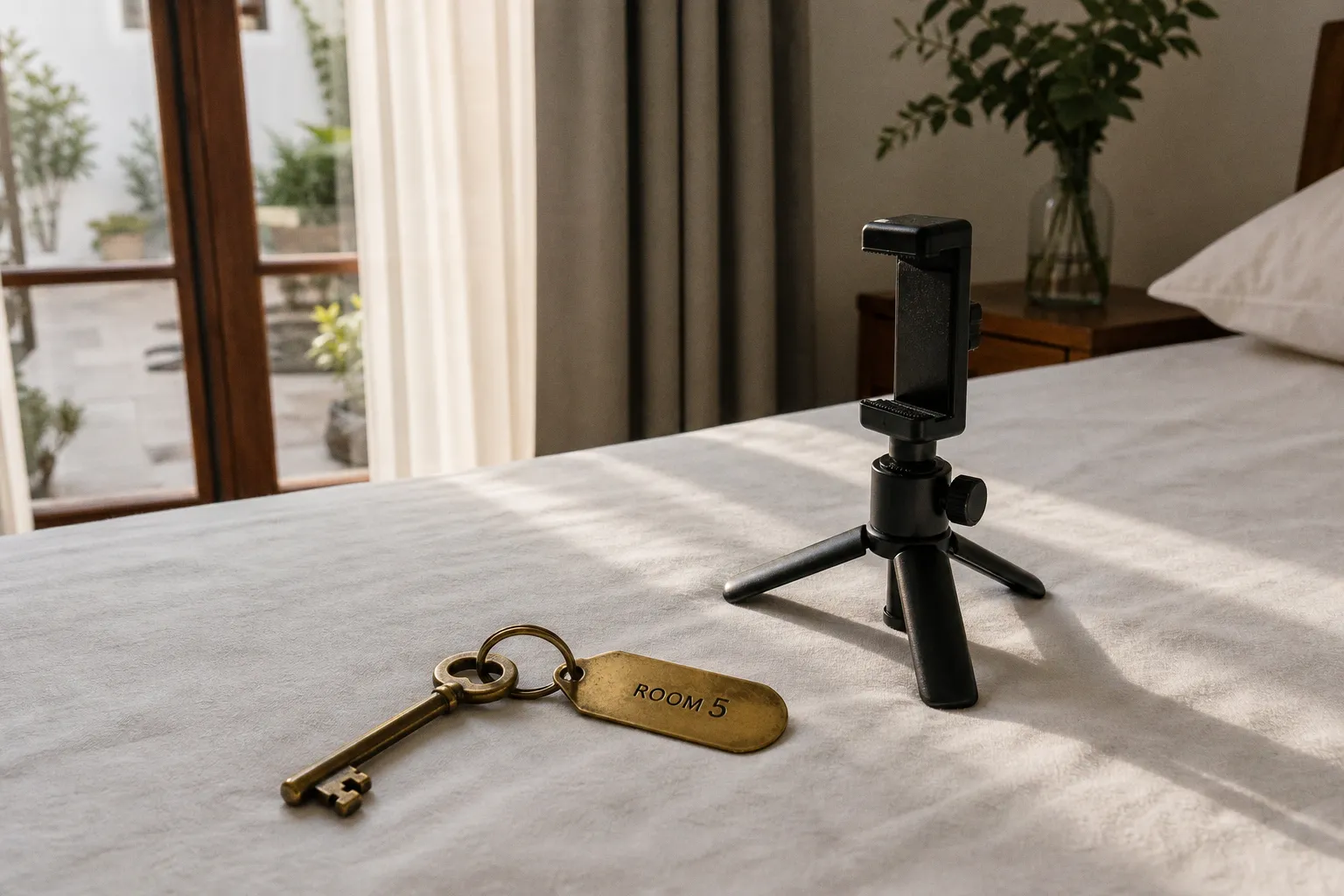
She had shot gorgeous reels of breakfast trays, the rolltop bath, the copper light fixtures catching the morning sun. Beautiful footage, really beautiful. Twelve months of posting across Instagram, TikTok, Facebook, and Pinterest — and her direct booking rate had barely budged. The problem wasn't the quality of her video. It was that she was treating every platform like a copy of the same room. Each channel pulls a different guest through a different door, and the brands that grow are the ones who learn to read the door before they push the video through it.
Compare car rental deals in United Kingdom
See available offersPartner link — DiscoverCars comparisonThe numbers tell a story that most hosts underestimate. Across UK hospitality, 91% of brands now use influencer marketing, and 90% lean on user-generated-style video as their dominant creative format — which means the field is no longer asking whether video works. The question is where it works, and for whom. When I sit down with a new client, the very first conversation isn't about lenses or lighting. It's about the guest journey — who's arriving at your door, what they were searching for before they found you, and which screen they were holding when your brand first registered in their memory.
The engagement gap: why most B&B video is going to the wrong room
Here's the statistic that should reframe every host's content calendar. On hotel Facebook pages, video accounts for only 13% of posts — yet it pulls dramatically higher engagement than the photos (51% of posts) and albums (23%) that dominate the feed. We're starving our highest-performing format of oxygen. The same pattern shows up across Instagram, where Reels sit at 33% of posts while images still take 40% and carousels take 27%. And here's the part that surprised me when I first pulled the data — for mid-sized accounts, carousels actually edge out Reels on raw engagement rate.
This isn't a call to abandon static content. A carousel of the breakfast room, the library corner, the cottage suite at dusk — those still serve a real role in your visual narrative. But it is a call to stop letting video be the garnish on a photo-heavy plate. If 13% of Facebook posts are generating disproportionate engagement, the hosts who flip that ratio — and put video closer to 40 or 50% — are the ones capturing the algorithm's attention.
What I see in practice is this: most B&B owners are filming out of obligation, not intention. They shoot a reel because they read somewhere they should, drop it on every platform, and then wonder why the bookings don't match the effort. The reframe is simple — and I mean genuinely simple — pick the platform where your ideal guest is already scrolling at the hour they're most likely to dream about a weekend away. Then build your video strategy around that single screen.
TikTok vs. Instagram Reels: reading the under-35 traveler
When we talk about short-form video, two platforms dominate the conversation — and they are not interchangeable. TikTok's user base skews heavily young: 50% of its users are under 34, and 41% sit in the 16-to-24 bracket. Instagram Reels' largest cohort is 25-to-34, which gives you a slightly older, often more affluent guest — the couple planning a babymoon, the professionals booking a design-led escape, the friends group choosing where to spend a milestone birthday.
For B&Bs, that demographic difference isn't academic. It's the difference between someone saving your post for a trip in eighteen months and someone booking your cheapest room for next weekend.
In the UK, the influence hierarchy for venue selection runs Instagram at 44%, TikTok at 25%, and Facebook at 13% — with multi-social channels and Google rounding out the rest. So Instagram still carries more weight overall, but TikTok punches above its weight for capturing intent at the dreaming stage, particularly among younger travelers. And here's something I want to underline — smaller B&B profiles on TikTok routinely pull engagement rates above 100%, with average views around 89,000 per post. That sounds improbable until you realise the algorithm rewards micro-creators in a way it simply does not on Facebook.
| Parameter | TikTok | Instagram Reels |
|---|---|---|
| Core demographic | 50% under 34, 41% aged 16–24 | Largest cohort 25–34 |
| Booking intent | Dreaming stage, future trips | Active planning, near-term bookings |
| UK venue selection influence | 25% | 44% |
| Engagement for small accounts | Often above 100% per post | Solid, but more follower-dependent |
| Best content mode | Native, lo-fi, UGC-feeling | Polished, brand-consistent, trend-aware |
| Link to direct booking | Limited (link in bio workflow) | Stronger (link stickers, DM funnels) |
The honest field note from my consulting work: if your B&B depends on impulse weekend bookings from a regional audience, Instagram Reels — with their tighter age bracket and link-out infrastructure — will convert faster. If your B&B depends on filling shoulder seasons, building a year-ahead reservation pipeline, and planting seeds with travelers who won't book for eighteen months, TikTok is the long game. Most of the B&Bs I work with need both, but they need them for different reasons — and the content shouldn't be cut from the same cloth.
A small practical example. A Cornish B&B I advised had been cross-posting identical reels to both platforms and watching Reels outperform on bookings while TikTok barely registered. When we restructured the content — Reels leaning into the polished breakfast room, the suite details, the concierge voice, TikTok leaning into the host's voice-over, the in-room kettle moment, the dog greeting a guest at the gate — the booking patterns split predictably. Reels drove next-month stays. TikTok built a waiting list for autumn that the owner hadn't planned for at all.
Pinterest as a discovery engine: tapping into unbranded travel searches
Pinterest confuses most hosts, because it doesn't behave like a social platform at all. It behaves like a search engine — which is exactly why it works. Sixty percent of Pinterest users have discovered new travel destinations or accommodations through the platform, and a staggering 97% of the queries people run there are unbranded. That means a guest isn't typing "The Old Rectory B&B Cornwall" — they're typing "cozy cottage weekend UK," "autumn getaway with fireplace," or "romantic boutique inn with breakfast."
For a B&B, this is the most generous marketing landscape you will ever find. The guest is telling you what mood they're in, and they're doing it before they've decided on a brand. A reel styled as a slow pan across a breakfast tray, tagged with the right descriptive language and pinned to a board called "Weekend Escapes I'm Dreaming About" — that's not a social post, that's a long-tail search result with the warmth of a magazine spread.
Pinterest isn't where your past guests go to reminisce — it's where future guests go to articulate a feeling they haven't named yet.
The mistake I see repeatedly is hosts treating Pinterest as a dumping ground for Instagram reposts. The platform rewards search-optimised visual content that solves a traveler's mood — and a vertical video pin with a text overlay that names the feeling ("Sunday morning quiet," "the softest linens you've ever slept in") will outperform a square repost every single time. If you're a small inn with limited production time, I'd actually argue Pinterest deserves more of your attention than TikTok — because the content you post there compounds for years, while a TikTok is functionally invisible after forty-eight hours.
The power of UGC-style video in modern hospitality branding
Here's where the strategy gets interesting. Ninety percent of UK hospitality brands now use user-generated-style video as their dominant creative format, and 91% are running influencer collaborations. The reason isn't budget — it's conversion psychology. Eighty-four percent of millennials and 73% of non-millennials say they're likely to plan a trip based on someone else's vacation photos or social media updates.
That number changed how I write every brief. Your beautifully lit, tripod-stable, colour-graded cinematic reel of the suite? It's a brand asset. But the shaky, golden-hour phone footage of a real guest laughing on the lawn with a glass of rosé? That's trust. And trust converts at a different rate than polish.
The practical move is to build UGC-style video into your distribution plan rather than your production plan — meaning, you create the conditions for it (a photogenic breakfast corner, a guest book prompt, a hashtagged welcome note in the room), and you let the content come to you. Then you repurpose it with permission across every channel that fits your guest profile. A TikTok creator's stay becomes a Reel cut-down becomes a Pinterest pin becomes a link in your next email — same moment, four different doors.
Three small moves that make UGC content work harder:
- Create one signature "shareable corner" in your property — a window seat, a courtyard table, a freestanding bath with the right light — and quietly steer guests toward it.
- Build a five-second ask into your checkout conversation: "If you snapped anything you're happy with, I'd love to see it — we share guest moments on our feed with credit."
- Keep a shared album (AirDrop, Dropbox, Google Drive) so guests can hand over files without friction. Friction kills UGC; ease feeds it.
Strategic distribution: balancing influencer reach and owned media
The hosts who scale are the ones who stop thinking about platforms and start thinking about routes. A guest's path from "I want to get away" to "I'm booking the Cotswolds cottage" almost never runs through a single channel. They discover you on a TikTok, save the Reel, search for the area on Pinterest, read the reviews, peek at your website gallery, then DM the booking question. Your video isn't competing across platforms — it's holding hands across them.
What I ask every new client to map is this: where does the guest first meet you, where do they deepen the interest, and where does the booking friction live? If your funnel feels stuck, it's almost always because the channel doing the dreaming isn't the same one doing the booking — and the bridge between them isn't built. That bridge is usually a link in bio, a pinned story highlight, a recently viewed email, or a single, well-placed YouTube short answering the question they didn't know how to ask.
| Channel | Role in the guest journey | Best content form | Direct booking lever |
|---|---|---|---|
| TikTok | Spark, dreaming, future intent | Native, lo-fi, behind-the-scenes | Link in bio, DM-to-book funnel |
| Instagram Reels | Active planning, near-term booking | Polished, brand-aligned, trend-aware | Link stickers, booking DM, "Save" prompts |
| Long-tail discovery, mood-based search | Vertical video pins, search-tagged | Saves, profile clicks, website traffic | |
| Older demographic, group travel, reviews | Mix of static and video, community tone | Booking link, Messenger, group engagement | |
| YouTube Shorts | Considered travel, deeper story | Mini-documentary, host POV, room tours | Cards, end screens, description links |
The final piece of the puzzle — and this is the bit I want every host to take seriously — is alignment between the video you make and the booking experience you deliver. There is no platform strategy in the world that survives a five-star guest receiving a checkout email that doesn't match the warmth of the reel they booked from. Your video is a promise. Your breakfast tray the next morning is the proof. Get the alignment right, and the algorithm stops mattering as much as the word-of-mouth it generates.
Pick one platform, learn its texture, and let the others follow at their own pace. The hosts who grow their direct bookings aren't the ones posting everywhere — they're the ones who post somewhere with intention, and let the rest of the strategy catch up to the guest instead of outrunning them.