Video production paths: in-house teams versus agencies
For many hotel teams, the question is no longer whether video belongs in the marketing mix.
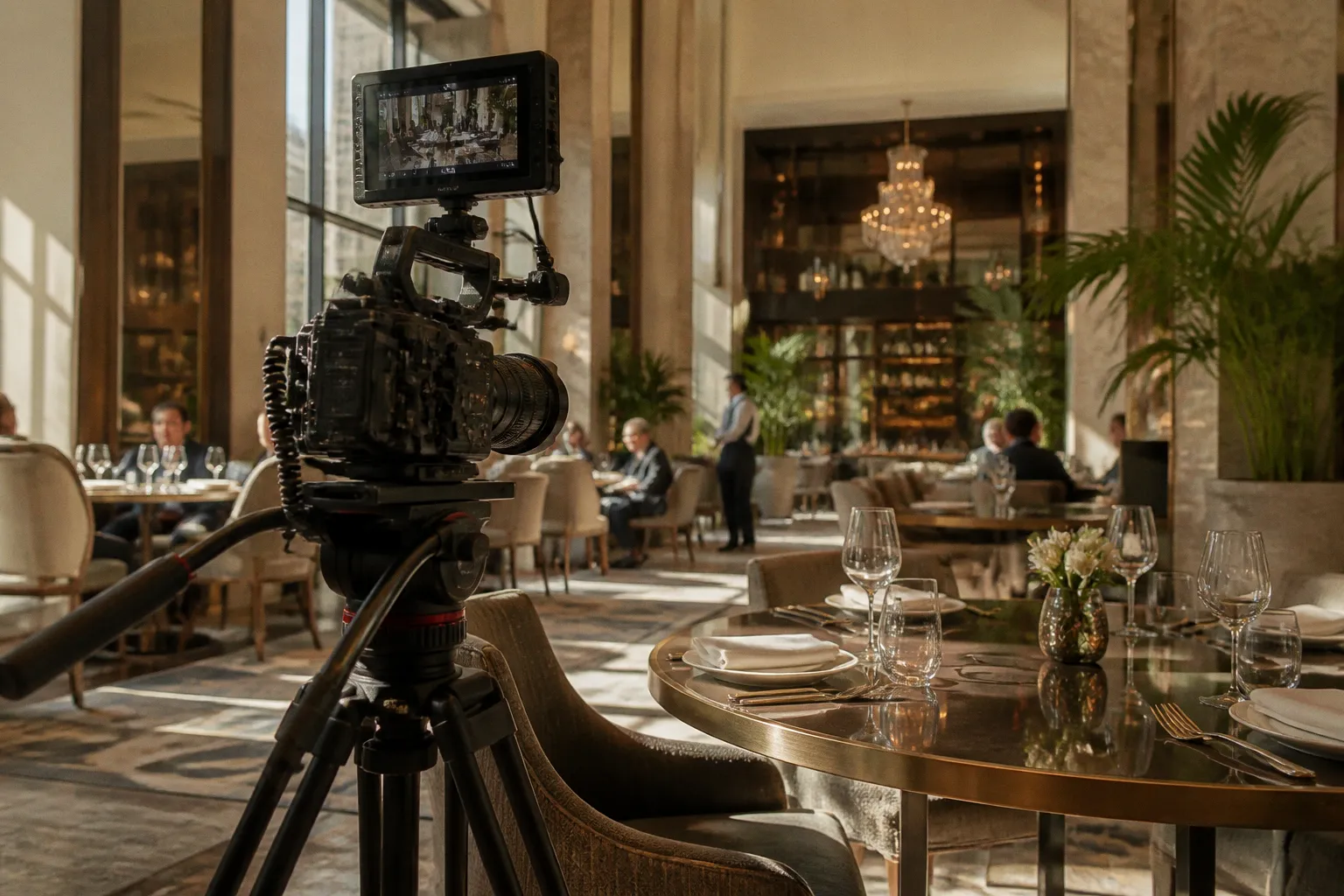
It is how to produce enough of it, at the right quality, without turning every campaign into a negotiation between the general manager, the brand team, the photographer, the booking engine, and an already overextended social media manager.
That is where the decision between an in-house team and an agency becomes more complicated than a simple cost comparison. Hotel video production outsourcing versus an in-house team is really a question of rhythm, capability, access, and commercial alignment. Who can capture the property when the light changes unexpectedly? Who understands the difference between a room that looks attractive and a room that feels bookable? Who can produce a polished resort campaign, then turn around a useful 20-second arrival video for next week’s Instagram schedule?
I have seen hotels make both choices successfully—and both choices fail. The difference has rarely been the camera package. It has been whether the production model matches the property’s guest journey and the work the marketing team actually needs to publish.
Video is already a standard part of modern marketing. In Wyzowl’s 2025 survey, 89% of businesses said they used video as a marketing tool, while 95% of video marketers considered it important to their wider strategy. More than half produced video in-house, 14% relied entirely on external vendors, and 31% used a mixture of internal and external production.
That mix is revealing. It suggests that the most useful question is not “Which option is best?” but “Which kind of work should live inside the hotel, and which work deserves specialist production support?”
The true cost of ownership: beyond the median salary
The first mistake I see in this conversation is treating an in-house videographer’s salary as if it were the cost of an in-house video department.
The U.S. Bureau of Labor Statistics reported a median annual wage of $70,980 for film and video editors in May 2024. That is a useful reference point for the labour market, but it is not the cost of maintaining a functioning hotel video capability. The real figure also includes benefits, recruitment, onboarding, management time, equipment, software, storage, travel between properties, training, insurance, and the cost of keeping that person meaningfully occupied throughout the year.
A hotel may hire one talented videographer and discover, six months later, that the role actually requires several different skill sets:
- filming and editing for social content;
- lighting and styling rooms, food, and amenities;
- writing short-form scripts and captions;
- producing paid social cutdowns;
- managing an organised media library;
- creating content for email, website, digital advertising, and sales teams;
- understanding platform specifications and delivery requirements;
- measuring whether the content is contributing to qualified website traffic or booking-engine actions.
One person may cover much of this. Few people cover all of it at the same depth, particularly during high-pressure campaign periods.
An agency invoice can look expensive beside a salary line, but an agency fee often includes a wider production system: creative direction, pre-production, a director or producer, camera and lighting equipment, sound, editing, motion graphics, colour grading, music licensing, travel coordination, and multiple deliverables from one shoot. The comparison becomes more useful when the hotel calculates the cost of obtaining the same capability internally.
A more realistic comparison
| Cost and capability | In-house team | Agency or production partner |
|---|---|---|
| Fixed staffing cost | Salary, benefits, recruitment, leave cover, and management time | Usually project-based or retainer-based fees |
| Equipment | Cameras, lenses, lighting, audio, storage, and replacement cycles | Often included in the production estimate, depending on scope |
| Property familiarity | Strong day-to-day knowledge of spaces, operations, and guest concerns | Must be built through briefings, site visits, and repeated work |
| Speed for simple content | Potentially very fast when footage can be captured during normal operations | Slower if every small request requires a new booking and brief |
| Campaign scale | Limited by internal capacity and available specialist skills | Easier to scale crews, locations, formats, and post-production |
| Creative perspective | Deep brand continuity, but risk of visual repetition | Fresh perspective and specialist creative direction |
| Asset management | Requires internal systems, naming conventions, permissions, and ownership | Can be professionally organised, but the hotel still needs long-term access |
| Utilisation risk | The hotel carries the cost during quiet production periods | Cost is usually tied more closely to the work commissioned |
| Strategic continuity | Close connection to hotel priorities and seasonal activity | Depends on the strength of the relationship and briefing process |
The cost of hotel video production therefore depends less on the hourly filming rate than on how often the capability is needed and how sophisticated the output must be.
A single boutique hotel that needs a quarterly campaign, a handful of room updates, and occasional paid social assets may not need a full-time production employee. A multi-property group with weekly content demands, multiple markets, and a constant flow of operational stories may find that outside production becomes cumbersome and expensive.
The key is to look at utilisation rather than aspiration. Many hotel leaders imagine the content they would like to create, then build a team around that imagined calendar. I prefer to look at the last twelve months: how many shoots actually happened, how many edits were needed, how quickly did the business need them, and which assets were used more than once?
The expensive choice is not always the agency. Sometimes it is paying for internal capability that the hotel only knows how to use four times a year.
Scalability and creative depth: when high-stakes campaigns need outside expertise
In-house production is often excellent at proximity. Agencies are often excellent at scale.
That distinction matters when a hotel is launching a new brand identity, opening a resort, repositioning a destination, or preparing a campaign that must work across paid media, organic social, email, PR, sales presentations, and the booking journey. These projects require more than attractive footage. They need a visual narrative with enough structure to communicate the property’s promise in a few seconds, then enough depth to support consideration later.
The strongest resort marketing campaigns usually involve a sequence of decisions before anyone picks up a camera:
- What kind of guest is the campaign speaking to?
- What is the emotional and practical reason to choose this property?
- Which moments differentiate the stay from nearby alternatives?
- How should the film move from first impression to proof?
- Which scenes need to sell the room, and which need to sell the sense of place?
- What versions are required for vertical, square, widescreen, paid, organic, and website use?
- Where will the guest encounter the video, and what action should follow?
A specialist agency can bring a team around those questions. A producer can shape the schedule. A creative director can protect the visual concept. A stylist can make sure the room tells the right story rather than simply looking tidy. An editor can build several narrative lengths without making every cut feel like a shortened version of the same film.
This is particularly valuable for properties with complex experiences. A luxury hotel may need to communicate service without showing staff performing for the camera. A wellness resort may need to express calm without producing a slow, indistinct film. A city hotel may need to show both the quietness of its rooms and its relationship to the neighbourhood outside. These are questions of context and alignment, not just coverage.
Agencies also make it easier to scale production temporarily. A hotel may need a small internal content shoot most months, then require a larger crew for a seasonal campaign or a new suite launch. Building permanent internal capacity for the peak requirement can create a great deal of unused capability in the quieter months.
Where agency production earns its place
Outsourcing tends to be most valuable when the project has one or more of the following characteristics:
1. The footage will carry a major commercial moment.
A new opening, renovation, rebrand, or high-season campaign deserves more than a collection of disconnected clips. The production should be planned around the booking proposition and the full guest journey.
2. The campaign must travel across markets.
Multiple languages, aspect ratios, audiences, and media placements create a post-production workload that can quickly overwhelm a small hotel team.
3. The visual standard needs to move upward.
If the property is competing in a premium category, inconsistent lighting, improvised sound, or weak editing can undermine the sense of place the brand is trying to establish.
4. The hotel needs specialist skills for a short period.
Drone work, underwater filming, complex food cinematography, animation, talent direction, or large-scale location production may not justify permanent employment.
5. The internal team lacks time for proper pre-production.
The shoot itself is only one part of a successful result. Without a clear brief, shot priorities, access plan, release permissions, weather backup, and delivery schedule, even expensive footage can become an expensive archive.
The caution is that agencies do not automatically produce better bookings. Nor does a larger crew guarantee a stronger visual narrative. The agency still needs access to the property, a clear brand brief, useful guest insight, and a client who can make decisions promptly.
The hotel must also retain ownership of the finished asset library. Original footage, project files where appropriate, usage rights, music licences, captions, and final exports should be organised in a way that allows the business to keep working after the campaign ends.
Operational agility: the case for in-house property familiarity
There is a kind of hotel video that an agency will struggle to produce efficiently, however talented the team may be: the content that depends on being present.
The internal team sees the hotel’s daily texture. They know when the breakfast terrace catches the best light, which room has just been restyled, when the chef is testing a seasonal dish, and how the arrival experience changes during a busy weekend. They notice the small details that make the property feel alive—fresh flowers being placed, a handwritten welcome note, the final turn-down, a local artist installing work in the lobby.
That familiarity can make the content more truthful. It can also make it faster.
A hotel videographer who works on site can capture a useful vertical clip before a meeting, record a short staff introduction during a quiet service window, or update a room tour when the furniture changes. These are modest productions, but they keep the visual narrative current. A property that only receives new footage during two formal shoots each year can look strangely static online, even while the actual guest experience is changing every week.
This is where managing hotel video assets internally becomes more than an efficiency exercise. It becomes part of brand stewardship.
An internal team can build a living library organised around how guests experience the property:
- arrival and first impressions;
- rooms, suites, and practical features;
- food and beverage;
- wellness and leisure;
- meetings and events;
- family or accessibility considerations;
- local experiences;
- seasonal atmosphere;
- people and service;
- behind-the-scenes details.
That structure helps marketing teams answer requests quickly. A sales manager looking for meeting-room footage should not have to ask for a new shoot. A social editor should be able to find a winter terrace sequence, a suite bathroom detail, or a short clip of the breakfast service without searching through files named “final_final_3.”
The internal team also has a better chance of filming the practical information guests need. How does the room connect to the terrace? Is there space for luggage? What does the pool look like at a realistic time of day? Where does a family sit during breakfast? Can a guest see the property’s relationship to the beach, station, or city centre?
A visual narrative built only from hero shots can create desire, but practical footage reduces uncertainty. Both are necessary for booking psychology.
The limits of proximity
In-house familiarity can become a weakness when the team stops seeing the property critically. After months of filming the same spaces, it is easy to repeat the same wide shot, the same bed-making sequence, and the same slow pan across the lobby.
There is also a risk that internal content becomes operationally convenient rather than strategically useful. The hotel films what is available rather than what the audience needs. A beautiful cocktail clip may receive attention, while the booking page still lacks a clear sense of the room, the view, the bathroom, or the arrival experience.
The best internal teams need editorial discipline. They should not simply collect footage. They should work from a seasonal content plan connected to commercial priorities, guest questions, and distribution channels.
Video length is another area where teams can become overly prescriptive. Wyzowl’s survey found that 73% of video marketers considered videos between 30 seconds and two minutes the most effective, but this is a broad marketer survey—not a universal hospitality rule. A six-second paid social asset, a 45-second room tour, a 90-second brand film, and a three-minute event overview can all be appropriate when they serve different moments in the guest journey.
Measuring the impact: connecting video assets to booking conversions
The phrase “video ROI” can mean almost anything unless the hotel defines the path between exposure and revenue.
Views and likes are not bookings. They may indicate attention, but attention needs to be connected to the next step: a website visit, a room-page interaction, an enquiry, a booking-engine session, an assisted conversion, or revenue from a defined campaign audience.
In Wyzowl’s 2025 data, 93% of video marketers said video had delivered a good return on investment. The same survey reported that 84% believed video had directly increased sales, 88% said it had generated leads, and 82% said it had increased website traffic. These figures show how widely marketers value video, but they are not a controlled comparison of hotel in-house teams and agencies. They also do not isolate production from media spend, pricing, seasonality, website experience, brand strength, or booking-engine performance.
For a hotel, the measurement framework should be more grounded.
Start with the asset’s commercial job
Before production begins, assign each video a primary role:
- Discovery: introduce the hotel or destination to a new audience.
- Consideration: help a guest understand the rooms, facilities, or experience.
- Conversion support: answer doubts close to the booking decision.
- Retention: help confirmed guests plan their stay or discover additional services.
- Commercial enablement: support group sales, weddings, meetings, or partnerships.
- Brand consistency: establish a recognisable visual language across channels.
A video can have secondary effects, but without a primary job it becomes difficult to judge. A brand film should not be criticised for failing to function like a booking-engine explainer, and a room tour should not be expected to carry the emotional weight of a destination campaign.
Then connect the asset to measurable signals:
- qualified sessions to the relevant landing page;
- engagement with room, package, or experience pages;
- clicks from video placements to the booking engine;
- booking-engine starts and completed bookings;
- enquiries or lead submissions;
- assisted conversions in the hotel’s analytics model;
- revenue and average booking value;
- performance by audience, placement, and device;
- content reuse across email, paid media, social, and sales channels.
Google’s video SEO guidance also makes the technical side clear: a video generally needs an indexed watch page, an embedded or otherwise discoverable video, and a valid thumbnail at a stable URL to be eligible for video features in Search. Video metadata such as VideoObject structured data, video sitemaps, and Open Graph information can help search engines understand the content. Search Console’s video indexing and performance reports provide another way to see whether those assets are being discovered.
This matters because a beautifully filmed video hidden inside an inaccessible page is not doing much work. Neither is a video placed on a booking page with no context, no supporting copy, no clear next step, and no useful mobile experience.
Paid distribution requires the same discipline. Google reports that hotel performance advertisers using Performance Max for travel goals saw an average 18% increase in total incremental conversions at a similar cost per action. That is a platform-reported average, not a promise for an individual hotel—and it should not be treated as evidence that one production model caused the result. Campaign structure, audience signals, feed quality, pricing, availability, creative, and landing-page experience all contribute.
Hotel Center feeds can also connect property information, pricing, images, and availability to Demand Gen campaigns on YouTube. The practical lesson is not that every hotel should adopt one specific campaign type. It is that video works harder when the creative is aligned with accurate property data and a clear path to action.
A video becomes commercially useful when the hotel can explain what it is meant to change—and can follow that change beyond the view count.
The hybrid model: balancing daily content with specialist production
In my consulting work, the most durable arrangement is often a hybrid one—not because hybrid is automatically superior, but because hotel content has two very different tempos.
The first tempo is continuous. It includes social clips, seasonal updates, staff stories, small changes to rooms and menus, local recommendations, guest FAQs, and content that responds to what is happening on property now.
The second tempo is campaign-based. It includes major brand films, launch campaigns, destination stories, renovation reveals, high-end photography and video, and large batches of content designed for several markets and placements.
Trying to force both tempos into one production model creates friction. An agency can become too slow or expensive for everyday content. An internal team can become stretched when a campaign demands a larger creative and technical operation.
A thoughtful hybrid workflow might look like this:
1. Keep the editorial pulse inside the property.
An internal content owner or videographer maintains the weekly and monthly rhythm, captures timely moments, and protects the hotel’s everyday voice.
2. Use an agency for strategic peaks.
Bring in specialist support for launches, seasonal hero campaigns, complex shoots, and moments when the brand needs a fresh visual perspective.
3. Build one shared content system.
Both teams should work from the same brand narrative, shot priorities, file structure, naming conventions, usage permissions, and distribution plan.
4. Capture for a content family, not a single film.
One campaign shoot should produce hero footage, vertical cutdowns, room details, still frames, short testimonials, website clips, and sales assets where the budget and rights allow.
5. Create a handover process.
The agency should not simply deliver a folder of exports. The hotel needs clear file access, captions, thumbnails, usage information, music rights, and guidance on which asset belongs to which stage of the guest journey.
6. Review performance together.
Internal and external teams should look at website behaviour, booking-engine actions, enquiries, assisted conversions, and revenue—not only platform engagement.
This model also protects the hotel from overdependence on a single person. If all knowledge lives with one internal videographer, a resignation can create an immediate gap in both production and asset management. If all knowledge lives with an agency, the hotel may lose its understanding of why certain creative decisions were made and how the library should continue to evolve.
The strongest relationship is collaborative. The internal team contributes access, operational intelligence, guest context, and brand continuity. The agency contributes specialist craft, production scale, outside perspective, and the ability to make a high-stakes campaign feel considered from the first frame to the final delivery.
How to choose the right path
When deciding between hiring hotel videographers and an agency, I would begin with five questions:
- How often will the hotel genuinely publish new video?
Not how often the team would like to publish—how often it can brief, approve, distribute, and measure content without creating bottlenecks.
- What level of production is required?
Regular mobile-first content and a cinematic multi-location campaign are different operational products.
- Where does the property have a competitive advantage?
If the hotel’s story depends on daily service, changing menus, local relationships, and an evolving sense of place, internal access may be especially valuable.
- What specialist capability is missing?
The gap may be editing rather than filming, creative direction rather than equipment, or distribution strategy rather than production itself.
- Can the organisation measure and reuse what it produces?
More footage does not equal more marketing value if assets are difficult to find, poorly labelled, trapped in one platform, or disconnected from a booking objective.
For a small B&B, a freelance videographer combined with internal capture may be enough. For a growing hotel group, an internal content lead supported by an agency roster can offer flexibility without sacrificing consistency. For a resort undergoing a major repositioning, specialist campaign production may be the sensible first investment, followed by an internal system to keep the new visual language alive.
Choosing the production path your guest journey can support
The right answer is rarely found by comparing one agency quote with one salary. It is found by looking at the entire operating model: production volume, capability, equipment, utilisation, creative ambition, access to the property, distribution, asset ownership, and the hotel’s ability to connect attention with bookings.
An internal team gives the hotel continuity and immediacy. It understands the property’s texture because it lives close to the operation. An agency brings depth, scale, and the ability to create a campaign that would be difficult to assemble from occasional internal capacity. Neither model guarantees stronger creative or better commercial performance on its own.
The hotel that wins is usually the one that gives each kind of work the right home.
Keep the daily, responsive, property-led content close to the guest experience. Bring in specialist production when the story is commercially important, technically demanding, or large enough to need a dedicated team. Most importantly, make sure both sides understand the same brand promise and the same route from visual narrative to booking decision.
Video should not merely make the hotel look desirable. It should help the right guest recognise the stay, understand the experience, feel confident about the choice, and know what to do next. That is the standard against which any production path deserves to be measured.