Founder vlogs vs guest testimonials for hotel branding
A hotelier came to me last spring with a beautiful property, a polished Instagram presence, and a stubborn problem: direct bookings had plateaued for three years running while the OTAs quietly absorbed the margin.
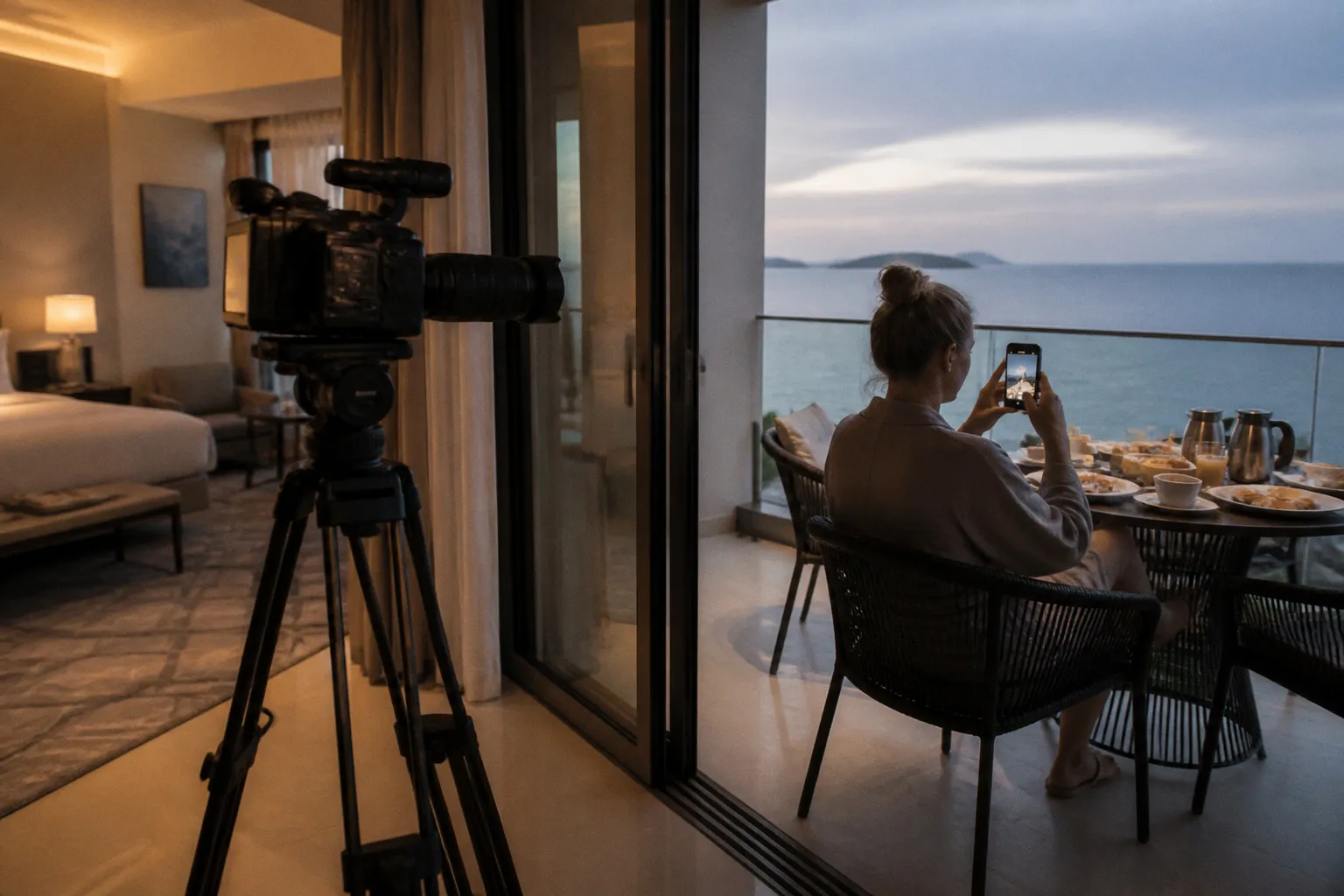
The owner was genuinely compelling — the kind of person whose sensibility shaped every corner of the place — and the guests kept leaving the kind of handwritten notes that make a general manager's week. So the question on the table was sharp and practical: which story should lead the next campaign? Should the owner step in front of the camera, or should the guests?
That question — founder video versus guest testimonials — is the one I hear most often in hospitality marketing right now, and it's almost always framed as a binary choice. It isn't. The two formats do fundamentally different work in the booking journey, and treating them as competitors is one of the more expensive mistakes an independent property can make. The right question isn't which one wins. The right question is where each one belongs in your funnel, what each one is actually capable of doing, and how to sequence them so a curious viewer becomes a confirmed guest.
Let me map that out.
The Strategic Role of Founder Vlogs in Brand Identity
A founder vlog isn't a corporate "about us" piece. It's the visual expression of the decisions that shaped the property — why the lobby was rearranged around a particular fireplace, why the breakfast menu shifts with the neighborhood bakery's seasonal rhythm, why a specific suite has the view it has. Done well, founder-led video carries the texture of intention. The viewer doesn't just see the hotel; they understand the sensibility behind it.
This matters because the top of the booking funnel is where emotion sets the terms of the search. A traveler deciding between your property and three similar options within a ten-minute drive isn't comparing square footage and amenity lists — those are filtered, not felt. They're choosing whose story they want to be inside of for two nights. And the content that wins that moment has to feel personal — not assembled by a committee, not polished into a brochure, but rooted in the perspective of someone who actually made the decisions that shaped the place. The content has to feel like the founder, not a brand committee.
The founder vlogs that actually move the needle in my consulting work share a structure that surprises most first-time clients. They aren't polished. They aren't scripted beyond a rough arc. They are conversational — the owner walking through a space, pointing at a specific object, explaining what it is and why it's there. The camera work is steady but intimate. The lighting is whatever the space gives you. The strongest versions run between three and seven minutes, which is long enough for texture and short enough to survive on Instagram, LinkedIn, and the homepage hero without re-editing.
Where founder vlogs underperform is when they try to do the work of a testimonial — when the owner starts narrating how wonderful the experience is, when the script slips into brochure language, when the visual becomes a tour of features rather than a tour of decisions. That format belongs somewhere else in the funnel.
Leveraging Guest Testimonials as High-Conversion Social Proof
Guest testimonials — whether filmed or transcribed — operate on peer validation. They answer a question the founder video cannot: what does it actually feel like to stay here? A traveler at the consideration stage is no longer asking whether the property is interesting. They're asking whether it will meet their specific need — early check-in after a long-haul flight, a quiet room for a work call, a bathtub deep enough for a proper soak, a breakfast that justifies leaving the hotel in the morning.
The quantitative review work that's been emerging over the past few years points consistently in one direction: specific, detailed guest feedback converts faster than generic praise. A guest saying "the room was beautiful" is pleasant. A guest saying "they got us into the room at 11 a.m. after a red-eye, no questions asked, and the shower pressure was unreal after fourteen hours of travel" — that converts. The difference is detail. Detail is what allows a future guest to project themselves into the experience. This is why major brands across the category — Marriott, Accor, Hyatt — have built guest-story video testimonials directly into landing pages and social feeds. The format has become table stakes for serious direct-booking strategy.
The strategic mistake I see most often is treating testimonials as a single asset. They're not. A great testimonial library is segmented: business travelers, couples, families, extended-stay guests, pet owners, accessibility-driven travelers. Each segment carries a different hesitation. Each one benefits from hearing someone who resolved that exact hesitation on camera. This is also where the question of authenticity deserves real care — and it deserves care because the temptation to script it is constant. The testimonials that move bookings are not the ones that read like ad copy. They are the ones where the guest pauses, looks slightly off-camera, and says the unscripted thing. Production value matters less than perceived honesty. In my experience, a testimonial shot on a phone with natural light and visible surroundings tends to feel more trustworthy to viewers than a studio-produced piece with a teleprompter — the roughness signals authenticity in a way that polish cannot.
Mapping Video Content to the Guest Booking Journey
This is where the framing of "versus" breaks down, because the two formats serve different stages and shouldn't be measured against each other. The booking journey for an independent property looks roughly like this: discovery — where the traveler becomes aware you exist; consideration — where they evaluate you against alternatives; decision — where they choose between booking direct and booking through an OTA; and post-stay, which loops back into the next booking cycle. Founder content earns its place at discovery and early consideration. It establishes sense of place, defines the brand's emotional vocabulary, and frames the property as a curated choice rather than a commodity. Guest content earns its place at late consideration and decision. It reduces the specific friction of conversion — the moment when a traveler has their cursor hovering over the "reserve" button and needs one more piece of permission.
The founder video opens the door. The guest testimonial walks the traveler across the threshold.
Practically, this means the homepage hero and the "about" page should carry founder-led storytelling. The room pages, the booking page itself, the confirmation follow-up, and the retargeting ads should carry guest-driven social proof. Splitting the formats by stage — and by page — is one of the highest-leverage structural moves in hotel video strategy, and it's the recommendation I find myself making most often when reviewing a property's existing video assets.
A quick comparison makes the architecture clearer:
| Dimension | Founder Vlog | Guest Testimonial |
|---|---|---|
| Funnel position | Discovery, early consideration | Late consideration, decision |
| Primary job | Build emotional brand identity | Resolve specific booking hesitation |
| Trust mechanism | Authority through intention and craft | Peer validation through lived experience |
| Typical length | 3–7 minutes | 60–180 seconds |
| Production cost | Higher (owner availability, few reshoots) | Lower (phone-shot viable) |
| Depreciation rate | Slow — repurposed for years | Faster — refresh quarterly |
| Risk if overproduced | Becomes generic hotel marketing | Becomes scripted ad copy |
One caveat, because frameworks always need a context check: this is a default, not a law. Properties with a particularly recognizable founder — someone with their own platform, a public presence, a media track record — can pull testimonial-style content closer to the top of the funnel, because the founder's reputation carries its own social proof. Conversely, a property whose founder is deliberately private, or whose brand identity was built around discretion, will get more lift from putting guests on camera earlier than the funnel model would predict. Read your own context before you apply any framework.
Balancing Authentic Narrative with Peer-Driven Trust
The integration question is where most hoteliers hesitate, and honestly, where the work gets interesting.
The two formats can live side by side without competing — but only if each one stays in its lane. A founder vlog that ends with a hard call-to-action undermines the founder video's texture. A guest testimonial that opens with thirty seconds of brand storytelling before the actual review loses the peer-validation effect entirely. Each format has a job. Mixing them muddies both.
What does work — and what I've seen produce the strongest results in mid-size properties — is sequencing rather than blending. A homepage that opens with a sixty-second founder-led vignette, transitions into a guest testimonial carousel, and closes with a clear direct-booking call-to-action respects the architecture of how a viewer actually processes information. The viewer's emotional state when they arrive is exploratory. Their rational state when they're about to book is skeptical. The page architecture needs to honor that shift.
Wyzowl's 2025 survey found that 89% of businesses use video as a marketing tool and 93% of video marketers report positive ROI — numbers that reflect broad adoption and perceived value across industries. Those figures don't tell you which format, in which position, for which property, produces the lift. That's the work the aggregate data can't do for you, and it's the work that distinguishes a video library from a video strategy.
Operationalizing Video Production for Maximum ROI
The production question is usually the one that stops the conversation cold, because hoteliers have been burned by video budgets that produced beautiful footage and no bookings. The good news is that the cost structure of both formats has improved substantially over the past few years, and neither one requires a Hollywood crew.
POV-style hotel videos — the format where internal team members or staff serve as on-screen talent while the camera frames the property from a guest's perspective — are one of the more interesting cost-effective alternatives to hiring professional on-screen talent. The format does two things at once: it gives the viewer the spatial context of "being there," and it gives the property a production model that scales. A general manager, a front-desk lead, a chef, a housekeeping supervisor — any of them can carry a segment if the questions are well-prepared and the environment is real. The editing is light, the gear is modest, and the turnaround from script to publishable cut can be as short as two weeks for a tight three-to-five-minute piece.
Founder vlogs require more care, not because they're expensive to shoot but because they're expensive to reshoot. The owner has one personality, one rhythm, one set of gestures, and if the footage doesn't capture it cleanly the first time, you've spent a budget on something that will underperform. I always recommend a half-day shoot with a single operator and a specific shot list — six to eight locations, three to four conversational arcs, no more than two wardrobe changes. The cost is predictable, the output is usable across the homepage, social, and email, and the founder walks away with a library they can repurpose for years.
Guest testimonials are the most forgiving format from a production standpoint and the most demanding from a sourcing standpoint. The footage is cheap. Finding guests who will say specific, detailed, conversion-relevant things on camera is the actual bottleneck. I typically recommend building a small group of willing guests during the slower shoulder season, filming three to five minute conversations in their actual rooms or in a quiet corner of the property, and treating each one as an evergreen asset rather than a campaign piece. A testimonial filmed well in February will still be working in November.
Treat founder video as a long-term brand asset and guest testimonials as a continuously refreshed trust library — they depreciate at different rates and deserve different budgets.
One operational warning that comes up regularly in my work: don't over-produce the founder video. The temptation to add a drone shot, a slow-motion breakfast pour, a sweeping lobby tilt is strong, and every one of those moves pushes the piece further from the founder and closer to generic hotel marketing. The texture you're after is the texture of a person in a space they chose. The camera should respect that. The drone shot is for the OTA listing. The founder video is for the people who are already leaning toward you and want to understand the sensibility before they commit.
The Strategic Position
Founder vlogs and guest testimonials are not competing formats. They are sequential ones. The founder video is where the brand earns attention and frames the emotional vocabulary of the property — it carries texture, intention, and sense of place at the top of the funnel. The guest testimonial is where the brand earns trust and resolves the specific hesitations that sit between consideration and booking. Both formats, deployed in their correct positions, do work the other cannot do. A property that uses only founder video will build a beautiful brand that struggles to convert. A property that uses only guest testimonials will convert efficiently but will struggle to be discovered at all.
The decision isn't founder or guest. The decision is where each one lives, how they sequence on the page, and how the production budget reflects the different depreciation rates of each asset. Get that architecture right and both formats start working together — the founder opening the door, the guest walking the traveler across it, and the direct booking closing behind them.