Curated video series vs user content: choosing your hotel strategy
Last autumn, a general manager of a coastal boutique hotel rang me with a familiar dilemma. Her property had a polished, six-minute cinematic piece—drone footage, a sweeping orchestral score, three local craftspeople sharing their morning rituals.
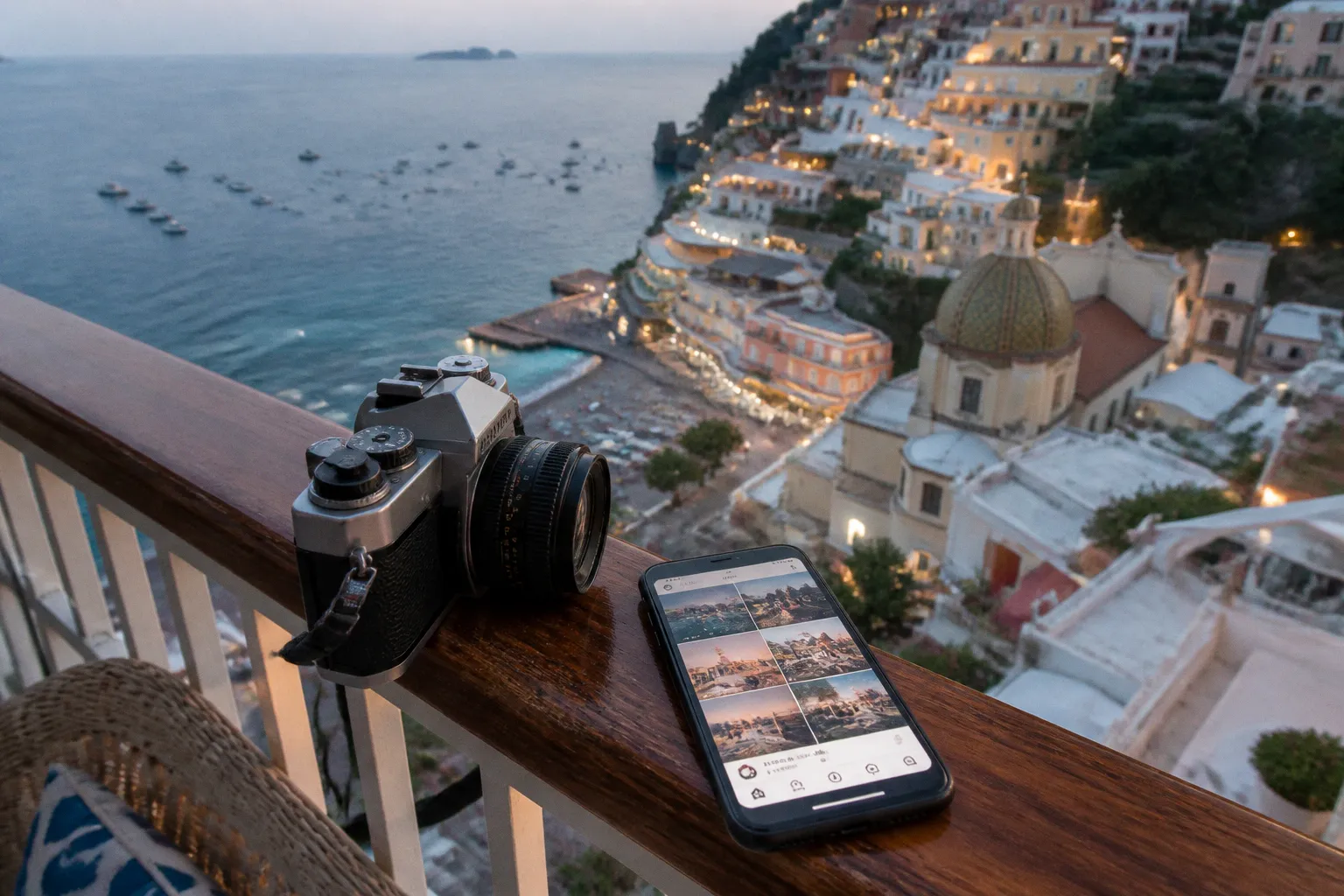
On the same laptop sat a guest's 45-second vertical reel, filmed on a phone from the same terrace at sunrise, that had organically generated remarkable engagement and a stream of direct inquiries. The tension was clear: one asset felt like the brand's soul; the other felt like its proof.
That tension—between the film that feels like your brand and the footage that feels like a peer's recommendation—is the actual question every hotel marketer is wrestling with right now. The industry has spent the last decade perfecting the curated travel video series, the kind of storytelling that earns respect and builds a sense of place you can almost taste. In parallel, user-generated content has quietly reshaped how travellers decide where to sleep, what to eat, and which corner of a city to fall in love with. Treating them as competitors is the mistake; treating them as a single layered strategy is where direct bookings start moving.
The Trust Gap: Why UGC Outperforms Polished Ads in Conversion
There is a reason the phone footage keeps winning—and it is not budget. It is that travellers, especially those under forty, have learned to read the seams of a produced advertisement the way they read hotel fine-print. When a viewer watches a cinematic hotel film with orchestral music and a voiceover promising "an experience like no other," the subconscious already files it under advertising—beautiful, perhaps aspirational, but not the same thing as a recommendation from a friend.
User-generated content reads as testimony, and the gap shows up clearly in the numbers. Consumers are roughly 2.4 times more likely to perceive UGC as authentic compared to polished branded content, and around 79% say user content directly shapes what they end up booking. That is not just engagement—it travels down the funnel to the reservation screen. Paid ads built around real guest footage routinely see click-through rates significantly higher than traditional branded ads, with cost-per-click dropping by half. On product and booking pages specifically, UGC videos convert at a notably higher rate than brand-produced videos, and integrating guest content into a wider hotel marketing strategy has been linked to substantial booking conversion lifts.
What I see in my own consulting work tracks that data closely. The boutique properties winning direct bookings are not the ones with the glossiest hero film—they are the ones whose website, Instagram grid, and confirmation emails all carry the texture of real stays. A shaky handheld pan across a breakfast table, the clink of espresso cups, a child laughing in the courtyard pool—these are the fragments that move a viewer from "interesting" to "I need to be there." The polished film does not have to vanish; it just has to stop pretending to be the only thing that earns trust.
Trust in travel marketing is no longer built by the camera alone—it is built by who appears to be holding it.
Building Brand Narrative Through Curated Cinematic Storytelling
And yet—and this matters—the curated film has a job that UGC genuinely cannot do. There is a category of storytelling that requires orchestration: the careful pacing of a guest journey, the visual narrative that introduces the property's architecture before it introduces the people, the design-led framing that aligns every frame with a brand's positioning. This is the work a curated travel video series was built for, and the reason it is not going anywhere.
Look at what the major brands have been doing. Marriott's StoryBooked series—multi-episode, with running times between four and eleven minutes—has been distributed to a massive network of hotel rooms globally and even screened theatrically in some markets. That kind of in-room distribution simply does not work with a guest's phone reel. The curation here is the point: the viewer is surrendering to a longer arc, and the brand gets to shape the emotional sequencing—arrival, wonder, indulgence, rest—in a way that aligns with the experience the hotel actually delivers.
The same principle applies at smaller scale. For a luxury resort trying to communicate the architecture of its spa, the layered atmosphere of its restaurants, the choreographed service rhythm of its staff, a polished four-to-eight-minute piece does work that scattered UGC fragments cannot. Curated storytelling is what establishes brand authority in the first place—it is the visual north star that everything else, including guest content, orbits around.
What I tell hoteliers is this: a curated series is not a campaign, it is an asset library. Every episode is a brand reference point your guest content can riff on, your sales team can share with a planner, your concierge can put on the in-room tablet before a long-stay guest's second night. UGC tells the story; the curated film establishes the visual grammar those stories are told in.
The Hybrid Model: Integrating Professional Production with Guest Content
The strongest destination marketing strategies I have built in the last three years have never been either/or. They have always been a layering—a curated spine with UGC as connective tissue. The hybrid model is not a compromise between two competing formats; it is a recognition that they solve different problems at different stages of the guest journey.
Here is roughly how the architecture tends to fall into place:
| Layer | Role in the strategy | Typical format | Where it lives |
|---|---|---|---|
| Curated hero film | Brand anchor—sets the visual grammar and emotional tone | 4–10 min cinematic series or 60–90 s brand film | Website homepage, booking engine, in-room, sales decks |
| Curated short form | Targeted emotional moments—spa, dining, neighbourhood | 20–45 s vertical or square | Instagram Reels, TikTok, YouTube Shorts |
| Guest UGC (organic) | Trust signal, social proof, sense of the real | 15–60 s phone footage | Instagram grid, TikTok, embedded on property pages |
| UGC campaigns (incentivised) | On-brief content from real guests in exchange for stay credit | Polished phone-style clips | Paid social, retargeting, email |
| Reposted influencer content | Reach expansion, audience overlap | 30–90 s creator edits | TikTok, YouTube, partnership placements |
The crucial detail—and the one most hotels get wrong—is sequencing. The curated hero film sits at the top of the funnel: it is what a planner sees when they search your brand, what a journalist plays in the back of a cab on the way to review you, what a high-intent visitor watches once they have already typed your name into a browser. UGC, on the other hand, does most of its work in the mid-funnel, when a traveller is comparing three properties and trying to decide which one will actually feel the way the website promised. By the time they reach the booking page, a stream of recognisable guest faces in the gallery—paired with the polished film as backdrop—is what converts.
What this looks like in practice: a guest checks into a Tulum property after seeing the cinematic hero film on the homepage, watches two or three real guest reels on TikTok the night before arrival, then arrives to find a six-minute in-room piece playing on loop that deepens the sense of place she already felt on social. Each format earned its place; none replaced another.
A hero film earns attention; a guest reel earns belief. Booking happens when the two arrive in the same guest journey.
Optimising Distribution: From In-Room Experiences to 30-Second Social Reels
Here is the part of the conversation most hoteliers arrive at unprepared—distribution. Production is the visible cost, but the platform decision is what determines whether a piece of video earns its budget back. A six-minute cinematic film uploaded as a single Instagram post is, in practical terms, a wasted asset. A 45-second UGC reel cross-posted without a hook in the first two seconds is, similarly, dead air.
Curated long-form pieces earn their keep in environments with longer attention spans and a captive viewer—in-room entertainment, sales presentations, the website's "our story" section, occasionally YouTube as a discoverable long-tail asset. This is where sense of place can be built slowly, with pacing, with score, with edits that linger on a tabletop or a hand-poured cocktail. A guest watching on the in-room tablet has nowhere to scroll; a four-to-eight-minute curated piece will hold them in ways no social platform ever could.
Short-form video lives and dies on hooks. For hotels working on TikTok and Reels, the practical guidance is to keep individual clips between roughly 21 and 35 seconds—long enough to deliver a feeling, short enough to survive the first swipe. The first two seconds are everything: a sunrise reflected in the pool, a server sliding a plate into frame, a child running across the lawn. No logo, no voiceover, no brand intro. Just the texture of the property doing what it does best, and with travellers under forty increasingly discovering restaurants and accommodation through these very surfaces, the stakes for getting those two seconds right are only rising.
The hybrid strategy lets each format go where it performs best. Curated films travel to long-attention venues; UGC travels to discovery and comparison venues. When the same hotel is present in both—properly formatted, properly captioned—the brand starts to compound rather than fragment.
Measuring Impact: Aligning Video Strategy with Direct Booking Goals
This is where the room usually goes quiet, and rightly so. A hotelier can fall in love with both formats and still leave money on the table if the measurement is not tied to the actual booking behaviour the videos are meant to influence. Production cost per asset, CPM of paid placements, and view counts are useful, but they are not the metric that matters. Direct booking share, revenue per available room from branded video referrals, and the conversion lift on pages that carry UGC versus pages that do not—those are the numbers a general manager can take to ownership.
What I ask clients to do, before commissioning another piece of content, is a simple audit: look at the booking path from a cold viewer's perspective. Where does the curated hero film currently appear, and does that placement actually have meaningful traffic? Where do guests currently post content, and is any of it being captured, tagged, and routed back to the brand? Which UGC has the longest organic half-life—the kind of guest reel that keeps pulling DMs months after posting?
From there, the investment logic becomes clearer. A curated series that lives only on the homepage is over-invested. UGC that is being posted but never reposted by the brand is under-leveraged. The strategic move is rarely to spend more—it is to make sure each existing asset is doing the job it was built for, and that the next commission fills the gap instead of repeating the one already covered. With roughly half of all travellers now using social platforms to choose their accommodation, the cost of getting this audit wrong is no longer a marketing line item—it is the difference between a direct booking and a commission handed to an OTA.
The Choice Is Not Curated or UGC—It Is Where Each One Does Its Best Work
The boutique GM who called me last autumn? We did not pick a side. Her cinematic hero film now anchors the website, the sales deck, and the in-room experience, where the longer emotional arc can breathe. The guest reel became the centre of her paid social strategy, formatted vertical, captioned with a soft call to action, and rotated against two follow-up UGC clips from the same guest. Illustratively, within a relatively short period, her direct booking metrics showed meaningful recovery, and the cinematic film—which had looked expensive and risky before—demonstrated strong return on investment because it was finally being used in the places it was built for.
That is the practical answer for any hotelier weighing the same decision. Curated video series are not the heritage format you keep out of nostalgia; they are the brand anchor that establishes your visual grammar, your sense of place, your emotional positioning. UGC is not a budget workaround; it is the trust layer that turns a beautiful website into a believable one. The hotels winning direct bookings right now are not choosing between them—they are layering them, sequencing them, and measuring each one against the moment in the guest journey it is meant to serve. The strategy is not a genre; it is a route through a guest's decision, and both kinds of video have a place on the map.