Hotel drone shoot prep: airspace and gear checklist
Your drone operator just showed up with a DJI Mini and a confident grin. He's “done a hundred of these.” Within thirty seconds, you've got a commercial shoot running into airspace violations, a…
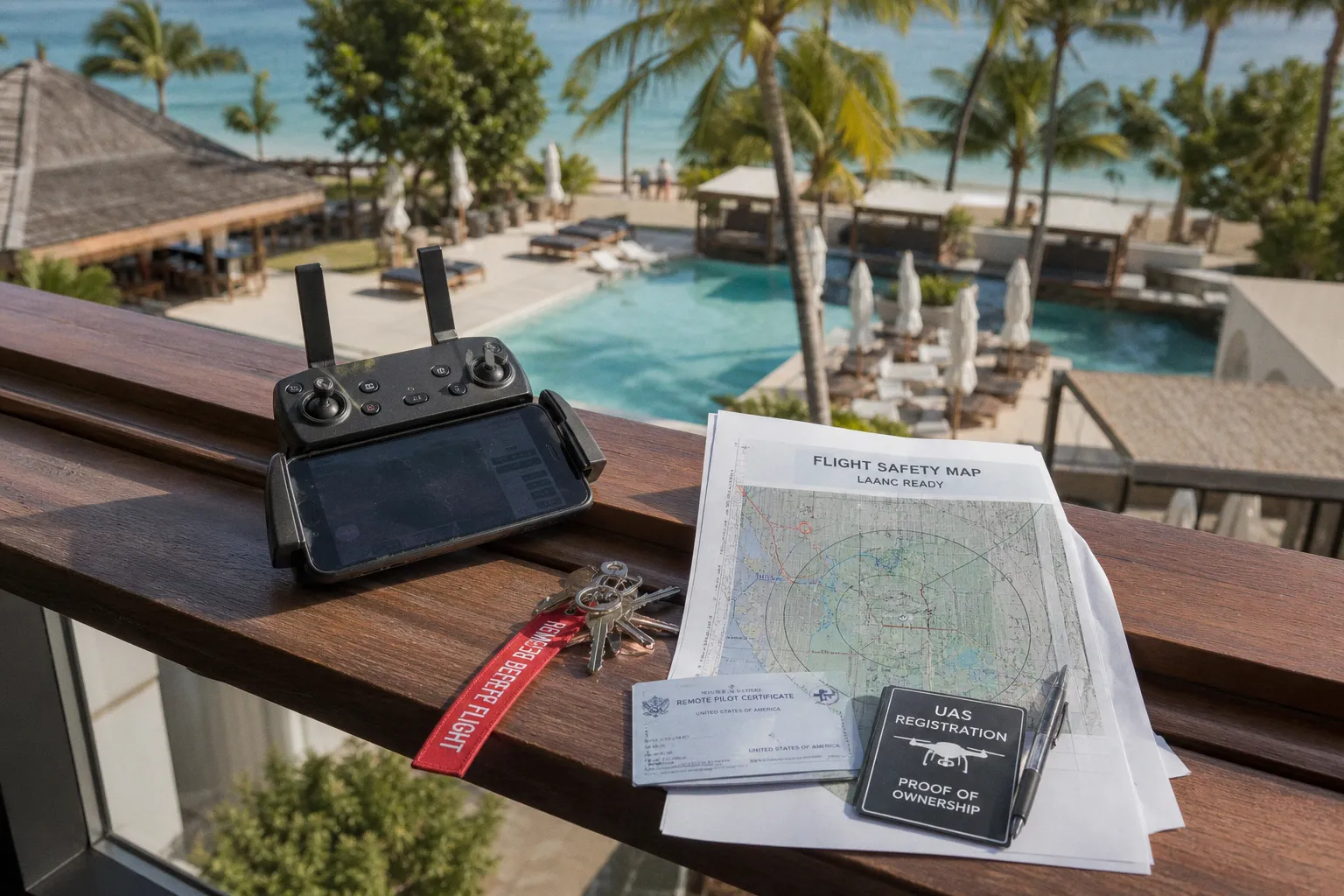
Your drone operator just showed up with a DJI Mini and a confident grin. He's “done a hundred of these.” Within thirty seconds, you've got a commercial shoot running into airspace violations, a guest's face captured in 4K without a release, and a prop strike waiting to happen on a balcony AC unit.
That's not a hypothetical. That's Tuesday.
Hospitality drone production isn't about owning a Mavic and knowing how to make it rise. It's about treating an aerial shoot like the regulated, technical, asset-producing production it actually is. Skip the prep and you don't have cinematic content. You have liability footage, unusable angles, and a hotel team wondering why the “hero shot” includes three overflowing bins.
Here's the hotel drone videography prep checklist, broken down in the order experienced crews actually work: airspace first, paperwork second, gear third, property last. The order matters. No amount of color grading fixes an unauthorized flight.
Navigating Airspace and Legal Compliance for Commercial Shoots
Before you think about framing the infinity pool, you need to know where the aircraft is legally allowed to fly. This is where casual operators cut corners and where hotels end up holding the bag.
In the United States, commercial drone operations generally fall under FAA Part 107. The remote pilot needs the appropriate certification, must follow the operating rules, and may need additional authorization to fly in controlled airspace. That matters for urban hotels, airport properties, resorts near heliports, and locations close to military or other restricted areas.
The authorization system most operators use in controlled airspace is LAANC: the Low Altitude Authorization and Notification Capability. It can provide near-real-time authorization for eligible flights within the system's limits. But “near-real-time” does not mean every location is instantly cleared, and it does not override other restrictions. A LAANC approval is one piece of the operating picture, not a universal permission slip.
The pilot should know:
- Whether the hotel sits inside controlled airspace or a special-use area
- Whether the planned altitude and operating area fit the available authorization
- Whether a nearby heliport, hospital, seaplane base, or private landing site creates an additional coordination issue
- Whether the flight path crosses roads, neighboring properties, beaches, public paths, or areas with active guests
- Whether the shoot date overlaps with a Temporary Flight Restriction, major event, emergency response, wildfire activity, or VIP movement
- Whether local rules add restrictions beyond the national aviation framework
That last point is easy to miss. A flight can be acceptable under aviation rules and still create problems under local privacy, trespass, noise, event, or property-management rules. Hotels often operate under municipal requirements, resort covenants, or internal policies that are stricter than the minimum legal standard.
Outside the US, don't accept a vague answer such as “the international rules are basically the same.” They aren't. The applicable authority and process depend on the country where the aircraft will operate, the aircraft's weight and class, the purpose of the flight, the operating environment, and sometimes the pilot's nationality or place of residence.
EU operations are governed through the European framework, but the practical registration, competency, operational authorization, and enforcement steps are handled through the relevant national aviation authority. The UK has its own CAA framework after leaving the EU system. India uses its own regulatory structure and Digital Sky processes. Other countries have different portals, categories, permit systems, and local restrictions.
For an international hotel shoot, ask the operator to identify the exact authority and process for that country. You want the name of the national aviation regulator, the applicable operating category or permit route, and the document that proves the flight is authorized. “We did this in Spain last year” is not a compliance plan for a shoot in Thailand, Morocco, or the United States.
Check airspace on the shoot day
Use the FAA's B4UFLY information through an FAA-authorized B4UFLY service provider, or use the relevant official or authorized national airspace tools for the country where you are filming. B4UFLY is the FAA's airspace-awareness service; the FAA authorizes companies to provide B4UFLY services rather than operating a single consumer app as the provider itself.
The distinction sounds technical until a production manager relies on the wrong screen and sends a drone into an active restriction.
Check the location during pre-production, again the day before, and once more on the shoot day. Conditions change. TFRs appear. A location that looked clear during the recce may become restricted because of a sporting event, emergency response, wildfire operations, or government activity.
Build a real pre-launch buffer into the call sheet. Thirty minutes is a useful working allowance for the final check, crew briefing, aircraft setup, and a decision about whether the planned route still makes sense. If the airspace status is unclear, the answer is not “we'll keep it low.” The answer is to pause and resolve the issue.
Don't hire a drone operator who can't name the relevant aviation authority and explain the authorization path for your property. That's not a creative choice — it's a red flag.
The pilot should also complete a site-specific risk assessment. A hotel is rarely an empty field. It can contain rooftop equipment, cranes, power lines, palm trees, glass façades, elevators opening onto terraces, moving vehicles, and guests who did not agree to become extras in a tourism campaign.
A useful site map marks:
- The launch and recovery area
- Emergency landing options
- Guest-access zones
- Staff-only areas
- Roof edges, cables, antennas, and mechanical equipment
- Nearby roads and pedestrian routes
- Adjacent properties that may enter the frame
- Areas where the aircraft will lose visual line of sight
- Locations where the pilot, visual observer, and hotel contact will stand
If the shot requires the drone to pass behind a building, over a crowded beach, or close to occupied balconies, the problem is not solved by using a smaller drone. Rework the shot. The safest aerial sequence is usually the one designed around the location's real constraints rather than forced into a risky route because somebody promised a “one-take reveal.”
Essential Documentation and Pilot Certification Requirements
Your pilot shows up, gear in hand, ready to fly. You need to see documentation before you see propellers spin.
For a US commercial hospitality shoot, the documentation package should normally include:
- Remote Pilot Certificate under Part 107, held by the person responsible for the operation
- Aircraft registration for the drone being used, with the identification matching the actual aircraft
- Remote ID compliance, where required for the aircraft and operation
- Airspace authorization, such as the relevant LAANC authorization or other approval
- Proof of insurance, with coverage that actually addresses aviation or unmanned aircraft operations
- A written risk assessment or site plan for the hotel property
- Property access authorization from the hotel or landowner
- Guest and talent releases, where recognizable people are intentionally included
- A privacy and footage-handling plan for incidental guest imagery
Not every document has to be printed and laminated. Digital records are normal. What matters is that the operator can produce them quickly, explain what each one covers, and show that the documents apply to this aircraft, this pilot, this location, and this date.
A certificate number is not the same thing as permission to fly a particular mission. A registered drone is not automatically authorized to operate over every property. Insurance does not legalize a flight. These documents solve different problems, and a professional operator understands the difference.
For a US crew, the hotel or production company can ask for the pilot's certificate details and use the FAA's official airmen inquiry resources to confirm the credential before the shoot. The operator should also be able to explain who is acting as the remote pilot in command. If several people are handling cameras, monitors, or flight support, there should still be no confusion about who has operational responsibility.
International paperwork is country-specific
For international shoots, check the aviation authority of the country where the drone will actually fly. Do not assume that an EU-wide framework means a single searchable pilot registry exists for every country, and do not treat EASA as a universal licensing database. EASA sets and supports the European regulatory framework; national authorities handle many of the practical registration, examination, declaration, authorization, and enforcement functions.
The same principle applies elsewhere. A CAA in one country may use a registration portal, while another authority may require an operational authorization, local permit, import paperwork, insurance certificate, or proof of competency. India, for example, has its own Digital Sky processes and airspace restrictions. A pilot who is compliant in the UK is not automatically cleared to operate in India, France, the UAE, or any other country.
Before contracting an international operator, request:
1. The name of the national aviation authority responsible for the location.
2. The registration or permit route for the aircraft.
3. The pilot credential or competency evidence accepted for that operation.
4. Any local authorization required for the hotel, resort, beach, heritage site, or protected area.
5. Evidence that the aircraft can legally enter the country and be used for commercial production.
6. A plan for privacy, data handling, and guest notification.
That list is deliberately unglamorous. It is also cheaper than discovering at customs that the drone cannot be imported, or discovering at the property gate that a local permit was required for a resort located inside a protected zone.
Insurance needs a closer look
“Fully insured” is not enough as a phrase. Ask what the policy covers, who is insured, where it applies, and whether the limits fit the hotel's requirements. Some properties require the hotel to be named as an additional insured. Some insist on a specific aviation policy or certificate wording. Some will not allow flight operations until their risk team has reviewed the certificate.
Coverage should be discussed before the call sheet is issued, not while the pilot is standing beside the pool. A drone over a luxury property creates a different risk profile from a drone over an empty rural location. The contract should also establish responsibility for guest complaints, accidental capture of private areas, lost media, equipment damage, and weather-related postponement.
Trust is not a compliance system. If the operator cannot explain which authority, permit, certificate, and insurance policy cover this exact shoot, the flight is not ready.
Technical Camera Calibration for Cinematic Hospitality Footage
Cinematic does not mean “auto mode and pray.” Hospitality drone footage lives or dies on consistency. Auto exposure, auto white balance, and uncontrolled shutter speeds can turn a polished resort sequence into a flickering collection of clips that do not match.
The working baseline for an outdoor daylight hotel shoot is straightforward:
| Parameter | Practical starting point | Why it matters |
|---|---|---|
| Resolution | 4K or the highest practical acquisition format | Gives the editor room to reframe, stabilize, and deliver multiple formats |
| Frame rate | 24 fps for a cinematic cadence; 30 fps for more natural motion or delivery requirements | Determines motion rendering and affects the shutter setting |
| ISO | The camera's cleanest native setting, often ISO 100 in daylight | Preserves dynamic range and minimizes noise |
| Shutter speed | Approximately 1/48s at 24 fps or 1/60s at 30 fps | Maintains natural motion blur when conditions allow |
| White balance | Manual Kelvin setting or a locked custom balance | Prevents color shifts as the drone turns from sun to pool shade |
| Picture profile | A profile the operator knows how to expose and grade | Flat footage is not automatically better footage |
| ND filter | Selected to control light while keeping the intended shutter speed | Prevents harsh, staccato motion in bright conditions |
| Color space and codec | Agreed with the editor before the shoot | Avoids mismatched footage and unnecessary transcoding later |
The exact settings depend on the aircraft, sensor, lens, delivery platform, weather, and the look the client wants. The point is not to force every drone into one formula. The point is to make deliberate choices before the first hero pass.
A drone moving from a sunlit roof to a dark pool deck is an exposure trap. If the camera is left in full auto, it may hunt visibly during the move. The operator should either design the shot around a stable exposure zone, use a controlled transition, or accept that the sequence needs to be split into separate passes.
The same goes for white balance. A camera that shifts from cool shade to warm sunlight halfway through a reveal gives the editor a problem that no amount of “cinematic LUT” branding will solve. Lock the white balance, record a reference frame if useful, and keep the lighting logic consistent across the shot list.
ND filters, glare, and reflective surfaces
In bright midday conditions, ND filters let the operator keep the shutter near the intended motion-blur relationship instead of jumping to an excessively fast shutter speed. ND8, ND16, and ND32 may all have a place depending on the light. Choose based on a meter or test image, not habit.
A polarizer can help with reflections from pools, windows, wet stone, and water features, but it is not a universal upgrade. It can also reduce exposure and create uneven results as the drone rotates relative to the sun. Test it on the actual route. A filter that looks excellent on a static pool shot may produce inconsistent reflections during a wide orbit.
If your pilot is shooting at 1/1000s in full sun without a reason, don't call the result cinematic by default. Fast shutter speeds can make water, palm leaves, people, and vehicle movement look brittle and unpleasant.
Check the image at the intended delivery resolution, not just on the controller's small screen. Fine roof textures, distant guests, window reflections, and signs can look acceptable in the air and distracting in the final edit. Record a short test clip, review highlights and shadows, and confirm that the camera is not clipping bright façades or turning shaded landscaping into a block of noise.
Calibrate the shot, not just the camera
Before the first take, verify:
- Gimbal horizon and roll
- Focus behavior or focus lock
- Exposure compensation
- Histogram or highlight warnings
- Lens and filter cleanliness
- Card capacity and recording format
- Audio expectations, if the footage will be paired with on-site sound
- Whether the intended moves can be repeated for alternate takes
- Whether the final footage needs vertical, square, or wide horizontal crops
A beautiful aerial shot that cannot survive a vertical crop may be the wrong asset for a hotel's current marketing plan. Discuss deliverables before the shoot. A drone route designed only for a website banner may not work for social ads, room screens, booking-platform listings, and short-form video.
Dusk and golden hour need their own plan. As light falls, the operator may need to open the aperture, raise ISO, slow the movement, or accept more noise. The drone's usable flight time, local wind, and return-to-home reserve also become more important. Put the most time-sensitive hero passes first. Don't spend the best light on battery checks and a complicated reposition.
Property Staging and Guest Privacy Protocols
Once the drone is airborne, the hotel becomes a set. Every trash can, garden hose, housekeeping cart, parked golf cart, and half-closed umbrella becomes part of the image.
Property staging for a hotel drone tour is brutally simple: remove what should not be there, place what should be featured, and understand what the camera sees from above. A ground-level walkthrough will not reveal the same problems as an aerial pass. Drone priorities are different.
Coordinate with housekeeping, engineering, grounds, security, and food and beverage before the shoot. Depending on the route, the morning-of staging list may include:
- Closing or aligning exterior guest-room doors visible from above
- Removing staff vehicles, delivery vans, and maintenance carts from driveways and porte-cochères
- Clearing trash cans, recycling bins, hoses, ladders, and temporary barriers
- Skimming the pool and cleaning the surrounding deck
- Checking rooflines, gutters, mechanical equipment, satellite dishes, and vents
- Positioning umbrellas, cabanas, loungers, and outdoor furniture consistently
- Turning on fountains, water features, fire features, or pool lighting where they support the shot
- Setting terrace dining, breakfast, or pool-service scenes before the relevant pass
- Removing signage, cones, or temporary notices that are not part of the intended story
- Confirming that construction, maintenance, and deliveries will not interrupt the route
The shot list should identify which areas need to be perfect and which can remain operational. A resort does not need to freeze the entire property for every aerial. It does need to know when a staff cart crossing the frame will ruin a timed reveal, and guests need to know when a pool area is temporarily restricted.
Privacy is part of production design
Privacy is not a legal footnote to be handled after editing. It changes the route, the lens choice, the time of day, and sometimes the entire concept.
Avoid flying close to occupied guest rooms, balconies, private villa patios, and active guest areas without explicit coordination. A high wide shot of a resort may be reasonable in one context; a low pass aimed toward individual balconies is a different proposition. The operator should know which spaces are private, which are communal, and which areas require temporary closure or a spotter.
If recognizable guests are intentionally included, secure the appropriate release before the footage is used. The same issue can arise with staff, performers, children, identifiable vehicles, license plates, and private properties visible beyond the hotel boundary. Local privacy and image-rights laws vary, so the production company and hotel should agree in advance on how incidental imagery will be handled.
Practical controls include:
- Scheduling flights during lower-occupancy or quieter periods
- Temporarily closing a pool deck, terrace, or pathway for a specific pass
- Posting advance notices in affected areas
- Informing guests through an in-room card, pre-arrival message, or front-desk notice
- Assigning a hotel security or operations contact to manage access
- Using a route and altitude that reduce views into private rooms and patios
- Reviewing rushes for unintended close-ups before publishing
- Blurring or removing identifiable people and plates when necessary
A 24-hour advance notification window is a useful operational standard when the property can support it. It gives guests a chance to ask questions and gives the hotel a clean record of how the shoot was communicated. For larger productions, treat the operation like a film set: signage, access control, a designated liaison, and a clear stop-flight signal.
Stage the property for the drone pass, not the lobby walkthrough. Top-down shots hide ground-level clutter but expose roof equipment, dirty gutters, service areas, and every piece of temporary infrastructure you hoped nobody would notice.
The privacy plan should also cover storage. Decide who can access raw footage, how long it will be retained, and who is responsible for deleting unusable clips that contain sensitive views. A shared drive full of unreviewed aerial footage is not a privacy policy.
Pre-Flight Airworthiness and Equipment Readiness
Airworthiness is not a box to tick after the creative meeting. Under US Part 107 operating rules, the remote pilot is responsible for determining that the aircraft is in a condition for safe operation before flight. The same basic discipline applies elsewhere, even where the wording and legal framework differ.
The aircraft should be inspected on the ground, before every flight. Not once a week. Not “it flew fine yesterday.” Hotels create unusual hazards: salt air, sand, pool humidity, reflective façades, rooftop downdrafts, narrow launch areas, landscaping, and people moving in and out of the operating zone.
A practical pre-flight inspection covers:
- Airframe integrity: Check arms, body panels, landing gear, motor mounts, and fasteners for cracks, looseness, or impact marks.
- Propellers: Look for chips, nicks, warping, and fine damage that may not be obvious at a glance. Bring spares that match the aircraft.
- Motors: Confirm they spin freely and are free of grit, sand, hair, and debris.
- Battery condition: Check charge level, physical swelling, temperature, connector condition, and any warnings in the flight app. Do not treat a battery percentage as a guarantee of usable flight time.
- Firmware and app status: Confirm that the aircraft, controller, batteries, and flight application are compatible and stable. Avoid a last-minute firmware update unless the crew has time to test it.
- Gimbal and camera: Clean the lens with proper material, confirm the gimbal moves correctly, and make sure filters are seated and secure.
- Controller and display device: Charge everything, disable avoidable interruptions, and confirm that the required maps and permissions are available.
- Storage media: Use a suitable card, verify available capacity, and test recording. Format in-camera when appropriate and only after confirming that needed files are backed up.
- Navigation: Confirm satellite reception, home-point behavior, compass and sensor status, and return-to-home settings. Never assume the settings are appropriate for a hotel roof or temporary launch point.
- Signal environment: Note interference from large structures, metal roofs, power infrastructure, Wi-Fi congestion, and dense urban surroundings.
- Weather: Check wind, visibility, precipitation risk, temperature, and local conditions at the actual property rather than relying only on a generic city forecast.
Battery planning deserves more attention than it usually gets. The number printed on a battery is not the same as the time available for a commercial shot. Wind, cold, repeated acceleration, hovering, payload weight, and the reserve required for a safe return all reduce usable flight time. A pilot should land with a sensible reserve, not stretch the final pass because the shot is almost perfect.
The route should also be divided into short, repeatable missions. One long flight that attempts the property entrance, pool reveal, rooftop orbit, and beach transition creates unnecessary pressure. Separate flights make it easier to change batteries, review footage, reposition the crew, and stop if guests enter the operating area.
Bring redundancy that matches the production
Redundancy matters more than brand loyalty. A serious commercial kit should include:
- Multiple charged batteries, stored and transported according to the manufacturer's requirements
- Spare propellers and the tools needed to replace them
- A compatible charger and power solution for the location
- Extra storage media
- A backup controller or display device where practical
- Lens cloths, cleaning tools, and filter cases
- Landing protection for sand, gravel, wet decks, or uneven surfaces
- A hard case that protects the aircraft during transport
- A second aircraft if the budget, risk, and project value justify it
- A non-drone backup plan for the key marketing message
The backup plan is not necessarily another drone. It may be a crane, a stabilized camera on a rooftop, a gimbal walk-through, a telephoto compression shot, or licensed aerial footage from an earlier season. If weather or regulation makes the aerial impossible, the campaign should still have a way to show the hotel's strongest asset.
Drone downtime at a hotel costs more than the aircraft. Housekeeping may have staged the property, food and beverage may have prepared a terrace scene, security may have closed a path, and the creative team may have built the schedule around a short light window. Put those dependencies on the call sheet so the crew understands the cost of delay.
The night-before brief that prevents day-of disasters
The best hotel drone shoots don't start on shoot day. They start with a short production call several days earlier, with the pilot, hotel operations lead, marketing director, and whoever controls guest communications.
The meeting should settle three practical questions:
1. What are the shots, and when does each one happen?
2. Which areas are restricted, staged, or temporarily closed?
3. What happens if the weather, airspace, aircraft, or guest flow makes the plan impossible?
Map the shot list to the light. A sunrise property hero, a mid-morning amenity pass, a high-sun architecture sequence, a golden-hour exterior, and a blue-hour pool shot are different production problems. Each has different exposure, staffing, guest-flow, and battery implications.
Write down the priority shots. If the weather window closes after forty minutes, the crew should know whether the entrance reveal, oceanfront establishing shot, pool orbit, or rooftop silhouette gets the available time. “Get everything” is not a shot list. It is how crews waste the best light.
A useful call sheet includes:
- Hotel address and exact launch area
- Pilot, visual observer, hotel liaison, and security contacts
- Planned flight windows and backup windows
- Airspace review responsibility
- Weather decision time
- Guest notification and access-control plan
- Areas to be staged and departments responsible for staging them
- Privacy restrictions and no-camera zones
- Battery, charging, and equipment location
- Emergency landing and stop-flight procedures
- Deliverables, aspect ratios, and priority takes
- Post-flight file backup and footage review responsibilities
The weather contingency should be specific. “We will reschedule if needed” is not a plan if the hotel has already blocked rooms, staged a dining terrace, and booked talent. Define who makes the call, how much notice is practical, what conditions trigger a stop, and whether the next available window is later that day or the following morning.
Keep the creative brief realistic about the aircraft. A small drone may be perfect for a quiet exterior reveal but unsuitable for strong wind, long-distance coastal travel, or a complex route around tall structures. A larger aircraft may offer better image quality and stability while creating greater operational, privacy, and regulatory demands. The right tool is the one that can complete the shot safely and repeatedly at the property.
Hotel drone videography prep is unglamorous. It is airspace research, country-specific paperwork, ND filter math, battery discipline, property walkthroughs, guest communication, and signed releases. But it is also the difference between a hero reel that drives direct bookings and a folder of “almost” footage gathering dust on a shared drive.
The hotels getting real value from aerial content are not necessarily the ones with the most expensive drone. They are the ones that make the flight predictable: legal route, documented pilot, controlled camera, staged property, protected guests, inspected aircraft, and a call sheet that leaves room for reality.
Skip the shortcuts. Lock the plan. Then fly.