Museum of Ice Cream Chicago: Complete Ticket Booking Roadmap
The Museum of Ice Cream Chicago uses timed entry, dynamic pricing, and several ticket tiers. The booking error is usually simple: visitors choose a date before deciding what access they actually need.
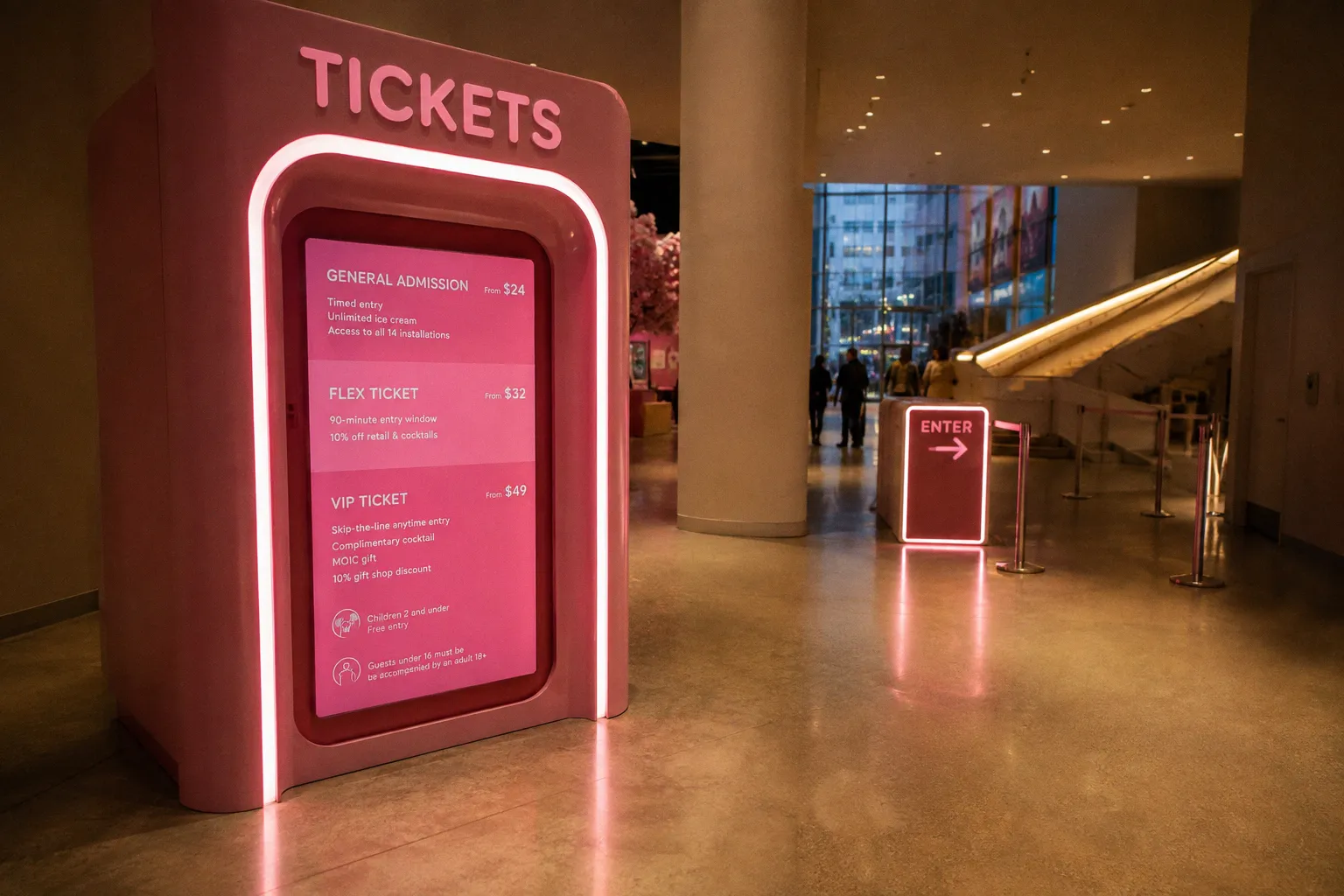
General Admission provides entry to all 14 interactive installations and includes unlimited ice cream treats. Flex adds a wider 90-minute arrival window. VIP is designed for visitors who want anytime skip-the-line access and bundled extras. The price changes by date, time, and demand, so the booking page is the final source for the amount payable.
 Chicago
Tickets and prices
Museum of Ice Cream
Entry ticket · 1.5 hours
fromUSD32.43
Book onlineOfficial ticket · General admission
fromUSD24
Book onlineThe operating address is 435 North Michigan Avenue, Suite G, Chicago, IL 60611, on the Magnificent Mile. The venue sits near the Tribune Tower and The Shops at Tribune Tower. It is not a conventional museum visit. It is a timed, route-based content environment with a fixed sequence of rooms, high visitor density, and multiple points where queues affect the usable time.
The ticket tier controls friction. The date controls price. The arrival slot controls the first half of the visit.
Navigating ticket tiers: General, Flex, and VIP access
The correct ticket depends on how much scheduling risk you can tolerate. It does not depend on the name of the product alone.
General Admission
General Admission is the baseline option. It includes:
- Entry at the selected timed slot.
- Access to all 14 interactive art installations and playscapes.
- Unlimited ice cream samples and treats during the visit.
- Standard entry procedures.
This is the rational choice for visitors with a fixed Chicago itinerary. If you already know when you will be near Michigan Avenue, standard timed entry removes unnecessary cost from the booking.
The constraint is operational. The ticket is attached to a selected date and arrival time. A late arrival can create friction, particularly during busy periods. The exact flexibility depends on the terms shown during checkout. Do not assume that a standard ticket can be moved or refunded after purchase.
General Admission also works for most content creators who have a defined shot list and enough time to complete it. The key limitation is not access to the installations. It is control over the schedule. You will be working inside the same visitor flow as everyone else.
Flex Tickets
Flex Tickets start at a higher price point and provide a 90-minute entry window rather than a narrow arrival slot. They also include retail and cocktail discounts.
The value is schedule protection. A 90-minute window absorbs:
- Delays on the CTA or rideshare journey.
- A late lunch near the Magnificent Mile.
- Hotel checkout friction.
- Slow movement through a family-heavy visitor area.
- A content shoot that runs over its planned duration.
Flex is not the same as unlimited access for the entire day. The window applies to entry. The self-guided experience itself typically takes about 60 to 90 minutes.
For visitors coordinating the Museum of Ice Cream with other downtown stops, Flex is the middle option. It reduces arrival risk without paying for the full VIP package.
VIP Tickets
VIP Tickets include:
- Anytime skip-the-line access.
- A complimentary cocktail.
- A Museum of Ice Cream gift.
- A gift shop discount.
VIP is primarily a queue-control product. The extras are secondary. The measurable benefit is reduced waiting and greater control over the entry sequence.
For a visitor with a hard departure time, that can matter. A missed timed slot can damage the entire itinerary. VIP removes more of that initial uncertainty, subject to the conditions displayed at booking.
For creators, VIP can protect a production schedule. This matters when the visit is part of a larger hotel, restaurant, or destination campaign. Every unplanned queue creates a cost. It affects crew time, camera battery, talent availability, and the next location’s call time.
| Ticket type | Best use case | Main operational benefit | Primary limitation |
|---|---|---|---|
| General Admission | Fixed itinerary and standard visit | Access to all installations with unlimited treats | Narrower scheduling tolerance |
| Flex | Visitors moving between downtown plans | 90-minute entry window | Higher cost without full VIP queue control |
| VIP | Tight schedules and lower queue tolerance | Anytime skip-the-line access plus extras | Premium price and package-dependent terms |
Ticket names and benefits can change. Read the live booking page before payment. The product displayed for a specific date is more reliable than a generic description elsewhere.
How to book Museum of Ice Cream Chicago tickets without losing the best slot
The booking process is straightforward. The decision sequence is where visitors create problems.
1. Start with the date, not the ticket tier
Open the date selector and identify the available entry windows. Prices are dynamic. They vary with demand, date, and time. A low-demand weekday may produce a different result from a weekend afternoon.
Do not build the itinerary around a fixed published price. Build it around the available slot and the required arrival tolerance.
Sunday through Thursday may also support a local resident discount, subject to eligibility and verification. That changes the calculation later. First confirm that the date qualifies and that every person using the discount can satisfy the entry requirements.
2. Match the time slot to the rest of the route
The Museum of Ice Cream is on North Michigan Avenue. The location is convenient for a Magnificent Mile route, but convenience does not eliminate transit variability.
Allow time for:
- Travel from the previous stop.
- Finding the correct entrance at 435 North Michigan Avenue.
- Security or check-in procedures.
- Elevator or building access.
- A short buffer before the selected entry time.
A booking slot that looks efficient on a map can fail in practice if it depends on arriving at the door with no margin. This is a route-planning issue, not a museum issue.
3. Select the ticket tier based on failure cost
Use a simple decision rule:
- Choose General Admission when the schedule is stable and the arrival window is manageable.
- Choose Flex when the schedule includes a previous activity, uncertain transit, or a meeting that may overrun.
- Choose VIP when a queue or delayed entry would damage a larger itinerary, production schedule, or fixed reservation.
The highest ticket tier is not automatically the best ticket. It is the best ticket only when the cost of lost time exceeds the premium.
4. Check every booking condition before payment
The checkout screen should be treated as the controlling document for the reservation. Confirm:
- Date and entry window.
- Number of visitors.
- Age categories.
- Ticket transfer or modification terms.
- Cancellation and refund conditions.
- Discount eligibility.
- Any add-ons or protection products.
- The exact meeting and entry instructions.
Standard tickets should not be treated as fully refundable by default. Protection terms, if offered, may change the outcome. Read the specific conditions attached to the product.
5. Save the confirmation in two places
Keep the booking confirmation in the email account used for purchase and on the device used for entry. A screenshot is useful if mobile reception is poor inside the building.
This is basic operational hygiene. It prevents a small access problem from becoming a missed slot.
Booking strategy for content creators
The Museum of Ice Cream is built for visual capture. That does not mean every visitor can produce usable footage. High color, reflective materials, moving groups, and mixed lighting create technical failure points.
Creators should separate the booking problem from the camera problem. The ticket secures access. It does not secure a clear frame, an empty installation, or a controlled lighting condition.
Plan around the visitor flow
A self-guided visit generally lasts 60 to 90 minutes. That is enough for a focused capture plan. It is not enough for unrestricted experimentation across every room.
Create a shot list before arrival:
1. Establishing exterior and location footage on Michigan Avenue.
2. Entry sequence and ticket experience.
3. Wide frame of the pink Sprink-L line train ride.
4. Movement through the mini Putt-Putt installation.
5. The signature sprinkle pool.
6. Detail shots of surfaces, treats, signage, and visitor interaction.
7. Vertical clips for short-form distribution.
8. A final exit or retail sequence.
Do not spend the first 20 minutes testing random focal lengths. The visit is too short for that workflow. Preselect a wide lens for spatial coverage and a normal or short telephoto option for details and people. The exact choice depends on the camera body and crop factor, but the principle is stable: one lens for geometry, one lens for compression.
Use focal length to control distortion
Wide lenses show more of the installation. They also exaggerate distance and bend architectural lines near the edges. In tight rooms, that distortion can make a space look larger than it is. It may also deform people at the frame boundary.
For room-scale footage:
- Keep vertical lines near the center of the frame.
- Avoid placing faces at the extreme edges of a wide shot.
- Level the camera before recording.
- Capture a second, tighter version if the first frame relies heavily on perspective.
- Do not correct severe distortion by aggressive cropping after the fact.
The visual target is not maximum coverage. It is credible spatial representation. Hospitality brands should be particularly strict here. A frame that misrepresents scale may perform well in a scroll feed and fail when a guest compares it with the real space.
Control dynamic range before recording
The installations combine bright surfaces, saturated colors, darker passages, and reflective materials. This creates exposure problems. A camera exposed for a pale ceiling can underexpose a face. A camera exposed for a person can clip bright signage or glossy highlights.
Use a consistent exposure strategy:
- Set a stable white balance where possible.
- Protect highlights in bright pink and white areas.
- Monitor skin tones if people are central to the frame.
- Avoid letting automatic exposure shift during a walking shot.
- Capture short static clips before attempting movement.
The problem is not lack of light. It is uneven light. Dynamic range is the constraint.
If the footage will be used in a hotel or destination campaign, test the most difficult room first. Do not leave the highest-contrast installation for the end of the visit when batteries, attention, and available time are lowest.
Account for queue geometry
Queues are not only a visitor inconvenience. They change the composition. A line can block the lower third of a frame, create unwanted faces, and make a staged sequence look accidental.
Flex and VIP can reduce entry friction, but they do not guarantee empty installations. The venue remains a public visitor experience. Work with the available flow.
A practical creator setup includes:
- A compact camera body.
- One wide lens.
- One standard lens.
- Minimal support equipment.
- Spare battery.
- Lens cloth for fingerprints and sugary residue.
- A prewritten shot list.
- A phone for quick vertical capture.
Large rigs add friction. They slow movement and create restrictions in crowded rooms. The best equipment is the equipment that can move through the route without disrupting other guests or missing the next installation.
Local resident discounts and booking savings
Chicago residents may unlock a discount from Sunday through Thursday by entering their billing ZIP code as a promotional code at checkout. Valid identification is required at entry.
This discount has two separate control points:
1. The billing ZIP code entered during checkout.
2. The identity verification performed at the venue.
A successful online checkout does not remove the verification requirement. Bring valid ID for each eligible visitor. If the booking includes non-residents, confirm how the discount applies before purchasing. Do not assume that one qualifying visitor automatically converts the entire order.
The discount is also not a universal weekend strategy. It applies to the stated Sunday-through-Thursday schedule and remains subject to the current terms.
Other savings may appear through the live ticket calendar or package structure. Because ticket prices are dynamic, compare the available products for the exact date rather than relying on a static third-party listing.
The correct comparison is not simply the lowest displayed number. Calculate the operational value:
- Does the lower-priced slot create a difficult transfer from another attraction?
- Does the standard ticket create a risk of missing entry?
- Does the Flex window remove a likely delay?
- Does VIP protect a fixed dinner, show, or production call time?
- Does the local discount require ID that nobody in the group will carry?
A cheaper ticket that causes a missed slot has a negative ROI. It can force a replacement booking, disrupt transport, and invalidate the rest of the day.
Opening hours, timed entry, and practical arrival rules
The Museum of Ice Cream does not operate like a venue where visitors can arrive at any point during a broad daily window. The booking calendar is the practical operating schedule for your visit.
Available times can change by date. Demand affects inventory. Seasonal programming may also affect the visible schedule. Check the calendar for the exact day you intend to visit and book the timed-entry ticket before building the rest of the route.
Age requirements
Children aged 2 and under receive free entry. Guests under 16 must be accompanied by an adult aged 18 or older.
These rules affect the booking quantity and the arrival plan. A child who qualifies for free admission still belongs in the group count operationally. The adult chaperone requirement applies to the visit, not only to the payment screen.
For families, calculate the route at the pace of the slowest participant. The standard visit length is approximately 60 to 90 minutes, but transitions, photos, treats, and child supervision can extend the practical duration.
Location and transport
The address is 435 North Michigan Avenue, Suite G. It is close to major Magnificent Mile landmarks, including Tribune Tower and The Shops at Tribune Tower.
The nearest practical transit reference in the surrounding area is the Grand station on the Red Line. Use the live map and the venue’s current entry instructions to confirm the final walking route. Downtown construction and building access can change the last few minutes of an otherwise simple journey.
Arrive with enough margin to locate the entrance. The most common route error is not selecting the wrong city location. It is reaching the correct block and then losing time inside a large commercial area.
Food, drinks, and the cocktail inclusion
Unlimited ice cream treats are included with admission. The exact seasonal flavors and tasting rotations can change. Do not plan the visit around a specific flavor unless it is confirmed in the current venue information.
The VIP package includes a complimentary cocktail. Flex includes a discount on cocktails and retail purchases. Age restrictions and service conditions may apply. Treat these as package benefits, not as a guarantee of a specific menu item.
Maximizing the 14 installations in 60 to 90 minutes
The museum contains 14 or more interactive installations and playscapes. The route rewards sequence control. Visitors lose time when every room becomes an unplanned photo stop.
Use three passes through the experience.
Pass one: route acquisition
Move through the first section without recording every detail. Identify:
- Where visitors queue.
- Which installations have a fixed participation order.
- Where the strongest wide frames are available.
- Which spaces are too crowded for clean footage.
- Where staff direct movement.
This first pass establishes the heatmap of the visit. You learn where the friction sits.
Pass two: priority capture
Record the high-value frames first. For most visitors, this means the signature sprinkle pool, the pink train installation, the mini Putt-Putt course, and the strongest wide interior views.
Use short takes. A 10-second clip with stable exposure is more useful than a 60-second walk that contains focus hunting, exposure shifts, and people crossing the frame.
Capture each priority installation in three formats:
- Wide shot for spatial context.
- Medium shot for interaction.
- Detail shot for texture or product reference.
This creates an edit structure without requiring a second visit.
Pass three: contingency and stills
Use the remaining time for missed shots, portraits, vertical clips, and still photography. Do not repeat a frame simply because the room looks different from the previous angle. Repeat only when the technical result changes.
A useful stopping rule is:
- One clean wide frame.
- One clean interaction frame.
- One clean detail.
- Move on.
More footage does not automatically improve the final asset library. It increases sorting time and can reduce the speed of delivery.
The best booking window is the one that preserves capture time after transit, check-in, and queue friction—not the one that looks cheapest in isolation.
For hotel and hospitality creators, the final output should show more than color. It should communicate movement, scale, access, and the sequence of the visit. A guest needs to understand what happens after the booking confirmation.
That requires deliberate framing:
- Show the transition between installations.
- Include enough architecture to establish scale.
- Avoid relying only on close-ups of ice cream.
- Use people as scale references, not as accidental obstructions.
- Keep the edit legible on mobile screens.
- Separate promotional claims from what the ticket actually includes.
A technical booking and visit checklist
Complete this before payment:
- Confirm the venue address: 435 North Michigan Avenue, Suite G.
- Select the exact visit date.
- Review the available timed-entry windows.
- Compare General Admission, Flex, and VIP against the cost of schedule failure.
- Check the current ticket terms.
- Apply the local resident promotion only when the billing ZIP code and entry ID requirements can be met.
- Enter all visitors, including children who qualify for free entry.
- Confirm that every guest under 16 has an adult aged 18 or older.
- Save the confirmation offline.
- Plan the route from the previous activity with arrival margin.
- Prepare a short shot list if the visit includes content production.
- Carry spare battery and a lens cloth.
- Keep the first priority installation in mind before entering the first room.
The booking objective is not maximum flexibility at any price. It is controlled access with a clear tolerance for delay.
General Admission is sufficient for a stable itinerary. Flex is the practical hedge against downtown schedule drift. VIP is a time-management tool for visitors who cannot afford an uncertain entry sequence.
Book from the live date calendar, select the tier that matches the actual risk, and treat the 60-to-90-minute visit as a production window rather than an open-ended museum stop. That is the cleanest route through MOIC Chicago.