Should hotels disable comments on TikTok ads?
No. Hotels should not disable comments on TikTok ads unless they have decided that looking polished matters more than being trusted.
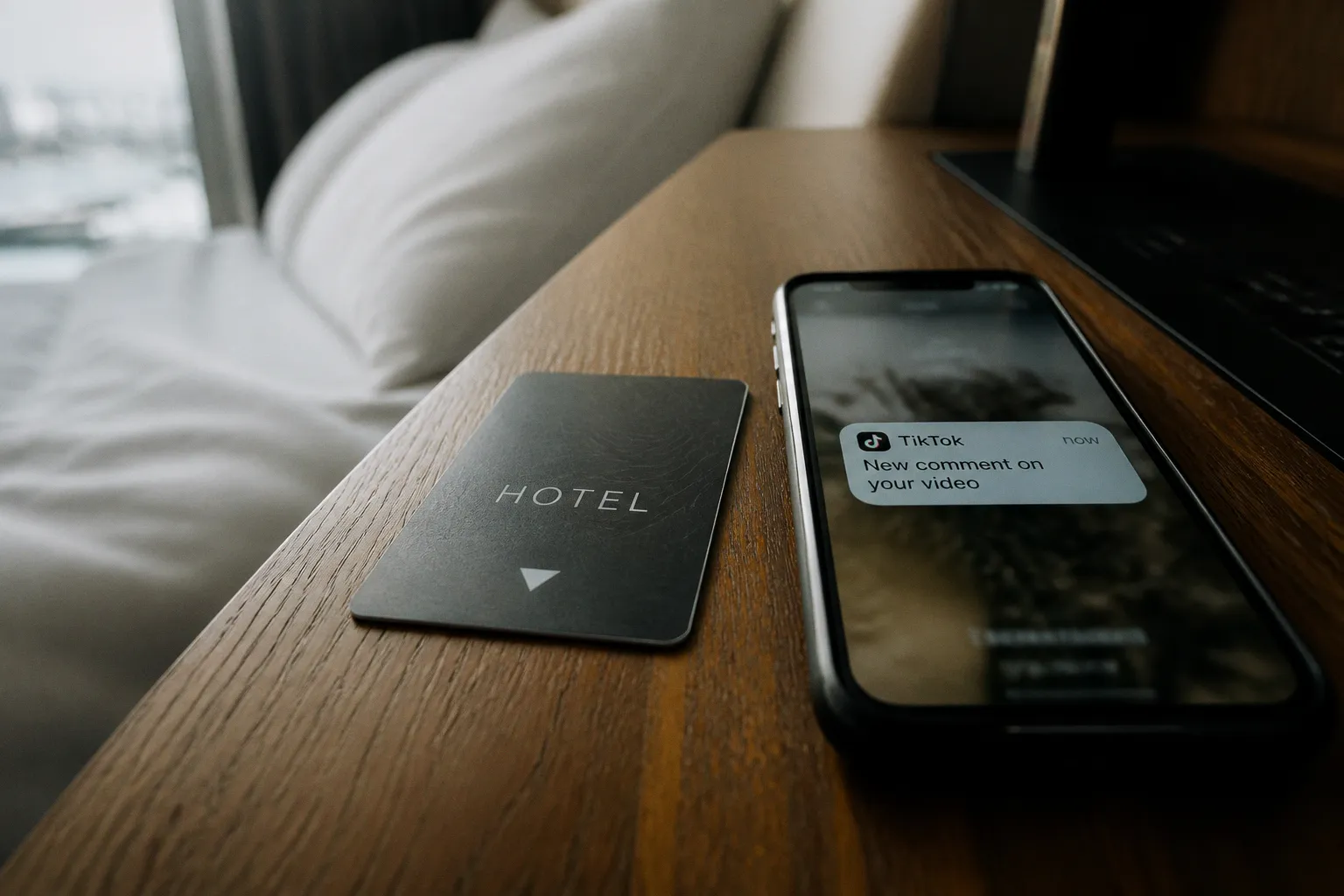
That trade-off is usually a bad one. Turning off comments may remove a few awkward questions, a complaint about breakfast, or the inevitable “this is definitely AI” accusation. It also removes social proof, visible customer interest, and one of the clearest ways potential guests judge whether a hotel is real, responsive, and worth booking.
The smarter move is not silence. It is a proper hotel TikTok comment moderation strategy: keep comments live, filter the junk, answer useful questions quickly, and hide or remove content that genuinely crosses the line.
A quiet TikTok ad does not look controlled. It looks unanswered.
The hidden cost of silencing your audience
The argument for disabling TikTok comments sounds sensible on a conference-room slide:
- Negative comments could damage the hotel’s reputation.
- Spam could clutter the ad.
- Staff may not have time to moderate replies.
- Guests might ask questions the brand cannot answer instantly.
All true. None of it proves that disabling comments is the right fix.
A public comment section is part of the ad creative now. It is not an optional add-on sitting underneath the video like a forgotten terms-and-conditions link. People read it. They look for questions from other travelers. They scan for complaints. They notice whether the hotel replies. They use that information to estimate risk.
That matters because hotel bookings are high-friction purchases. A viewer is not just buying a product. They are committing money, time, travel logistics, and expectations to a place they may not have visited before. The comments can help reduce that uncertainty.
A user asking, “Is the pool heated in October?” is doing the hotel a favor. So is someone asking whether the room shown has a balcony, how far the property is from the airport, or whether late check-in is available. Those questions reveal what other viewers want to know. A useful reply can turn one public interaction into a small piece of sales content.
Disable comments and the hotel loses that entire layer.
What travelers see when comments are active
An active comment section can communicate:
- Real people are watching the ad.
- The hotel is willing to answer questions.
- Guests are interested enough to react.
- The property can handle public feedback.
- The brand is not trying to hide every imperfect detail.
The comments do not need to be universally positive. That is not how credible social content works. A feed full of suspiciously enthusiastic one-line compliments can look less trustworthy than a mixed conversation with clear, professional replies.
Research from the University of Alabama and Vanderbilt University found that disabling social media comments can make brands and public figures appear less sincere, less likable, and less receptive to consumer feedback. That is a particularly unpleasant result for hospitality brands, because hospitality is built on perceived responsiveness. A hotel that cannot tolerate a question in public may not feel like one that will handle a problem at check-in.
The difference between criticism and risk
Not every negative comment is a reputation crisis.
“Room was too small for the price” is criticism. It may be uncomfortable, but it is also a genuine positioning signal.
“Is parking included?” is a buying question.
“Loved the view, but the check-in line took 40 minutes” is feedback that should reach operations.
A comment containing a scam link, abusive slur, personal information, or coordinated spam is a moderation problem.
These are different categories. Treating all of them as the same thing leads to the laziest possible response: turn everything off.
For hotel teams, the useful distinction is whether the comment adds context for future guests or creates a safety and brand-integrity problem. The first group should usually remain visible. The second can be filtered, hidden, or removed according to a documented moderation policy.
Algorithmic impact: comments are not decorative
TikTok does not distribute a hotel ad only because the video looks good. Visual quality gets attention, but attention has to become behavior. Views, watch time, shares, saves, profile visits, clicks, and comments all help indicate whether the content is worth showing to more people.
Comments are one of those signals. Turning them off removes an engagement action that could otherwise help the ad generate more activity and visibility. It also removes the public conversation that gives other viewers a reason to stop scrolling.
TikTok officially recommends keeping user comments enabled on ads to maximize impressions and conversions. That is not a guarantee of performance. No platform recommendation is a booking guarantee. It is a strong indication that comment sections are part of the intended advertising system, not an annoying loophole hotels should close immediately.
The algorithm is not a hotel general manager. It does not understand that the rooftop bar looks better at sunset or that the “private beach” is technically a short walk from the building. It reads behavior. If people stop, watch, ask questions, reply to each other, and visit the profile, the content has more traction than a video that simply plays in silence.
Do this, not that
| Hotel situation | Do this | Not that |
|---|---|---|
| Guests ask practical booking questions | Reply with a clear answer and a useful next step | Disable comments because the questions are repetitive |
| A guest posts a fair complaint | Acknowledge it, move sensitive details to private support, and keep the response visible | Delete criticism just because it is negative |
| Spam accounts flood the ad | Use filters, bulk moderation, blocking, and automated tools | Shut off every comment for every viewer |
| A video attracts misinformation | Correct the fact publicly with precise wording | Leave the false claim unanswered |
| The team cannot monitor all campaigns | Set ownership, response windows, and escalation rules | Assume comments will manage themselves |
| A comment includes abuse or malicious links | Hide, delete, or block according to policy | Treat it as ordinary guest feedback |
There is another reason not to overreact: social proof compounds in public. One useful reply can prompt another question. A guest may tag a travel partner. Someone else may answer from personal experience. That interaction makes the ad feel less like a paid interruption and more like a live piece of travel research.
A silent ad cannot do that.
Comments and Spark Ads
The difference can be even more visible when a hotel promotes existing creator or guest content through Spark Ads. These posts already have a social context, and the audience may be more willing to comment because the content feels native rather than produced in a campaign studio.
One analysis reported that Spark Ads earned 42% more comments than standard ads. That figure should not be treated as a universal forecast for hotel performance, but it reinforces the strategic point: when content feels more authentic, conversation becomes part of the asset.
Removing comments from that content is like booking a creator for their credibility and then covering the audience reaction with a sheet of plywood.
Native moderation tools: keep the door open, control the traffic
TikTok Ads Manager includes native comment management tools that let advertisers view, reply to, like, pin, block, export, hide, and filter comments individually or in bulk. That gives hotels more control than the binary choice many teams imagine: comments on or comments off.
The useful approach is to build moderation around the type of campaign and the expected volume.
For a small hotel or independent property
A lean team can manage comments manually if it creates a repeatable routine.
Assign one person to check active campaigns at set times rather than asking “someone from marketing” to keep an eye on them. That phrase usually means nobody owns the queue.
For a modest campaign, a practical rhythm might be:
1. Check comments shortly after the ad launches, when the first audience reactions reveal whether the creative is attracting confusion or hostility.
2. Review the queue at least once during the main booking audience’s active hours.
3. Answer questions that affect booking decisions before they become buried.
4. Pin the strongest answer when a recurring question appears.
5. Export or record repeated feedback so the creative, landing page, or offer can be improved.
6. Escalate complaints involving payment, safety, discrimination, accessibility, or a named employee.
The point is not to respond to every emoji with a paragraph. That is how teams waste time while missing the actual sales questions.
For a hotel group or multi-property brand
A chain needs rules before it needs more software. Otherwise each property will invent its own tone, escalation process, and definition of “remove immediately.”
Set a shared framework covering:
- Response ownership by property and market.
- Approved information for rates, amenities, policies, and availability.
- Issues that require customer service escalation.
- Content that can be hidden or deleted.
- Response time targets for active paid campaigns.
- Regional language requirements.
- The difference between a public answer and a private case.
A property manager does not need access to every brand conversation, but someone at the central level should be able to spot patterns. If guests across six hotels are asking whether resort fees are included, the problem may not be the comments. It may be the booking journey.
The “filter all comments” setting
TikTok’s “Filter all comments” setting holds every comment in a review queue until the brand approves it. This can be useful for a short, high-risk period, such as a campaign involving a controversial offer, a service disruption, or a sudden spike in attention.
It also has a serious downside: if moderation is slow, the video can look unnaturally empty. A viewer sees a high-view ad with no visible conversation and may assume the hotel is suppressing feedback or simply not paying attention.
Use full review mode as a temporary control, not as a permanent operating model. If the campaign is active, the queue must move quickly. Otherwise the hotel has technically kept comments enabled while functionally silencing them.
Moderation is a response system, not a delete button with better branding.
Building a hospitality moderation policy that staff can actually use
A moderation policy should be short enough for a team member to apply while juggling campaigns, guest messages, and the rest of the internet’s daily chaos.
One workable model uses four levels.
Level one: buying questions
These deserve fast, direct answers.
Examples:
- “Does this rate include breakfast?”
- “Is the beach private?”
- “Do you allow children?”
- “How far is the hotel from the city center?”
- “Is the room shown available with a king bed?”
- “Can I check in after midnight?”
Answer publicly when the information is stable and accurate. If availability changes constantly, direct the user to the booking page or reservations team rather than inventing certainty.
Good reply:
“Breakfast is included with the package shown here. Room availability changes by date, so our reservations team can confirm the king-bed option for your stay.”
Weak reply:
“Please visit our website for more information.”
That second version is not a reply. It is a brush-off wearing a brand voice.
Level two: neutral or mildly negative feedback
Keep it visible and respond without performing panic.
If someone says the rooms look small, do not claim they are “spacious” when the footage clearly shows otherwise. Clarify the room category, square footage if available, or offer the larger option.
If someone complains about pricing, explain what the displayed rate includes. Do not argue with the traveler’s budget.
If someone says the location is too far from the airport, provide the approximate transfer time and transport options. That may disqualify one guest while reassuring another. Better an accurate expectation than a disappointed arrival.
Level three: service complaints
These need a public acknowledgment and a private route.
A reliable format is:
1. Confirm that the hotel has seen the issue.
2. Avoid debating details in the comments.
3. Invite the guest to contact the appropriate team.
4. Ask for booking information privately, never in a public thread.
5. Pass the case to operations and track whether it was resolved.
Example:
“We’re sorry the check-in experience fell short. Please send us your booking details by direct message so the front desk team can review what happened.”
Do not promise compensation in public unless the brand has authorized it. Do not write an essay explaining why the guest is technically wrong. Public defensiveness is still defensiveness, even when the facts are on your side.
Level four: spam, abuse, and malicious content
This is where hiding and blocking make sense.
Remove or restrict:
- Repeated promotional spam.
- Phishing links and fake booking offers.
- Hate speech and targeted abuse.
- Threats.
- Attempts to publish private guest or employee information.
- Impersonation of the hotel.
- Content that creates a genuine safety concern.
The policy should state who can make that call and what happens next. If the moderation team deletes a threat but nobody alerts security or management, the platform action is incomplete.
Scaling hospitality moderation with AI tools
Manual moderation is useful, but it does not scale elegantly across multiple hotels, languages, time zones, and campaign bursts. This is where AI-driven moderation tools can help.
Third-party platforms such as NapoleonCat and Sprinklr offer automated tools designed to identify and hide or delete spam and negative comments on TikTok ads. The value is not that AI magically understands hospitality. It does not. The value is speed, filtering, and queue reduction.
Use automation for obvious patterns:
- Scam phrases.
- Repeated links.
- Common spam formats.
- Profanity and slurs.
- Duplicate comments posted across several campaigns.
- High-volume attacks from newly created accounts.
Keep human review for context-heavy situations:
- A guest complaint that includes an accusation.
- Sarcasm.
- Local slang.
- Accessibility or discrimination issues.
- Safety claims.
- A creator criticizing the hotel after a collaboration.
- Comments that look negative but contain a valuable operational insight.
A filter can recognize “free holiday link” as spam. It may not understand why “the accessible room shown here has stairs at the entrance” needs an immediate response from the property team.
Automation should protect authenticity, not erase it
The danger with aggressive AI moderation is false cleanliness. A tool can remove every unpleasant comment and leave an ad looking neat, empty, and strangely frictionless. That is not authenticity. It is digital taxidermy.
Set the system to hide clear violations automatically while routing uncertain comments for review. Review the false positives every week. If legitimate guest questions keep disappearing, the rules are too broad.
Also watch language variation. A word that is harmless in one market can be offensive in another. A complaint written in mixed languages may not be classified correctly. Hotels operating internationally should test moderation rules against real comments from each market, not just a list of English examples created in a meeting.
The operating model that works
For a property group, moderation generally needs three layers:
Automation handles volume. It catches repetitive spam and obvious abuse.
A social team handles conversation. It answers questions, likes useful comments, pins helpful information, and keeps the thread moving.
Operations handles consequences. It receives complaints about rooms, service, safety, accessibility, billing, and staff conduct.
If all three layers sit with one overworked social media coordinator, the system will fail during the first viral video. That is not a people problem. It is a design problem.
Turning comments into booking content
The best hospitality teams do not treat comments as an inbox. They treat them as a live research stream.
The questions appearing under TikTok ads often reveal what the video failed to explain. That creates a direct feedback loop between social content and conversion.
If viewers repeatedly ask whether the pool is heated, make the next video answer that question. If they ask how long it takes to reach the ski lift, show the route and travel time. If people cannot tell whether a room has a balcony, fix the shot sequence. If several users ask about resort fees, make the pricing language impossible to miss.
Do this, not that:
- Turn recurring questions into new videos, not canned replies.
- Show the actual room category, not a generic “luxury” montage.
- Put the location in the first seconds, not buried in the caption.
- Explain what the rate includes, not just the headline price.
- Use guest-generated footage to answer practical questions, not only to create mood.
- Pin a useful clarification, not the brand’s most promotional sentence.
A comment can also become a hook for the next TikTok:
“Is the beach actually walkable from the hotel?”
That is not a nuisance. That is a script.
The answer might be a 15-second route from the lobby to the shore, with walking time, terrain, and the exact entrance shown on screen. It is more credible than another slow pan across a bed with a decorative throw.
Comment engagement and direct bookings
Responding to comments does not guarantee direct bookings. Anyone promising that is selling a dashboard, not a strategy.
But active comment management can improve the conditions around conversion. It helps answer objections in public, builds trust, provides social proof, and signals that the account is engaged. It can also improve search visibility inside TikTok because the platform indexes and surfaces content through its broader engagement and discovery systems.
For hotel TikTok content, comment replies should support the next action without forcing every interaction into a sales pitch.
Useful calls to action include:
- “Check the dates shown in our profile link.”
- “Message our reservations team with your travel dates.”
- “The room in this video is the Deluxe Sea View category.”
- “Save this for your arrival planning.”
- “We’ve pinned the airport transfer details above.”
Avoid turning every answer into “Book now.” If someone asks about parking and receives a hard sell, the brand sounds automated. If they receive a precise answer, the brand sounds useful. Usefulness earns more trust than urgency theater.
Measure the comment section properly
Do not judge comment performance by raw volume alone. A thousand irrelevant reactions may produce less value than twenty questions from people actively planning a trip.
Track:
- Comment volume per thousand impressions.
- Percentage of comments that are booking-related.
- Response time during active campaign periods.
- Replies that lead to profile visits or direct messages.
- Repeated questions indicating a content gap.
- Sentiment trends by property or campaign.
- Spam and false-positive removal rates.
- Clicks or conversions following high-engagement posts.
- The number of service complaints escalated and resolved.
The exact impact on CPC or ROAS will vary by campaign, audience, creative, and booking path. There is no reliable universal number for how much keeping comments enabled will improve a hotel’s return. That is precisely why teams should test rather than repeat platform folklore.
Run controlled comparisons where possible. Keep creative, audience, budget, placement, and landing experience consistent. Compare an active, moderated comment environment with a restricted one. Watch not only immediate conversions, but also profile behavior, question quality, and assisted booking activity.
When disabling comments may be justified
The answer is still “usually no,” but “never” is not a serious operating rule.
Temporary comment restrictions may be reasonable when:
- The account is experiencing a coordinated spam or abuse attack.
- A major operational incident is unfolding and the team cannot safely moderate the conversation.
- The campaign contains sensitive information that requires pre-approval.
- A legal or safety issue makes uncontrolled public replies particularly risky.
- The hotel is migrating accounts, systems, or moderation ownership.
- A short-term crisis response plan requires comments to be held while facts are verified.
Even then, disabling comments should be treated as a tactical pause with an owner and a review time. It should not become a default setting that nobody remembers to revisit.
The more common scenario is less dramatic: a hotel fears negative feedback because its service or offer has unresolved problems. In that case, comments are not the core issue. The issue is the gap between the ad’s promise and the guest experience.
No moderation tool can permanently fix a bad promise.
If the video shows a tranquil private beach and the guest arrives at a crowded public shoreline, the comment section is correctly identifying a problem. If the campaign sells “from $199” while most realistic dates cost twice that, complaints are not an algorithm issue. If the video implies a rooftop pool is open year-round when it closes for winter, deleting questions only delays the backlash.
Fix the claim. Then moderate the conversation.
A practical 24-hour workflow for active hotel ads
Hotels do not need a social team online every minute. They do need a clear rhythm.
Before launch
Confirm:
- Who owns the comments.
- Which team handles reservations questions.
- Which issues go to guest relations or operations.
- Which words, links, and behaviors trigger automated filtering.
- What information is approved for public replies.
- Which comment, if any, should be pinned.
- When the first review will happen after launch.
Prepare short answer blocks for predictable questions, but do not paste them blindly. A template should speed up accuracy, not make the brand sound like a chatbot trapped in a resort brochure.
During the first few hours
Look for confusion before looking for sentiment.
Are users misunderstanding the rate? Are they asking whether the footage is from the advertised property? Are they confused about the location, dates, or room type? Early comments tell you whether the hook is working or whether it has created the wrong expectation.
Reply to high-intent questions first. Like useful comments. Pin a clarification if it answers a question several people are asking.
During the campaign
Review the queue at a consistent cadence. Remove obvious abuse. Keep legitimate criticism visible when it can be answered professionally. Track recurring issues in a shared log.
Do not let replies become a collection of disconnected mini-sales pitches. The comment section should read like a competent hotel team is present, not like an ad agency is pressing “send” from a basement.
After the campaign
Pull the useful lessons into the next creative brief:
- Which questions appeared most often?
- Which objections were not answered by the landing page?
- Which comment generated the strongest follow-on conversation?
- Did creator content attract more meaningful questions?
- Were automated filters too aggressive?
- Did response speed change during weekends or different time zones?
- Which complaints pointed to a real operational issue?
That is how comment moderation creates traction beyond the individual ad.
The bottom line
Should hotels disable TikTok ad comments? In most cases, no.
Comments provide social proof, reveal booking objections, support engagement, and give the hotel a public opportunity to demonstrate competence. Disabling them removes the good with the bad—and can make the brand look less sincere, less receptive, and less alive.
The better strategy is simple, but not effortless:
1. Keep comments enabled by default.
2. Use TikTok’s native tools to filter, hide, block, pin, and manage replies.
3. Automate obvious spam when campaign volume justifies it.
4. Keep humans in charge of context, complaints, and sensitive issues.
5. Answer real questions with specific information.
6. Turn recurring questions into better videos and clearer booking pages.
7. Measure comment quality and assisted conversion, not vanity volume.
8. Treat disabling comments as a temporary emergency control, not a marketing strategy.
The modern hotel does not win by looking untouched. It wins by showing that real people can ask real questions—and get a useful answer before they scroll away.