Video itineraries vs static guides for local tourism
Late last year, a hotelier in northern Portugal sent me her analytics dashboard with a single frustrated note — her beautifully designed neighborhood guide, the one she had commissioned with…
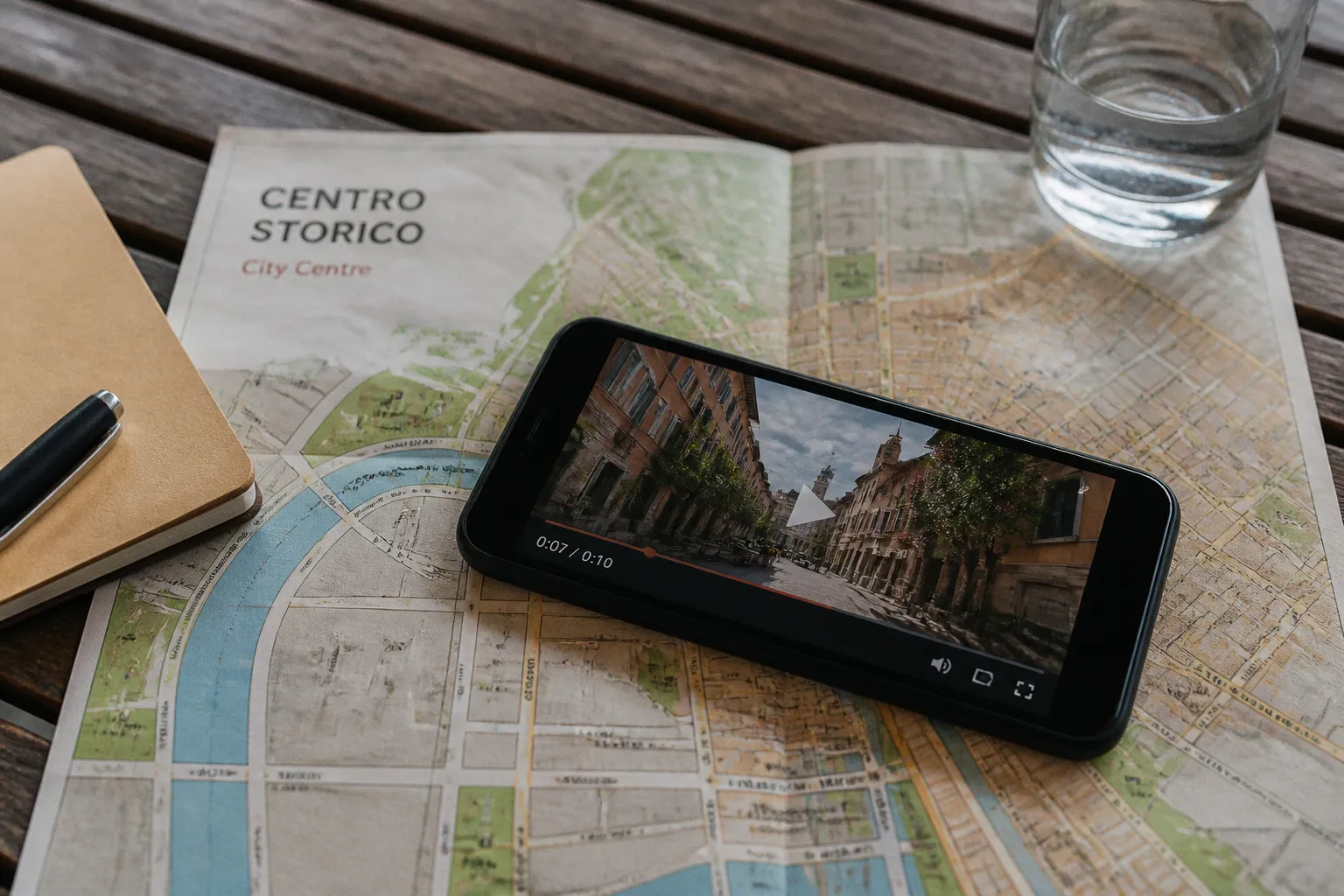
Video Itineraries vs Static Guides: The Question Every DMO Is Asking Right Now
Late last year, a hotelier in northern Portugal sent me her analytics dashboard with a single frustrated note — her beautifully designed neighborhood guide, the one she had commissioned with watercolor maps and curated walking routes, was being downloaded fewer than eighty times a month. Meanwhile, a property fifteen minutes down the coast was running 30-second route videos on Instagram and watching direct bookings quietly climb. Her question was the one I hear more than any other in my consulting work right now: "Sarah, do I stop printing and go all-in on video?" My answer, as it usually is, was neither — but the gap between what static formats still do well and what moving images accomplish has widened enough that every destination marketer needs to understand both sides clearly.
Compare car rental deals in United Kingdom
See available offersPartner link — DiscoverCars comparisonThis is the conversation I want to walk you through — not as a sales pitch for one format over the other, but as a working strategist who has watched the distance grow between destinations investing in interactive travel guide videos and those still leaning on PDFs, brochures, and printed booklets. By the end, you will have a clearer sense of where each format earns its place, where they complement one another, and what the engagement data actually tells us about traveler behavior in 2026.
The Cognitive Shift Behind Why Video Wins the First Impression
Here is the uncomfortable biology of travel planning: human brains process visual information roughly 60,000 times faster than text. That is not a marketing flourish — it is a measured difference between how the visual cortex handles a single image and how the language centers decode written words. For a traveler scrolling through their phone at 11 p.m., deciding whether your destination deserves a five-hour flight, this speed difference is the entire game.
When I sit down with a hotelier whose direct bookings have plateaued, I usually pull up the existing static guide and we time how long it takes to absorb the destination's personality. Then we cut together a 45-second route video — the kind of piece that follows a guest from the lobby out through the cobbled streets, into a family-run tasca, ending at a viewpoint. The contrast is not subtle. The text guide conveys information; the video conveys context — the texture of the stone underfoot, the way the light moves at golden hour, the sound of a fado singer drifting from an open doorway. None of that arrives through bullet points.
A printed page tells travelers where to go. A video itinerary shows them what it feels like to be there — and that difference is where booking intent is born.
This is why watching a travel video increases booking intent for more than 70% of viewers, and why the funnel impact shows up across the entire guest journey: 66% of travelers turn to video when they are merely thinking about a trip, 65% when choosing between destinations, and 63% when researching activities. Static guides rarely appear in that first inspiration phase — they surface later, when a traveler has already committed and wants logistical detail. That sequencing matters enormously when you are designing the visual narrative for your destination.
Putting Numbers to the Format War
Let me lay out the performance gap in concrete terms, because this is where the conversation stops being theoretical and starts being operational. Destination marketers often ask me which format "wins" — and the honest answer is that they serve different stages of the funnel, but the velocity at which video moves travelers through those stages is hard to overstate.
| Engagement Signal | Video Itineraries | Static / Text Guides |
|---|---|---|
| Booking intent after exposure | More than 70% of travelers report higher intent | Modest, context-dependent |
| Social share rate vs text + images combined | ~1,200% higher baseline | Baseline |
| Landing page conversion lift with embedded video | Up to 80% | Single-digit improvements typical |
| Discovery-phase engagement (Reels, 6–12s) | 8.4% average engagement | Not applicable |
| Short-form share-rate multiplier | 2.5× higher than static posts | 1× |
The table above is not a moral judgment — it is what the engagement data tells us when both formats run side by side, and it is the same set of numbers I show skeptical clients in our first strategy session. But numbers alone miss one of the most practical advantages video carries into 2026, and it has very little to do with aesthetics.
Real-Time Updates Are No Longer Optional
Last autumn, a hiking lodge in the Pyrenees lost an entire weekend of bookings because their printed trail map still recommended a route that had been closed for rockfall — and the closure had only been announced on the regional tourism board's social channels. The owner called me that Monday, frustrated beyond measure. We rebuilt their trail guide as a short-form video sequence within forty-eight hours, with on-screen captions they could swap whenever conditions changed, and the lost weekend pattern never repeated.
This is the operational reality that static guides simply cannot solve: printed brochures freeze in time the moment they leave the printer. Digital video itineraries can be updated the same day — a caption swap here, a re-edit there, a pinned comment that flags a closed beach, a new restaurant opening, a shifted ferry schedule. Weather alerts, road closures, seasonal menu changes, storm advisories — none of these wait for the next print run, and increasingly, neither do travelers checking their phones at the trailhead.
For destinations that experience real volatility — coastal towns in storm season, mountain regions with shifting access, urban neighborhoods in constant flux — this agility is not a luxury. It is a baseline expectation. Static guides still earn their keep for archival detail, offline use in low-connectivity zones, and the kind of step-by-step logistical planning a guest wants to print and tuck into a daypack. But they cannot be the primary format when the landscape — literally — moves.
Slow Travel Is Pulling Itineraries Longer, Not Shorter
Here is a counterintuitive shift I want you to sit with: in 2025, the average trip length grew from 4.5 days to 5.5 days, and that number is still climbing. Travelers are not looking for the shortest possible itinerary — they are looking for the deepest one. They want to know which bakery in the old quarter opens at seven in the morning, which courtyard is worth the detour, which fishing village two hours down the coast rewards an overnight stay. That is a meaningful change in what an itinerary has to deliver.
This is where local tourism video itineraries earn their real value. A six-to-twelve-second clip is perfect for discovery — that 8.4% engagement window I mentioned earlier — but the booking-confirmation phase asks for something longer and more textured. I have watched conversion rates climb when a destination layers its funnel thoughtfully: a short Reel hooks the dream, a 90-second itinerary video on the landing page builds the plan, and a longer ten-minute slow-travel route film seals the emotional commitment before the guest ever clicks "reserve."
The static guide, used well, can still hold the second and third positions in that funnel — particularly when a guest wants to print a checklist for the day. But the opening move, the one that determines whether a traveler keeps scrolling or clicks through to your booking engine, is increasingly a video moment. That reordering is the single biggest shift I have seen in five years of consulting on destination video marketing routes.
Where AI Enters, and Where It Does Not
I will be direct about this one: 89% of travel agencies planned to increase their AI budget in 2025, and 63% of those were prioritizing video automation to scale content production. That is the industry direction, and destination marketers who ignore it do so at their peril. But the temptation to hand the entire creative process to a machine is exactly the wrong read.
What AI does well is the part of the work that exhausts humans — batch-editing vertical cuts, generating captions, swapping b-roll across twenty neighborhood segments, translating voiceover tracks for international audiences, and personalizing routes for niche traveler segments. I use these tools in my own client work, and they have cut production timelines roughly in half for properties that previously could only afford one or two destination videos per year. What AI does not do well is the part that defines a destination's sense of place: the editorial instinct that recognizes which grandmother's pastel de nata recipe is worth filming, the eye that knows when a moment of stillness belongs in the cut, the alignment between brand voice and on-screen storytelling.
AI is the editor's assistant, not the destination's voice — and the brands that confuse the two will produce content that looks efficient and feels hollow.
For digital travel guide formats specifically, the workflow I recommend now is hybrid: human-led concepting and on-location direction, AI-assisted editing and personalization at scale. This is how smaller properties — independent hotels, regional tourism boards, boutique tour operators — can compete with the production budgets of major chains without surrendering the sense of place that makes their destination worth visiting in the first place.
So Where Does This Leave Static Guides?
Not dead. Not even close.
The PDF and the printed booklet still win in three specific contexts: offline use in remote areas where connectivity fails, detailed step-by-step logistical planning where travelers want to print a checklist for the day, and the premium "welcome packet" experience a guest clutches on arrival. I have a client who doubled her upsell rate simply by adding a beautifully printed itinerary slip to every room — a tactile artifact that complements the digital route running on her site. The two formats are not rivals; they are layers of the same guest journey.
What has changed is hierarchy. Static guides used to be the destination's primary voice. In 2026, they are the companion — the thoughtful backup to a digital travel guide ecosystem that does the heavy lifting of inspiration, conversion, and real-time communication. Treating them otherwise is how independent properties end up with beautiful printed booklets gathering dust in the lobby while their competitor down the road runs a thirty-second route video and watches direct bookings climb.
If you are a hotelier or a destination marketing organization wrestling with where to invest next quarter, here is the practical sequence I walk my own clients through:
- Audit where your current static guide still earns its keep — and where it is genuinely being ignored.
- Build a six-to-twelve-second vertical video for each of your top three itineraries — the discovery hook.
- Layer a sixty-to-ninety-second landing page video that walks a viewer through the full route.
- Reserve printed or PDF formats for arrival-day use, detailed logistics, and offline backup.
- Use AI tools for editing, captioning, and translation — not for creative direction.
The destination marketers winning right now are not the ones who abandoned print, nor the ones who went all-in on video. They are the ones who understood what each format does uniquely well — and built a guest journey that honors both. That, more than any single tactic, is what turns a viewer into a booking, and a booking into someone who comes home already planning the next trip.