Experiential travel videos: milestones from brief to launch
A standard tourism shoot can produce a 90-second hero film, a 60-second paid-social cut, three to five vertical edits between 15 and 30 seconds, aerial footage, and a usable archive of raw B-roll.
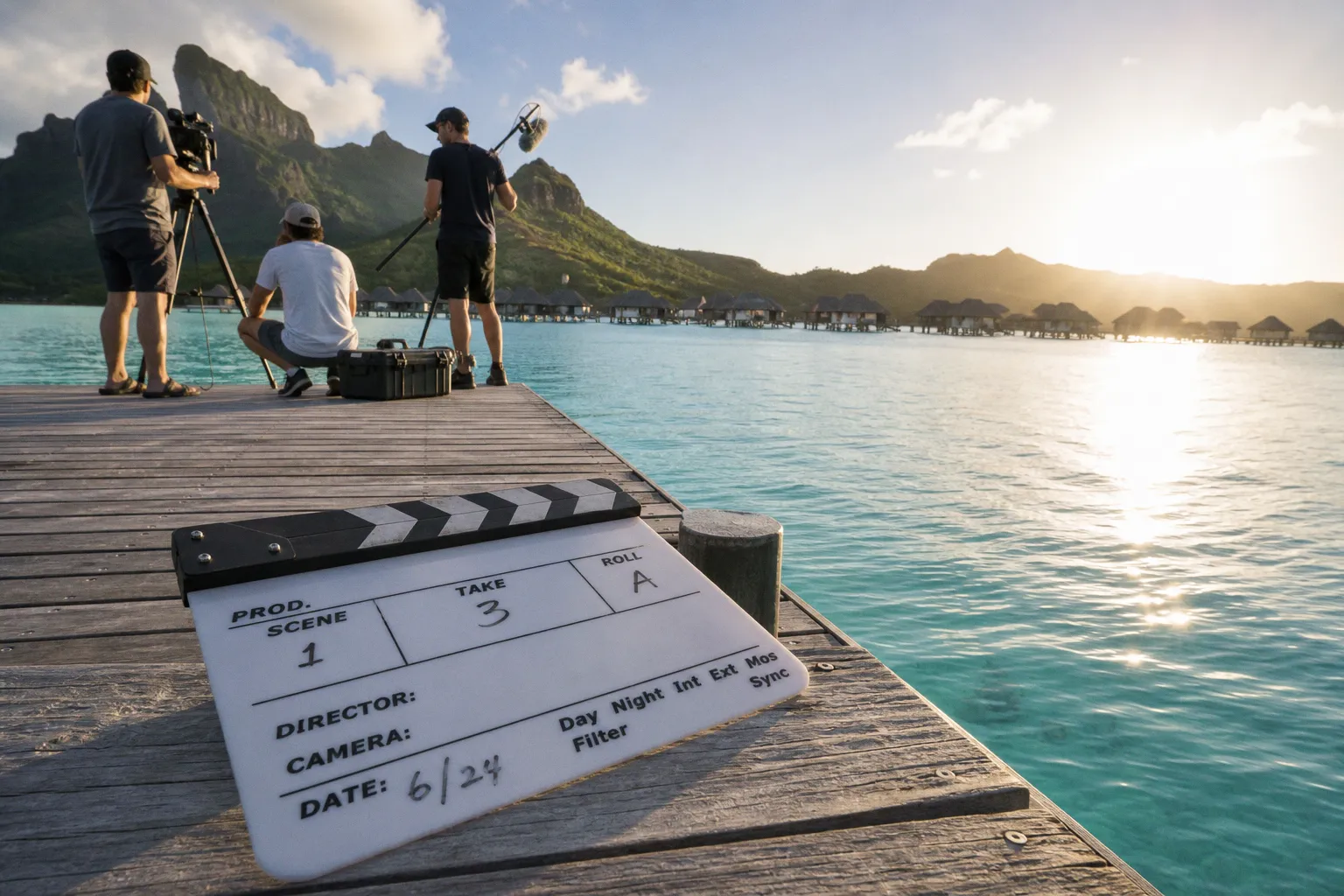
The filming window may be only one to three days.
That compression creates the main production risk. The camera is rarely the bottleneck. The bottleneck is the sequence around it: an incomplete brief, late travel bookings, unapproved scripts, missing releases, weak shot coverage, and a rough cut that enters review without a defined decision-maker.
The experiential travel video production timeline usually runs from 2 to 8 weeks for pre-production, 1 to 3 days for filming, and 1 to 4 weeks for post-production. International projects need travel and lodging booked 4 to 6 weeks in advance. Add advanced visual effects or virtual production and the schedule can expand by another 2 to 4 weeks.
This is not administrative overhead. It is the delivery system for destination video marketing. Every unresolved decision in pre-production becomes a production delay, an editing compromise, or a conversion problem on the booking page.
Strategic Pre-Production: The 2-to-8 Week Foundation
Pre-production determines what the final video can prove.
A destination film is not a moving travel brochure. It is a sequence of evidence. The viewer needs to understand the location, the available experience, the access conditions, the reason to stay longer, and the next action. If the footage does not establish those points, the final edit will rely on generic landscape shots and music.
That pattern performs poorly because it creates low information density. A viewer sees a beach, a street, or a hotel exterior. They do not see a usable trip.
For a full campaign, pre-production typically takes 2 to 8 weeks. A simpler project can move in 3 to 10 days, but only when the geography, access, talent, approvals, and deliverables are already defined. The difference is not the camera package. It is the number of variables still moving.
Start with the conversion task
The creative brief should specify the commercial job of the video. “Promote the destination” is not a production brief. It is a category label.
A workable brief defines:
- Primary audience: leisure travelers, long-stay visitors, luxury guests, families, adventure travelers, or another identifiable segment.
- Primary action: book accommodation, request an itinerary, visit a tourism board site, reserve an activity, or save the destination for later.
- Distribution environment: hotel website, destination landing page, paid social, YouTube, connected TV, trade presentation, or in-room display.
- Decision stage: discovery, comparison, or booking intent.
- Proof points: travel time, local access, accommodation type, seasonal conditions, available activities, or partnerships.
- Measurement plan: completion rate, click-through rate, landing-page engagement, booking-engine entry, or assisted conversion.
The brief also needs a list of claims that the footage must support. If the destination is positioned around walkability, the film needs route logic. If it promotes eco-tourism, the content needs specific practices or experiences rather than a recycled “untouched nature” sequence.
This is where a heatmap from the existing website can affect the shot list. If visitors repeatedly stop scrolling at accommodation images but fail to move into the booking engine, the video may need to resolve the transition between destination desire and property selection. If users click an attraction map but abandon the page, the destination content may be too broad or poorly connected to planning information.
The visual strategy follows the friction. It does not precede it.
Build the story around a route
Travel guide content creation steps should follow the visitor’s movement through the destination. A route-based structure is easier to shoot, easier to edit, and easier to use across landing pages.
A practical sequence can include:
1. Arrival: the airport, station, road, harbor, or transfer point. This establishes access.
2. Orientation: the district, town, coastline, or landscape in relation to the visitor.
3. Stay: the hotel, lodge, rental, or base used during the trip.
4. Experience: the activity that gives the destination a reason to visit.
5. Local detail: food, craft, architecture, markets, or a partner business.
6. Transition: the movement between locations. This prevents the edit from becoming a set of disconnected attractions.
7. Action: a final destination or accommodation frame that supports the next step.
This structure does not require a voice-over. It requires continuity. The viewer should be able to infer how the experience fits into a real itinerary.
Shot lists should therefore describe function, not just subject. “Mountain drone shot” is weak. “Aerial establishes the lodge’s distance from the trailhead” is usable. “Market footage” is weak. “Handheld sequence shows the guest moving from the hotel entrance to the market route in under five minutes” gives the editor a purpose.
Convert the brief into deliverables before filming
The hero film cannot be the only editorial output. Social cuts, paid media edits, vertical versions, still frames, and B-roll often have different framing and pacing requirements.
Define the delivery set before the camera is booked:
| Deliverable | Typical role | Planning requirement |
|---|---|---|
| 90-second hero film | Destination or hospitality landing page | Requires a complete route and narrative progression |
| 60-second paid-social cut | Awareness and retargeting | Needs a fast opening and early proof point |
| Three to five 15–30-second social cuts | Platform-specific discovery | Requires modular scenes and clean vertical compositions |
| Aerial footage | Scale, geography, and access | Requires weather, airspace, and launch planning |
| Raw B-roll | Future campaigns and editorial use | Requires organized files, usage rights, and metadata |
A common failure occurs when the hero film is composed horizontally and the production team later crops it for vertical placements. Architectural lines distort. Subjects move out of frame. Text-safe areas disappear. The issue is visible before editing. It exists in the shot design.
For destinations, capture should account for multiple aspect ratios at the planning stage. The camera operator needs to know whether a scene must work at 16:9, 1:1, and 9:16. A wide establishing shot may support the website. A tighter centered composition may be required for vertical social. Those are separate framing decisions.
The shoot is not successful because it captures attractive locations. It is successful when each location provides usable evidence for a defined conversion task.
Logistical Planning for International Destination Shoots
International production adds dependencies that cannot be solved in post-production.
Travel and lodging should be booked 4 to 6 weeks in advance. That lead time allows the team to manage passports, visas, vaccinations, accommodation, transport, equipment movement, and local access. Expediting fees are only one risk. A late booking can also reduce route flexibility and force the crew into inefficient travel between locations.
The schedule should be built around geography before it is built around the shot list.
Map the production route
A destination campaign can lose a full shooting day to poor routing. Two locations may look close on a map but require a long transfer because of mountain roads, ferry schedules, restricted access, or seasonal traffic. The production calendar should show:
- travel time between every location;
- parking and loading conditions;
- access windows for private or protected sites;
- sunrise and sunset positions;
- expected light direction on architectural subjects;
- meal, fuel, and equipment reset points;
- weather-sensitive activities;
- local contact details and escalation paths.
The route should also include a fallback location near each major setup. Weather can remove a drone sequence, a boat departure, or a mountain vista from the schedule. A backup is only useful if it can be reached without breaking the rest of the day.
Do not build a schedule with every minute occupied. That is not efficiency. It is a single-point-of-failure system. Travel delays, talent movement, location access, and equipment changes consume time. The actual buffer depends on the destination and season, so it should be calculated locally rather than copied from a generic production template.
Secure access and usage rights
Destination video marketing often involves several rights holders:
- tourism boards;
- hotels and resorts;
- restaurants;
- activity operators;
- museums and cultural sites;
- private landowners;
- local performers or guides;
- guests and members of the public;
- transport operators;
- drone regulators.
A location release does not automatically clear every person, logo, artwork, or commercial activity visible in the frame. The production manager should identify what can appear incidentally and what requires explicit permission.
The same applies to music. A track licensed for organic social may not be cleared for paid advertising, broadcast, or use by a hotel group in another market. Rights should be matched to the distribution plan at the brief stage.
A missing release may not stop the shoot. It can stop the launch.
Sequence approvals
The production timeline should treat approval as a chain, not a final meeting. The critical milestones are:
1. Creative brief approval.
2. Script and storyboard approval.
3. Shoot logistics approval.
4. Footage backup and media verification.
5. Rough-cut approval.
6. Fine-cut approval.
7. Final delivery-format approval.
Each stage should have one accountable approver. A committee can provide input, but it should not generate contradictory instructions after the edit has entered fine cut.
The footage backup milestone is operational, not creative. It confirms that media exists in at least the required backup structure and that files can be opened. A damaged card or missing audio file discovered during editing is not a revision. It is a production failure.
Plan for the platform, not the archive
A tourism board may want a master file. The booking page may need a compressed version with captions. Paid social may need a vertical edit with a different first three seconds. A hotel sales team may need a clean version without on-screen pricing or campaign language.
The delivery specification should define:
- aspect ratio;
- resolution;
- frame rate;
- caption requirements;
- audio mix;
- maximum file size;
- thumbnail or poster frame;
- title-safe and text-safe zones;
- platform duration limits;
- naming and version control.
If these details appear after the edit is complete, the production is not finished. It has entered rework.
Optimizing the 1-to-3 Day Filming Window
Standard tourism and corporate productions usually film in 1 to 3 days. Complex campaigns and documentaries can extend to 2 to 4 weeks. The short production window requires coverage discipline.
The objective is not to collect the maximum number of shots. It is to capture enough coverage to create transitions, establish geography, show use, and preserve edit options.
Use a coverage matrix
Every planned experience should be recorded across several shot functions:
- Establishing: shows where the viewer is.
- Approach: shows how the visitor reaches the location.
- Action: shows the experience in progress.
- Detail: records the physical evidence that makes the experience specific.
- Reaction: captures a credible human response without staging a generic smile.
- Transition: connects the location to the next part of the route.
- Utility: provides clean footage for text overlays, cutdowns, or edits.
This matrix prevents a familiar production error: five versions of the same wide shot and no usable detail for the edit.
For architectural and hospitality subjects, focal length should follow the proof point. A wide lens can establish a room, but it can also exaggerate dimensions and create misleading spatial relationships. A tighter focal length can show material quality, furniture, or service detail without making the property look larger than it is. The choice is not aesthetic decoration. It controls how the viewer estimates space.
Dynamic range also matters when interiors open to bright exterior views. If windows clip to white, the connection between the hotel and destination disappears. If the interior is lifted too aggressively, shadow noise and color shifts enter the image. Exposure should preserve the information that supports the booking decision: room volume, window outlook, access to outdoor space, and material condition.
Stage people as users, not props
Experiential travel marketing needs human activity, but people should demonstrate the experience rather than obscure it.
A usable action sequence often requires:
- a clear starting position;
- a visible movement path;
- a defined interaction;
- enough repetition for multiple angles;
- a clean frame without unrelated bystanders;
- continuity in wardrobe, props, and direction.
The performer does not need to act out a fictional holiday. They need to make the experience legible. A guide opening a route map, a guest moving from reception to a terrace, or a visitor preparing equipment communicates more than a posed look toward a landmark.
Capture clean plates when possible. A few seconds without the subject can support title graphics, transitions, and cutdowns. Hold shots longer than the final edit requires. Short-form platforms reward speed, but editors still need handles.
Treat sound as location evidence
Many destination videos fail because the image communicates place while the sound could have been recorded anywhere.
Record usable ambient sound:
- harbor movement;
- market activity;
- footsteps on local surfaces;
- cooking or service sounds;
- water, wind, and wildlife;
- guide interaction;
- transport departure;
- room and lobby sound.
Sound design can increase geographic specificity without adding another line of narration. It also gives the edit a rhythm that generic music cannot provide.
Wind is a technical problem. So is uncontrolled crowd noise. The production plan should identify when the location is quiet enough for dialogue or clean ambient capture. If the video depends on a guide explaining an activity, schedule an audio-focused take rather than assuming the first performance will be usable.
Use the day in production blocks
A productive schedule separates light-sensitive, access-sensitive, and performance-sensitive work.
A block can be assigned to:
- sunrise or sunset exteriors;
- hotel interiors and guest movement;
- activity coverage;
- partner businesses;
- aerial work;
- interviews or guide narration;
- clean plates and details;
- pickups and contingency.
Aerial footage should not be treated as a spare five-minute task. It may require local permissions, launch-site checks, wind assessment, safety control, and repeated passes. The visual payoff is high, but the operational dependency is also high.
The final hour of the day should not be filled automatically with a new location. It is often better used for missing details, clean sound, alternate framings, and verification of the coverage matrix.
Post-Production Workflows and Approval Milestones
Post-production usually takes 1 to 4 weeks. It includes ingest, organization, editing, color grading, sound design, graphics, captions, exports, and revisions. Complex projects can extend to 2 months.
The timeline depends on the number of deliverables and the speed of approvals. Editing is sequential. A rough cut must establish structure before a fine cut can refine timing. Color and sound should not be treated as a substitute for weak narrative logic.
Ingest the footage as a production stage
The editor needs a usable media system, not a folder containing thousands of unnamed clips.
The ingest workflow should include:
- verified backups;
- consistent file naming;
- camera and audio synchronization;
- scene and location labels;
- selects for each destination experience;
- identification of missing coverage;
- separation of licensed music and graphics;
- notes on releases and usage restrictions.
Metadata has a direct effect on schedule. If the editor cannot locate “hotel terrace at sunset” without reviewing every card, the production has created avoidable friction. Searchable labels reduce edit time and make future B-roll retrieval possible.
A destination campaign should be organized around the audience route, not the camera operator’s card structure. “Card 03” is not an editorial category.
Cut for information density
The first seconds need to establish relevance. That does not always mean the widest landscape. It can mean a clear activity, a strong access point, a hotel-to-destination relationship, or a specific local detail.
A useful sequence answers three questions:
1. What is the destination or property?
2. What can the visitor do there?
3. What should the visitor do next?
The answers can be visual. They can use captions. They can use narration. The format depends on distribution and audience behavior.
A high completion rate is not enough if the video produces no downstream action. Conversely, a click-through rate without booking-engine engagement may indicate a mismatch between the promise in the video and the landing-page experience. Video performance should be read alongside bounce rate, scroll depth, booking-engine entry, and assisted conversion where those data points exist.
The edit should also be tested against the page context. A destination film embedded above the fold has a different job from a social cut that introduces a paid campaign. The same sequence should not be assumed to perform identically in both placements.
Separate rough-cut decisions from finish decisions
The rough cut should answer:
- Is the destination clear?
- Is the route understandable?
- Does the experience have a beginning, middle, and end?
- Are the commercial proof points present?
- Does the first section earn continued viewing?
- Are the required locations and partners represented?
- Is the call to action aligned with the landing page?
The fine cut should address:
- timing;
- shot selection;
- continuity;
- music and ambient sound;
- captions;
- graphics;
- brand treatment;
- color;
- platform-specific framing.
A client who gives color feedback on an unapproved structure is moving decisions out of order. That creates revisions without resolving the central problem.
Control review cycles
The project manager should establish a single review document and a deadline for consolidated comments. Timestamped notes are more useful than general responses such as “make it more engaging.” The editor needs an action: replace the opening, shorten the activity sequence, clarify the location, remove the unsupported claim.
Unstructured feedback increases the number of versions and weakens version control. The final file may be technically correct but commercially inconsistent because different stakeholders approved different cuts.
A practical review system identifies:
- version number;
- review owner;
- open comments;
- approved sections;
- unresolved legal or usage issues;
- next export date;
- final delivery formats.
A late approval is not a minor scheduling issue. It moves every dependent milestone, including captions, color, sound, exports, and launch QA.
Scaling Deliverables from a Single Production Cycle
A single-day shoot can create a campaign library if the production is designed for reuse. It can also create one expensive hero film and a large archive nobody can deploy.
The difference is modular coverage.
Design scenes that can be re-edited
Each scene should offer multiple entry and exit points. A 20-second activity sequence can become:
- an opening hook for a paid-social cut;
- a middle section in the hero film;
- a vertical edit focused on the action;
- a still frame for a destination guide;
- background footage beneath a price or booking message;
- B-roll for a partner page.
This requires more than recording the central action. Capture the approach, setup, interaction, result, and departure. Those components can be rearranged without creating visible gaps.
For local attraction partnerships, record enough material to give each partner a distinct role. A restaurant should not appear as an anonymous food close-up if the campaign needs to drive visitors to a specific district. The frame should establish the business, the product, and its place in the route.
The same rule applies to neighborhood travel guides. Record landmarks and transitions that allow the guide to explain distance and sequence. A list of disconnected attractions creates planning friction. A route makes the content operational.
Build platform versions from the same evidence
Platform adaptation is not simply a crop-and-export task.
A vertical social cut may need:
- a subject centered within a narrow frame;
- earlier text placement;
- faster scene changes;
- captions designed for silent viewing;
- a clear first-frame proposition;
- a shorter path to the action.
A hotel website film may need slower spatial coverage because the viewer is evaluating the property. A paid ad may need the destination benefit before the brand identification. A trade presentation may need more contextual text and fewer abrupt transitions.
The source footage should support these differences. If it does not, the problem began during framing.
Preserve raw B-roll as an asset
Raw footage has value only when the rights, metadata, and storage structure are clear.
The archive should record:
- location;
- date;
- subjects;
- restrictions;
- model or property release status;
- orientation;
- resolution;
- audio availability;
- recommended use;
- expiration date where applicable.
This turns a one-day production into a reusable content bank. It supports seasonal edits, partner campaigns, travel guide updates, and retargeting sequences without requiring a new full shoot for every message.
The archive should not be treated as an excuse to film without a narrative. More footage does not correct weak positioning. It only increases storage and selection time.
A Realistic Production Map
The experiential travel video production timeline can be managed as a sequence of locked decisions:
| Phase | Typical duration | Output that must be approved |
|---|---|---|
| Brief and strategy | Part of the 2–8 week pre-production window | Audience, action, distribution, claims, measurement |
| Story and route design | Part of pre-production | Script, storyboard, shot functions, destination route |
| Logistics | Usually completed 4–6 weeks before international travel | Travel, lodging, access, releases, permits, contingency |
| Filming | 1–3 days for standard tourism work | Verified coverage, audio, aerial material, backups |
| Ingest and assembly | Within the post-production workflow | Organized media, selects, rough structure |
| Rough cut | Post-production milestone | Approved narrative and proof points |
| Fine cut and finish | Within the 1–4 week post-production window | Timing, sound, color, captions, graphics |
| Final delivery and QA | Final milestone | Correct files for every platform and placement |
The durations overlap. Brief development can continue while logistics are being secured. Media organization begins during production. But the decision sequence should not be reversed.
Advanced visual effects, green screen, and virtual production add another 2 to 4 weeks to the overall timeline. They also add approval points. A visual effect that changes the perceived geography or scale of a destination should be reviewed as a brand and accuracy issue, not only as a post-production task.
The technical launch check
Before publication, verify the final files against the actual placement. Not the export preset. The placement.
Check:
- the first frame on mobile;
- captions with sound disabled;
- legibility over bright and dark footage;
- crop behavior at every aspect ratio;
- audio levels and channel mapping;
- thumbnail or poster frame;
- loading behavior on the booking page;
- link destination and call-to-action match;
- partner and location credit requirements;
- file naming and version status;
- tracking parameters for paid distribution;
- replacement of draft files in content management systems.
A video can pass editorial approval and still fail at launch. The player may crop the hotel entrance. The caption may sit beneath a platform control. The compressed file may lose detail in an interior. The call to action may lead to a generic homepage instead of the itinerary or booking page promised in the film.
Those are conversion failures, not cosmetic defects.
Final Position
The production timeline for experiential travel videos is controlled by dependencies. Pre-production defines the evidence. Logistics protects access to that evidence. A 1-to-3 day shoot captures it. Post-production organizes it into a route that the viewer can understand. Launch QA confirms that the route survives the platform.
The most reliable destination video marketing roadmap is therefore strict:
- approve the commercial brief before the storyboard;
- define deliverables before framing the first shot;
- book international travel and lodging 4 to 6 weeks ahead;
- map the route by geography and light;
- capture every experience as establishing, action, detail, and transition coverage;
- back up and label footage before editing;
- approve the rough cut before fine-cut work;
- export for the real platforms, not an assumed one;
- measure video behavior against booking-page behavior;
- retain usable B-roll with rights and metadata attached.
A camera can record a destination in one day. A conversion-ready campaign takes the full sequence.