Video SEO or paid ads for direct bookings?
A hotel can have beautiful video, a healthy occupancy forecast, and still watch too many bookings pass through Booking.com or Expedia. The problem is rarely a lack of content alone.
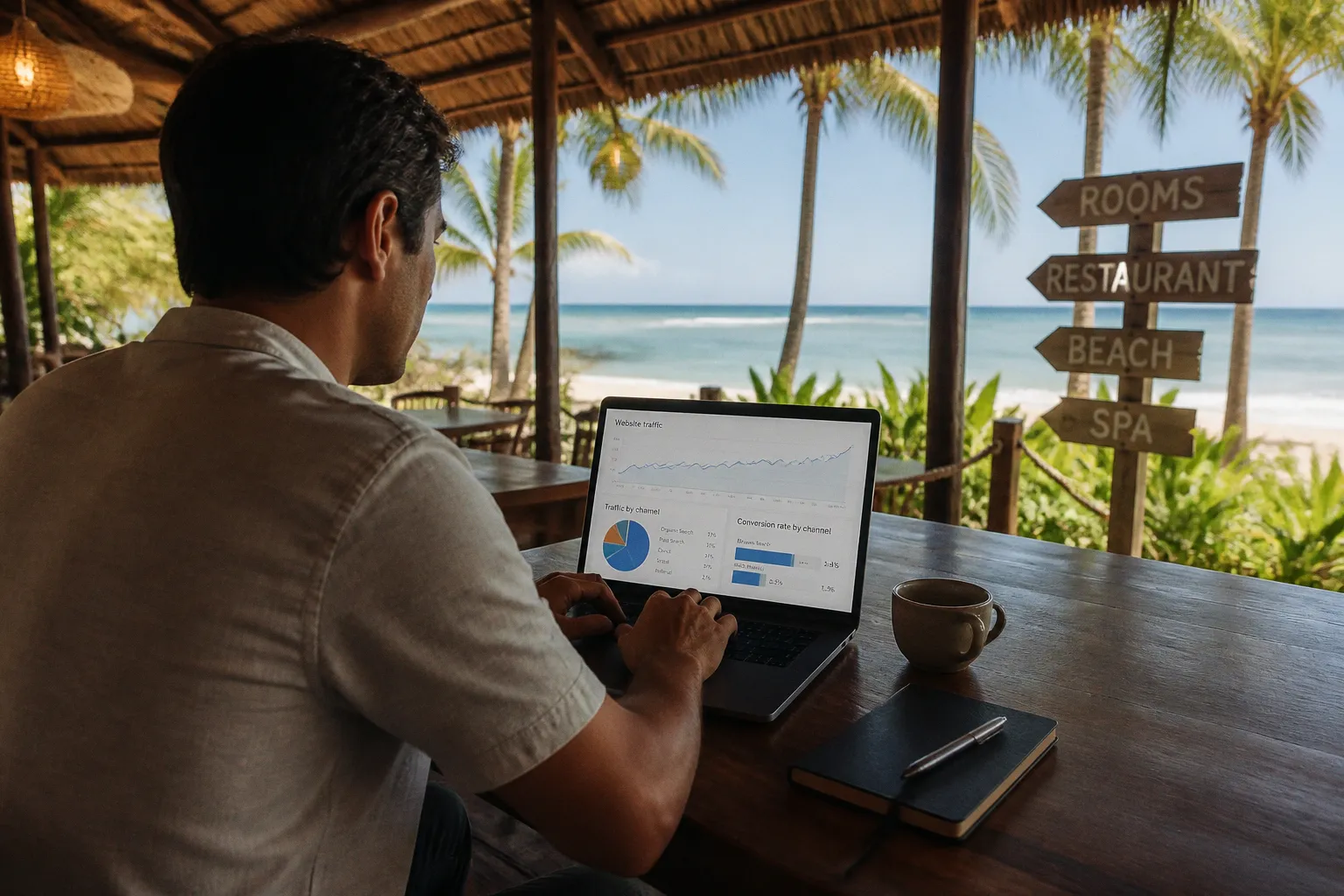
More often, the property has not decided whether its visual narrative should work as a long-term discovery asset, an immediate sales tool, or—most effectively—both.
The choice between hotel video SEO and paid video ads is therefore not simply a question of which channel is cheaper. It is a question of timing, guest intent, brand maturity, and how much control you want over the guest journey before the booking engine opens. Paid campaigns can create visibility as soon as they are activated. Organic video search can take six to twelve months to build meaningful momentum, but it can continue bringing qualified visitors without paying for every click.
That difference matters when an OTA commission can remove 15% to 25% of the booking value before the guest has even arrived.
The direct-booking problem is larger than the booking button
Hotels often describe direct bookings as a conversion problem: the website needs a clearer call to action, a shorter booking path, or a stronger offer. Those things matter, but they sit at the end of the guest journey. The harder question is what happens before the guest reaches the website.
A traveller may first discover a destination on YouTube, search for a beach resort several weeks later, compare room types through Google, watch a short property video on Instagram, and only then arrive at the hotel website with a reasonably clear sense of place. If the hotel appears nowhere in that discovery process—or appears only as a listing on an OTA—the property is paying someone else to introduce it.
This is where video has an unusual advantage. A still image can show the room. A well-made video can establish the relationship between the room, the light, the neighbourhood, the breakfast service, the pool, and the pace of a stay. It gives the guest context. That context reduces uncertainty, and uncertainty is one of the quiet reasons travellers default to familiar booking platforms.
The financial logic is straightforward:
- An OTA may deliver the booking, but it takes a commission of roughly 15% to 25%.
- Paid video can bring immediate traffic, but every campaign requires a media budget and ongoing optimisation.
- Organic video SEO takes longer to establish, but successful visibility can continue producing discovery without a charge for each visit.
- Direct traffic and direct bookings give the hotel more room to communicate its brand, package the stay, and build a relationship after the reservation.
The real comparison is not “free traffic versus paid traffic.” It is rented demand versus an audience asset you gradually own.
The most useful decision comes from understanding what each channel is designed to do.
Organic video SEO: slow authority, stronger compounding value
Video SEO is often reduced to uploading a few property films to YouTube and adding keywords to the description. That is not a strategy. Search visibility grows when the content answers a real planning question and connects naturally to the hotel’s sense of place.
A polished room tour may be attractive, but it is not necessarily discoverable. A video built around a specific guest need—where to stay for a long weekend, what a particular beach is like at sunrise, how far the hotel is from a conference venue, or what a family can realistically do nearby—has a clearer search context. It can introduce the property before the viewer is ready to book, which is precisely when trust begins to form.
For a hotel, organic video SEO can support several layers of search behaviour:
1. Destination discovery
These are broad searches around a location, season, experience, or type of trip. The viewer may not know the hotel yet. Content here needs to create desire while giving practical orientation.
2. Property consideration
The traveller is comparing hotels and wants evidence. Room layouts, arrival experience, breakfast, accessibility, pool areas, workspaces, and the surrounding streets become useful subjects.
3. Brand and booking research
At this stage, the viewer may search for the hotel by name, look for reviews, inspect facilities, or compare direct offers with OTA listings. Video helps confirm that the property matches the promise.
4. Experience-led searches
These are particularly valuable for resorts, boutique hotels, and B&Bs. A video about a local food route, a hiking trail, a wedding weekend, or a seasonal event can attract people who are not yet searching for accommodation but are already forming the shape of a trip.
Organic hotel video SEO works best when the content library reflects the full guest journey rather than repeating the same hero film in different formats. A 30-second social cut, a three-minute neighbourhood guide, a detailed room walkthrough, and a practical arrival video may all serve different search and decision-making moments.
Why the six-to-twelve-month horizon matters
Standard organic SEO commonly requires six to twelve months to show substantial results. Video content does not escape that reality. A channel may gain views quickly, but consistent visibility for commercially valuable searches usually needs time, relevance, technical support, and a body of related content.
That waiting period is frustrating, especially for an independent hotel competing against large brands with established domain authority. But it is also where many properties misread the channel. They judge organic video after a few weeks, see modest view counts, and conclude that guests do not want to watch. In reality, the first stage is often about building a catalogue that search engines and viewers can understand.
The strongest assets tend to have:
- A clear location and property context in the title and description.
- A useful answer rather than a purely promotional message.
- Captions and spoken language that reflect how guests search.
- A thumbnail that communicates the experience without looking like a generic property brochure.
- A route back to the hotel website or booking environment.
- Links between related videos, so one useful answer leads into another.
- A landing page that fulfils the expectation created by the video.
Search traffic is not valuable simply because it is organic. It becomes valuable when the content attracts the right traveller and the landing experience preserves the same visual and emotional alignment.
Conversion is about trust, not just visibility
Broad online marketing benchmarks put organic SEO conversion at around 2.4%, compared with approximately 1.3% for paid search advertising. Those are general benchmarks, not a universal forecast for hotel video content, and they should not be treated as a guaranteed hotel booking rate. They do, however, illustrate a familiar pattern: visitors who actively find a relevant answer through search often arrive with more self-selected intent than people who encounter an advertisement in a feed.
That distinction is important in hospitality. Someone who searches for a quiet hotel near a particular trail is already expressing a need. Someone who sees a beautiful pool video while scrolling may be inspired, but may not yet have dates, budget, or a destination in mind.
Organic video can support conversion by answering the questions that photography and short copy leave open:
- How does the hotel feel at different times of day?
- Is the surrounding area walkable, lively, quiet, or isolated?
- Does the room work for the type of stay being planned?
- What does arrival actually look like?
- Is the property polished in a way that feels welcoming, or polished in a way that feels impersonal?
- Does the hotel understand the experience the guest is trying to create?
These are not decorative details. They are part of the booking decision.
Paid video ads: immediate reach when timing cannot wait
Paid video advertising is built for a different kind of pressure. A hotel opening a new wing, filling shoulder-season inventory, launching a package, or entering a competitive local market may not have six to twelve months to wait for organic visibility. Meta and Google campaigns can begin placing the property in front of defined audiences as soon as the creative, targeting, tracking, and landing pages are ready.
Paid campaigns are particularly useful when the hotel knows exactly what it needs to promote:
- A seasonal stay with a fixed booking window.
- A limited package tied to an event or local attraction.
- A new property that has little search history.
- A destination where guests plan several weeks or months in advance.
- A need to reach past website visitors or people who watched earlier content.
- A direct-booking offer that should be seen by a narrow, relevant audience.
The strongest paid campaigns do not begin with the question, “Which video do we have?” They begin with, “What decision are we asking this audience to make?”
A short video for awareness can introduce the hotel’s atmosphere. A retargeting cut can answer an objection. A booking-focused asset can make the offer, dates, room type, or included experience clear. Treating every video as a hero film usually produces attractive campaigns with weak commercial alignment.
Paid does not mean indiscriminate
One of the common mistakes I see is targeting too broadly because the hotel wants to reach everyone who might enjoy the destination. That approach can create views without creating a meaningful guest journey. A coastal resort does not necessarily need every person interested in travel. It may need couples planning a particular type of break, families looking for a specific school-holiday experience, or previous website visitors who have already shown interest.
Paid video gives the hotel control over:
- Audience location and travel market.
- Interests, behaviours, and travel intent signals available on the platform.
- Retargeting windows.
- Campaign objective and landing-page destination.
- Budget allocation by audience or creative.
- The timing of exposure in relation to peak demand.
It does not, however, remove the need for a good offer or a credible website. If the film promises a serene, design-led stay but the landing page is cluttered, slow, or difficult to book, the campaign simply delivers more people to the point of disappointment.
The 60-to-90-day planning window
For peak travel periods, hospitality marketing practice commonly recommends launching paid Meta video awareness and booking campaigns 60 to 90 days before demand reaches its highest point. That window allows the property to introduce itself during the planning phase, build familiarity, and then move interested viewers toward a more direct booking message.
The sequence might look like this:
1. Early awareness
Show the destination, property atmosphere, and distinctive experience. The aim is recognition and relevance rather than an immediate hard sell.
2. Consideration
Retarget people who watched, visited the website, engaged with the property, or interacted with related content. Use videos that clarify rooms, facilities, location, and what is included.
3. Booking action
Present a direct route to availability, a relevant package, or a reason to book through the hotel rather than continuing to compare on an OTA.
4. Post-click refinement
Review which audiences and creative combinations produce quality visits and booking-engine engagement. Do not judge the campaign on reach alone.
This staged approach is more patient than placing a discount in front of a cold audience and hoping the booking button does the rest. It also gives the visual narrative time to do its job: establishing a recognisable, believable experience.
Hotel video SEO versus paid video ads
The decision becomes clearer when the two channels are placed beside each other—not as rivals, but as tools for different moments.
| Parameter | Hotel video SEO | Paid video ads |
|---|---|---|
| Speed of visibility | Usually gradual; substantial organic search growth often takes 6–12 months | Immediate visibility once the campaign is approved and active |
| Best use | Building long-term discovery, authority, and destination relevance | Generating timely reach, demand, and traffic for specific dates or offers |
| Audience intent | Often self-selected through a search query or related content | Can range from broad awareness to high-intent retargeting |
| Cost structure | Upfront production and optimisation, without paying for every organic visit | Ongoing media spend, plus creative and campaign management |
| Booking economics | Can reduce dependence on OTA discovery over time | Can support direct bookings quickly, but acquisition cost must be monitored |
| Content lifespan | Potentially evergreen when the subject remains relevant | Usually tied to a campaign, audience, offer, or season |
| Main weakness | Slow compounding and uncertain early traction | Performance can decline when budgets stop or creative becomes fatigued |
| Strongest creative | Useful destination guides, room context, experience-led search content | Short, focused assets matched to awareness, retargeting, or booking intent |
The table does not produce a universal winner because hotels rarely operate under one set of conditions. A newly opened property with no organic presence may need paid activity immediately. An established boutique hotel with strong destination content may be able to rely more heavily on organic discovery. A seasonal resort may need both: evergreen content to build authority and paid campaigns to concentrate attention before high-demand dates.
The most effective model is usually an intentional combination
In consulting work, the before-and-after pattern is often less dramatic than a sudden traffic spike—and more valuable. Before the strategy is aligned, a property may have one polished film, several disconnected social clips, and paid campaigns that send every audience to the same generic homepage. The hotel is visible, but the guest journey has gaps.
After the content and distribution are aligned, each asset has a role. The destination film creates initial recognition. Search-led videos answer practical planning questions. Paid cuts bring the right audience back to a room or package page. Retargeting reflects what the viewer has already shown interest in. The booking engine receives a visitor who has been given enough context to make a decision.
That is the difference between producing video and building a video marketing system.
A practical content architecture might include:
- One brand-level film that establishes the hotel’s sense of place and visual identity.
- Several search-led videos answering destination and experience questions.
- Room and facility walkthroughs that remove uncertainty without overpromising.
- Short paid variations with one clear audience and one clear action.
- Retargeting content that responds to previous behaviour rather than repeating the opening message.
- Post-booking or pre-arrival content that extends the relationship and supports the guest experience.
The same footage can sometimes serve multiple purposes, but the edit, opening seconds, captioning, and destination page should change with the channel. A YouTube search viewer may need practical detail. A social viewer may need an immediate visual cue. A retargeted visitor may need reassurance about value, availability, or what makes the property worth booking directly.
The best hotel video is not the one that looks most expensive. It is the one that gives the next guest exactly the context needed for the next decision.
Measuring hotel video marketing without fooling yourself
The danger of hospitality reporting is that the most visible numbers are not always the most useful. Views, impressions, and reach can tell you whether a platform distributed the content. They cannot, by themselves, tell you whether the content helped a guest choose the hotel.
For organic video SEO, I would look at the relationship between:
- Search impressions and the queries producing them.
- Watch time and points where viewers leave.
- Clicks to the hotel website.
- Engagement with relevant room, package, or destination pages.
- Assisted visits that occur before a later direct booking.
- Branded search growth and repeat discovery.
- Booking-engine sessions from organic content over time.
For paid video, the emphasis shifts toward:
- Cost per qualified website visit.
- Landing-page engagement.
- Booking-engine starts and completed bookings.
- Performance by audience, creative, location, and travel window.
- The difference between first-touch awareness and retargeting activity.
- Incremental direct traffic rather than traffic that would have arrived anyway.
- The contribution of the campaign to direct revenue after media and production costs.
A campaign may look weak if assessed only by last-click bookings, particularly when video introduces the hotel early in the planning process. Equally, a campaign may look impressive if it generates cheap traffic that never reaches availability or booking. The measurement model needs to reflect the length of the guest journey.
Global hotel and resort traffic benchmarks offer useful directional context: organic search accounts for about 44% of website traffic, compared with 16% from paid search and 6% from social media. These figures are not a target for every hotel, and they do not mean social video is unimportant. They do suggest that a property should be cautious about building an entire acquisition strategy around short-lived social reach.
Paid video can also support organic performance indirectly. When a campaign introduces a destination or property to a relevant audience, that audience may later search for the hotel by name, explore its website, or engage with a longer video. The channels should not be treated as sealed compartments. The question is whether the hotel can see how awareness becomes consideration and, eventually, a direct booking.
Choosing the right starting point
The right balance depends on the hotel’s commercial situation more than on enthusiasm for a particular platform.
Start with paid video when:
- You have an immediate occupancy need tied to specific dates.
- The property or offer is new and has little organic visibility.
- You need to reach a clearly defined market during its planning window.
- You have a strong landing page and a booking path that can handle the traffic.
- You can create multiple versions of the creative rather than relying on one film.
- The campaign has enough time—ideally 60 to 90 days before peak demand—to build familiarity.
Paid campaigns should not be used to conceal a weak proposition. If the hotel cannot explain why the guest should book now, directly, and for this particular stay, more impressions will not solve the underlying issue.
Prioritise video SEO when:
- The hotel has a stable brand and can invest in a six-to-twelve-month horizon.
- Destination, neighbourhood, or experience searches are important to acquisition.
- The property wants to reduce dependence on OTA discovery over time.
- You have expertise or access to produce genuinely useful content.
- The hotel website can support search-led landing pages and clear internal linking.
- The same questions arise repeatedly in enquiries, reviews, or pre-arrival conversations.
Organic content is not a passive investment. It needs a publishing rhythm, accurate information, technical maintenance, and periodic refreshes. A neighbourhood video can remain useful for years, but restaurant hours, transport routes, seasonal access, and local attractions can change. The content must retain its credibility.
Use both when:
- You want paid media to accelerate awareness while organic content builds authority.
- You have several guest segments with different questions and booking windows.
- You need a dependable campaign engine for peaks, alongside a longer-term acquisition asset.
- You want to retarget viewers who first discovered the property through search or social.
- The hotel is serious about making direct bookings a strategic channel, not just a last-minute discount route.
A before-and-after audit for your current content
Before commissioning another film, I recommend auditing the content already in circulation. The exercise is simple but revealing.
Before: the hotel has assets, but they are organised by format—hero film, room photos, reels, paid cutdowns—rather than by guest decision. The same opening shot appears everywhere. The paid campaign sends all traffic to one page. Organic titles describe the hotel but not the questions travellers ask. Reporting counts views but not booking-engine behaviour.
After: the assets are organised by purpose. A guest searching for a destination experience finds a useful video. A guest comparing rooms sees the relevant walkthrough. A paid viewer receives a message suited to their stage of consideration. The landing page continues the same visual narrative, and the booking path makes the direct option easy to understand.
To move from one state to the other, work through these questions:
- Which guest segment is this video for?
- What does that guest already know?
- What uncertainty does the video remove?
- Is the content designed for discovery, consideration, or booking action?
- Does the opening make sense without prior knowledge of the hotel?
- Where does the viewer go next?
- Does the next page carry the same tone, texture, and promise?
- How will you recognise assisted influence if the booking happens later?
- Is the content evergreen, seasonal, or tied to a short offer?
- What needs to be updated when the property, destination, or package changes?
These questions are more useful than asking whether a video feels luxurious. Luxury is not a substitute for alignment. A visually beautiful film that attracts the wrong audience—or creates a promise the property cannot deliver—can make the booking journey harder, not easier.
The decision is a planning decision, not a platform preference
For most hotels, the practical answer to hotel video SEO versus paid video ads is not to choose one channel permanently. It is to assign each channel a job.
Use paid video when timing matters: a peak season is approaching, a new package needs attention, or the hotel needs qualified traffic now. Use organic video SEO when the goal is to build a durable discovery engine around the property, destination, and experiences guests are already researching. Use the two together when you want immediate demand capture without neglecting the acquisition costs you will face next year.
The economics favour that longer view. Organic search already represents a substantial share of hotel website traffic in global benchmarks, while OTA commissions continue to put pressure on direct-booking margins. Video can help shift the relationship from a transaction mediated by a booking platform to a guest journey that begins with the hotel’s own visual narrative.
The work is not finished when the film is exported. It is finished when the right guest sees the right story, understands the stay in context, reaches a coherent booking experience, and has a credible reason to book directly.
That is where video stops being decoration and starts doing strategic work for the hotel brand.