Why Boutique Hotels Need a Multi-Layered Video Strategy to Boost Direct Bookings
Most hoteliers I talk to tell me the same thing — they have a beautiful property, drone shots of the coastline on the website, polished photography on every booking page — and yet their direct bookings have plateaued.
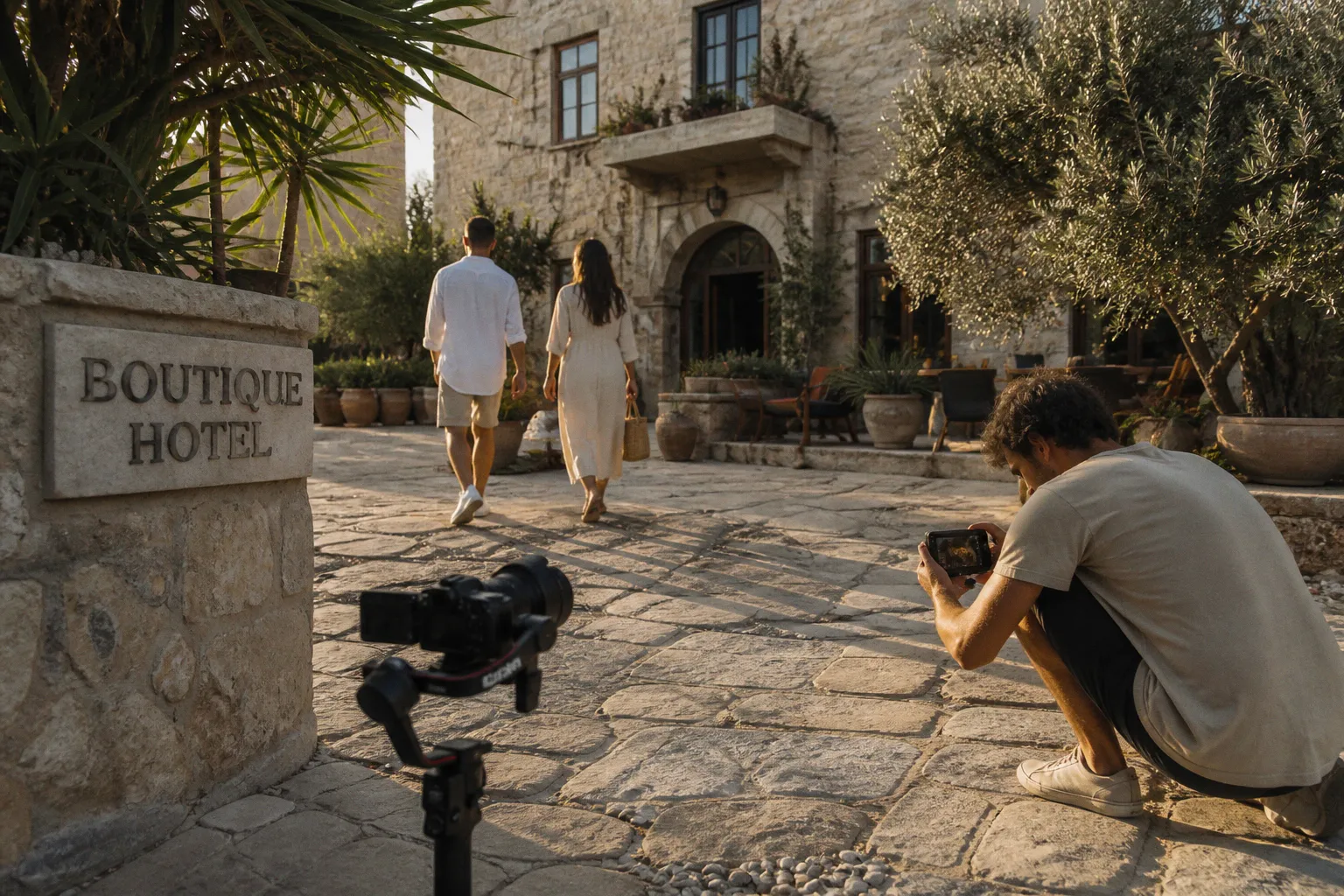
What I've seen across a decade of brand work, and what a recent Logan County case study confirms with hard numbers, is that video carries the heaviest load in destination marketing — but only when you stop trying to say everything in a single piece.
A small tourism bureau, a measurable lesson
According to a case study published by OOT Box Media, the Logan County Tourism Bureau ran a three-month digital campaign built around Midwestern road-trippers, and the returns reveal a pattern hoteliers can borrow directly. The work generated nearly 2 million impressions, reached almost 600,000 people, earned more than 362,000 video views, and drove 9,919 link clicks resulting in 5,529 confirmed website visits.
The numbers matter less as headline stats than as a structural lesson — they were earned by splitting the work. Rather than one bloated piece trying to feature every town and attraction, the team created three distinct layers: a primary awareness video introducing Logan County as an approachable Midwest drive (the campaign's top-of-funnel piece, generating more than 470,000 impressions on its own), town-specific Reels that leaned into local stories — Atlanta and its Route 66 nostalgia, Middletown and its Lincoln-era history, Elkhart and one of the highest points in Illinois rising unexpectedly from the prairie — and traffic-focused ads aimed at travelers ready to plan their route.
Why your hotel website isn't converting
The pattern I see with boutique hotels is uncomfortably similar. Independent properties pile every suite type, every amenity, every dining option into one hero video, and end up with a piece that feels like a brochure — flat, forgettable, and impossible to act on. Meanwhile, the single most measurable format keeps being video: in the Logan County work, four of the five top-performing ads used video, with town-specific Reels driving the strongest engagement. The Atlanta Reel alone pulled 7,952 link clicks and 5,527 confirmed website visits.
The deepest lesson, though, isn't reach — it's specificity. Atlanta sold nostalgia. Middletown sold heritage. Elkhart sold a geographic quirk. Each story stayed short enough to feel like a tip from a friend, not an advertisement — exactly the sense of place a guest journey needs at the inspiration stage. Generic framing such as "there's something for everyone" is what flattens most destination content; local quirks and human-scale history are what give viewers a reason to keep watching.
What to watch — and what to try this quarter
Two related signals are quietly reinforcing the pattern. A Business Wire release announced that National CineMedia will acquire Captivate for $275 million, positioning the combined entity as the leading premium video and digital out-of-home advertising platform. Around the same time, an OpenPR brief surfaced around Mumbai-based video production companies billing themselves as the next generation of digital advertising capacity. Read together, the takeaway for independent hotels is straightforward: the production and distribution rails for cinematic, on-brand video are getting cheaper and more specialized — but the storytelling bar keeps rising in lockstep.
The practical next step is harder than picking a vendor. Choose one guest persona, one moment of truth on-property, and let a short vertical Reel carry that single story — then build a lighter awareness layer above it. In my consulting work, that single discipline is where the visual narrative finally stops reading like inventory and starts behaving like a booking engine.