Hotel Video Email Campaigns: A Five-Step Launch Roadmap
Hotel email campaigns that use video can increase click-through rates by up to 65%. That figure is useful only when the technical implementation is correct.
A broken thumbnail, an irrelevant landing page, or a generic audience segment can erase the gain before the recipient reaches the booking engine.
The core problem is simple. Most major email clients, including Gmail, Outlook, and Yahoo, do not reliably support native HTML5 video playback inside the inbox. A hotel cannot treat an email like a web page. The campaign needs a fallback architecture: static image or animated GIF, visible play button, and a landing page designed to continue the same conversion path.
That is the working definition of hotel email marketing video integration. The video is not the product. It is the click trigger.
Step 1: Define the booking action before producing the video
A hotel video newsletter often fails before production begins. The team starts with a property walkthrough, a room tour, or a seasonal montage. The email then has no measurable job beyond generating views.
That is not a strategy. It is an asset with a tracking problem.
A campaign needs one primary conversion objective:
- Direct booking for a specific stay period.
- Room upgrade before arrival.
- Package purchase, such as spa, dining, or late checkout.
- Repeat booking from previous guests.
- Lead capture for a resort event or wedding inquiry.
- Re-engagement of subscribers who have stopped opening campaigns.
The video format follows the action. A 30-second room walkthrough may support a booking campaign. It is less suitable for a post-stay email promoting a loyalty offer. A dining video may generate interest, but it should not send the recipient to a generic homepage. The destination needs to match the promise made in the email.
Use a single primary call to action. Multiple buttons create measurement noise and dilute the heatmap. If the campaign sells a weekend package, the thumbnail, subject line, copy, and landing page should all support that package.
The first measurement layer should include:
- Delivery rate.
- Open rate.
- Click-through rate.
- Click-to-open rate.
- Landing-page engagement.
- Booking-engine starts.
- Completed bookings.
- Revenue retained after distribution costs.
- Unsubscribe and spam-complaint rates.
The most useful diagnostic distinction is between open rate and click-through rate. A strong open rate with weak clicks points to a content or layout failure. Weak opens with strong clicks usually indicate a subject-line or list-segmentation problem. High clicks with low bookings points to landing-page friction, pricing mismatch, availability, or booking-engine failure.
The video does not increase bookings by existing. It increases the probability of a qualified click. The landing page must complete the conversion.
Match the visual asset to the commercial objective
A hotel should not produce one general-purpose video and distribute it across every audience. The footage may be reusable. The edit should not be.
| Campaign objective | Video focus | Landing-page destination | Primary metric |
|---|---|---|---|
| Direct room booking | Room layout, bed configuration, bathroom, view, rate context | Room or package booking page | Completed bookings |
| Seasonal package | Included benefits, timing, property access, dining or spa components | Package-specific landing page | Package revenue |
| Pre-arrival upsell | Room upgrade, breakfast, transfer, treatment, late checkout | Guest upsell portal | Revenue per reservation |
| Repeat guest campaign | Recognizable property details, loyalty benefits, new rooms or services | Member or return-guest offer | Repeat booking rate |
| Event promotion | Meeting spaces, capacity, flow, accommodation, catering | Event inquiry form | Qualified leads |
The footage should be edited for the inbox, not for a cinematic portfolio. The first frame must communicate the property or offer without relying on audio. Many recipients will see the message on mobile, with images partially loaded or muted video unavailable.
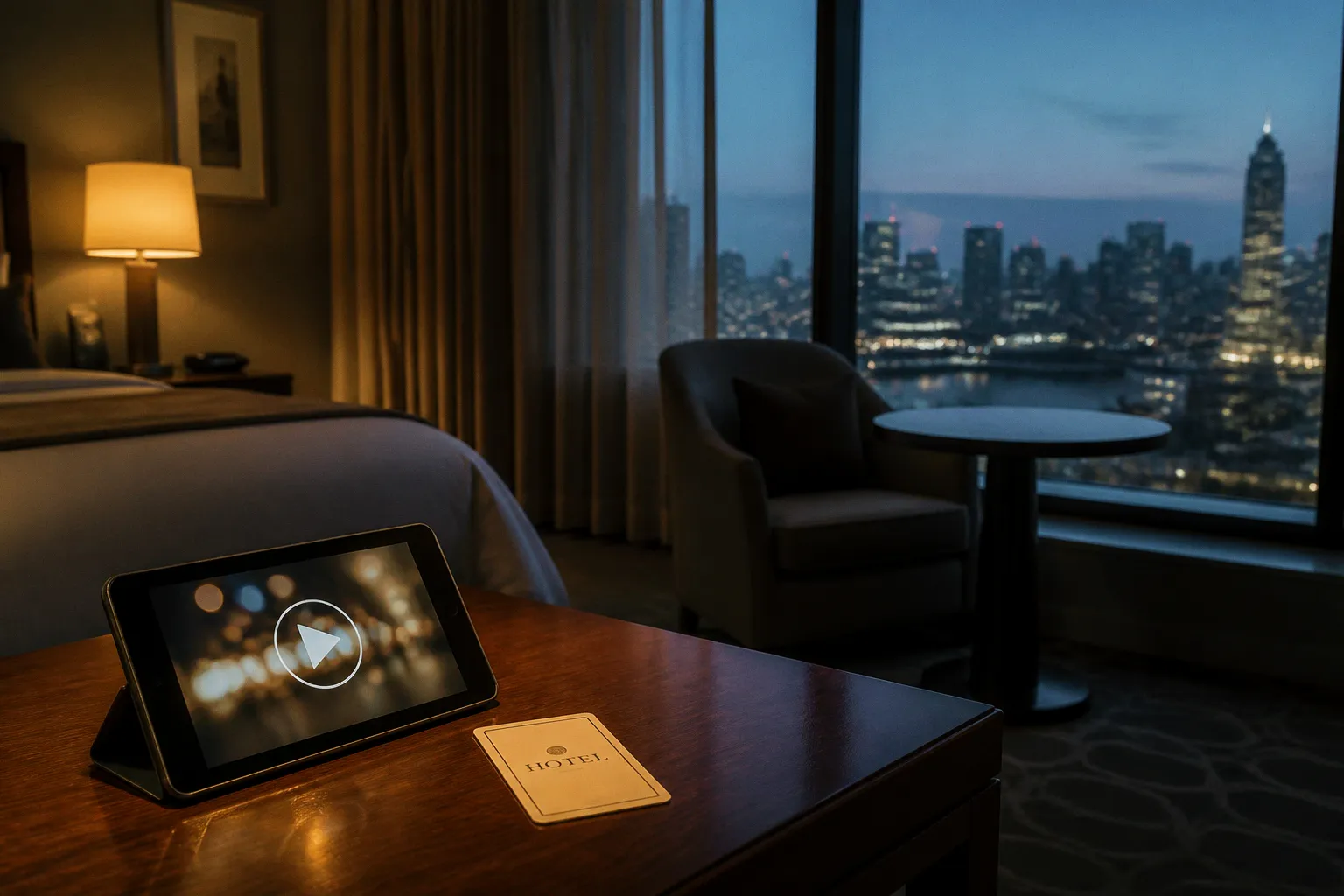
Use a thumbnail that resembles a video player. Add a clear play icon. Keep text overlays short. Avoid placing the main promise near the edges, where mobile crops can remove it.
Step 2: Build the email around a reliable fallback
Native video playback inside email is not a dependable baseline. The safe implementation is a clickable static thumbnail linked to a landing page. An animated GIF can show motion, but it should be treated as a preview, not as a substitute for the full video experience.
The email structure should be deliberately narrow:
1. Subject line with a specific promise.
2. Preheader that adds context rather than repeating the subject.
3. Hero thumbnail with a play button.
4. One short paragraph connecting the video to the offer.
5. One primary call to action.
6. Supporting details such as dates, inclusions, or restrictions.
7. Secondary navigation only if required by the broader email template.
Do not place the entire offer inside the image. Image blocking, accessibility settings, and slow mobile connections can remove the content. The recipient should understand the offer from live text even if the thumbnail fails to load.
The image needs descriptive alt text. A useful alt description identifies the property and the action. It should not be a keyword list. The goal is functional recovery when the image is unavailable.
The thumbnail also needs technical control:
- Use a compressed image that remains sharp on high-density mobile screens.
- Preserve the play button at a readable size.
- Keep the focal subject inside the central crop-safe area.
- Test both portrait and landscape mobile previews.
- Avoid fine architectural details that disappear at email width.
- Use a filename and alt text that support internal asset management.
- Add tracking parameters to the thumbnail link and every relevant button.
The button should not say only “Watch video.” That describes the media, not the commercial action. A booking campaign needs a booking-oriented label. A pre-arrival campaign needs an upgrade-oriented label. The difference affects intent and post-click expectations.
The first frame is a conversion component
The first frame has a separate job from the video itself. It must survive three conditions:
- The recipient has images disabled.
- The recipient sees the email on a small screen.
- The recipient scans the message without reading the body copy.
For a room campaign, the first frame should establish scale and configuration. A wide-angle shot can show more of the room, but excessive focal length creates spatial distortion. The bed may appear oversized. The room can look larger than it is. That creates a post-click expectation gap.
Use a focal length that documents the space rather than exaggerates it. Keep vertical lines controlled. Architectural distortion is not merely a photographic defect. It is a trust problem. If the image suggests a room that does not match the guest’s arrival experience, the campaign may produce a click and still damage conversion quality.
Dynamic range also matters. Hotel interiors often contain bright windows and dark furniture. If the window is clipped, the view disappears. If the room is underexposed, the interior loses usable detail. The thumbnail should retain both. A high-contrast image may attract attention in a portfolio, but it performs poorly when the visual proof is the room itself.
Step 3: Segment the audience before sending
A hotel database is not one audience. It is a collection of purchase histories, trip purposes, rate sensitivities, geographic markets, and engagement states.
Broad batch sends create weak relevance. Segmented hotel email campaigns sent to targeted lists of fewer than 5,000 contacts can achieve open rates above 42%, while broad sends may remain below 30%. The difference is not produced by video alone. It comes from matching the message to the recipient.
Useful segments include:
- Previous guests who stayed for leisure.
- Previous guests who booked business travel.
- Guests from a specific origin market.
- Subscribers who viewed rooms but did not book.
- Guests with an upcoming reservation.
- Guests who purchased spa, dining, or transfer services.
- Loyalty members with a defined booking history.
- Subscribers who opened recent emails but did not click.
- Dormant contacts requiring a re-engagement sequence.
Each segment needs a different edit or at least a different opening frame and message. A business traveler does not need the same visual sequence as a family booking a school-holiday stay. A previous spa customer should not receive a generic property tour when the commercial opportunity is an upgrade or treatment package.
Segmentation should also control frequency. A subscriber who received a pre-arrival email should not receive a conflicting acquisition offer during the same decision window. Frequency pressure increases friction. It also makes attribution less reliable because multiple campaigns compete for the same booking.
Subject lines are part of the video strategy
Adding the word “video” to an email subject line can increase open rates by approximately 6%. That does not mean every subject line should use the word. The term is useful when the video itself contains the value. It is weak when it acts as decoration.
A subject line should identify one of three things:
- The visual content: a new room or property walkthrough.
- The commercial benefit: a package with defined inclusions.
- The timing: a seasonal offer or pre-arrival upgrade.
Avoid vague language. “See what your stay could look like” carries less information than a direct statement about the room, package, or date range. The subject line should also align with the thumbnail. If the subject promises a suite and the image shows the pool, the email creates an information gap before the click.
Run a split-test on one variable at a time. Subject line, thumbnail, button copy, and offer structure should not all change in one test. If they do, the result cannot isolate the cause.
A basic test matrix can compare:
| Test variable | Version A | Version B | Readout |
|---|---|---|---|
| Subject line | Property or offer named directly | “Video” included in the subject | Open rate and click-to-open rate |
| Thumbnail | Room-wide frame | Detail frame with visible benefit | Click-through rate |
| CTA | Watch the room tour | Check availability | Booking-engine starts |
| Landing page | Generic rooms page | Offer-specific page | Booking conversion and bounce rate |
| Audience | Broad leisure list | Recent leisure guests | Revenue per recipient |
Do not declare a winner from opens alone. A subject line can produce more opens and fewer bookings if it attracts low-intent curiosity. The final decision should use qualified clicks, booking-engine starts, completed bookings, and revenue.
Step 4: Send the click to a page built for continuation
The landing page is where most video email campaigns lose their conversion advantage. The email creates visual interest. The page then replaces the video with a generic navigation menu, a slow booking engine, or a property page with no reference to the original offer.
That introduces friction at the exact point where intent is highest.
The landing page should preserve continuity:
- Repeat the same room, package, or service shown in the thumbnail.
- Place the full video near the top of the page.
- Keep the main booking action visible without excessive scrolling.
- Display dates, inclusions, restrictions, and price context clearly.
- Use a mobile-first layout.
- Remove unnecessary navigation if the page has a single commercial purpose.
- Ensure the booking engine retains the campaign parameters.
- Confirm that the page works when the video is paused, muted, or unavailable.
- Track video starts, completion points, CTA clicks, and booking-engine transitions.
The page should load faster than the recipient can lose interest. Large hero videos, uncompressed stills, third-party scripts, and multiple tracking tags increase load time. A hotel can have a technically beautiful landing page with a poor bounce rate because the first interaction is delayed.
A useful audit separates media performance from page performance:
- Thumbnail impression to click measures email creative.
- Landing-page view to video start measures page usability.
- Video start to CTA click measures content relevance.
- CTA click to booking-engine start measures offer continuity.
- Booking-engine start to completion measures checkout friction.
This prevents the common error of blaming the video for a booking-engine problem.
Video length and information density
The email does not need to host the full property film. The click should lead to a version designed for the decision stage.
A room video should answer practical spatial questions:
- How is the room configured?
- Where are the bed, desk, bathroom, and storage areas?
- What is visible from the window?
- Is the path through the room clear?
- Which features are included in the advertised rate?
A resort video should establish the relationship between key facilities. Show the route from arrival to room, dining, pool, spa, or beach access if distance affects the stay. A sequence of disconnected visuals may look polished but provide weak planning information.
For hotel video marketing, spatial accuracy has commercial value. Guests use images to model the experience before purchase. The more expensive or complex the stay, the more damaging a mismatch becomes.
Do not use aggressive camera movement to manufacture energy. Fast pans and wide-angle transitions reduce spatial legibility. The viewer needs to understand the property. A stable camera, controlled exposure, and consistent color are more useful than motion for its own sake.
Step 5: Automate, measure, and route the next message
A one-off newsletter is only the first layer. The strongest hospitality email marketing video strategy connects video behavior to the next message.
Automation can route contacts based on actions:
- Opened but did not click: resend with a different subject line or thumbnail.
- Clicked but did not book: send a follow-up with availability, package detail, or a clearer booking CTA.
- Watched the video but abandoned the page: reduce page friction and retarget with the same offer.
- Started booking but did not complete: use an appropriate abandonment sequence within the hotel’s consent and frequency rules.
- Booked after viewing: suppress acquisition messages and move the guest into the pre-arrival flow.
- Watched an upsell video but did not purchase: send a concise reminder tied to the reservation date.
- Ignored several campaigns: reduce frequency or move the contact into re-engagement.
Automation should not treat every click as equal. A thumbnail click is a weaker signal than a video completion followed by a booking-engine start. Behavioral scoring needs to reflect that difference.
The campaign dashboard should report revenue, not only engagement. Direct website bookings retain approximately 94.87% of revenue, compared with about 82.06% for OTA bookings, where commissions commonly range from 15% to 25%. This changes the ROI calculation. A campaign that moves a guest from an OTA path to a direct booking can generate value even when the email conversion rate looks modest.
Email marketing in hospitality is also associated with an average ROI of $36 for every $1 spent. Treat that as a benchmark, not a guarantee. The result depends on list quality, deliverability, segmentation, offer economics, landing-page performance, and booking attribution.
Attribution needs a fixed window and a clear hierarchy. A guest may open an email, search the hotel separately, return through a branded search, and book on the website. If the reporting model credits only the final session, the email appears ineffective. If it credits every touch equally, the result becomes inflated.
Use a consistent reporting model across campaigns. At minimum, separate:
- Assisted revenue.
- Last-click revenue.
- Direct revenue.
- OTA displacement, where measurable.
- Revenue per delivered email.
- Revenue per engaged recipient.
- Cost per booking.
- Net revenue after discounts and campaign production.
A high click-through rate is not proof of a successful hotel email campaign. It is proof that the email created enough interest to earn the next interaction.
Technical production standards for hotel video newsletters
The production workflow should be designed around the distribution environment. A property may have excellent footage and still produce a weak campaign if the file, crop, or edit is wrong for the inbox.
Use separate deliverables for separate placements:
- Email thumbnail in a wide crop for desktop templates.
- Mobile-safe version with the subject positioned centrally.
- Short animated preview only when file weight and client support are acceptable.
- Full video hosted on the campaign landing page.
- Silent version with captions or on-screen text for muted playback.
- Vertical cut for mobile landing pages and social retargeting.
- Still frames for fallback, accessibility, and performance recovery.
The image should preserve the architectural facts that influence booking decisions. Keep room edges visible. Avoid extreme lens correction that bends furniture or doorways. Maintain consistent white balance between shots. A guest comparing two rooms should not interpret a color shift as a difference in finish or lighting.
Captioning is not optional for a mute-first environment. Audio may add context, but the visual sequence and on-screen text must carry the commercial message independently.
Email code also needs a client matrix test. Check at least:
- Gmail desktop and mobile.
- Outlook desktop where applicable.
- Yahoo Mail.
- Apple Mail.
- Dark mode.
- Images disabled.
- Narrow mobile screens.
- High-density displays.
- Screen-reader behavior.
- Click tracking after redirect.
The test is complete only when the recipient can identify the offer and reach the correct destination without native video playback.
Common failure points and their measurable symptoms
A forensic audit usually finds the same failures.
The thumbnail shows a beautiful detail with no spatial information
The click-through rate may be acceptable, but booking-engine starts remain weak. The image creates curiosity without answering a purchase question.
Use a frame that proves the room, package, or service. Detail shots can support the sequence. They should not carry the entire conversion burden.
The email sends traffic to the homepage
This increases bounce rate and forces the recipient to reconstruct the offer. The campaign loses message continuity.
Send traffic to the narrowest relevant page. If the email promotes a suite, use the suite page or a suite-specific booking path. If it promotes a package, preserve the package name, inclusions, and date logic.
The video starts with a logo
Brand recognition is not the first conversion task. The recipient already sees the sender name. The opening frame should establish the product.
Place the logo in the interface or later in the edit. Use the first seconds to show the room, facility, or offer.
The campaign uses one list for every message
The result is uneven engagement, higher unsubscribes, and misleading averages. A strong response from one segment can conceal poor performance elsewhere.
Report by audience, booking intent, property, room type, and campaign objective.
The booking engine breaks the attribution chain
Missing parameters, cross-domain tracking errors, or inconsistent consent handling can make revenue disappear from the report.
Test the path from thumbnail to landing page to booking confirmation. Record the campaign identifier at each stage. Do not rely on the email platform’s click count as a revenue proxy.
A five-step launch sequence
The roadmap is operationally simple when each stage has a defined gate:
1. Set the conversion target. Choose direct booking, upsell, package purchase, or lead capture. Assign one primary CTA and one primary revenue metric.
2. Produce the correct visual. Build a thumbnail and landing-page video that document the product accurately. Control focal length, dynamic range, crop, compression, and captions.
3. Segment the audience. Match the edit, offer, subject line, and send frequency to guest history and intent.
4. Connect the landing page. Preserve the visual promise, remove navigation friction, and track the full path to booking.
5. Automate the follow-up. Route recipients by engagement behavior. Measure qualified clicks, booking starts, completed bookings, net revenue, and OTA displacement.
The final technical check should be completed before scheduling:
- The email works without native video playback.
- The thumbnail has a visible play button and functional alt text.
- The first frame survives mobile cropping.
- The landing page matches the email promise.
- The primary CTA is visible above the main scroll threshold.
- The page loads with compressed media.
- Tracking parameters survive every redirect.
- The audience excludes guests who should not receive the message.
- Subject line and thumbnail tests isolate one variable at a time.
- Revenue reporting distinguishes direct bookings from OTA bookings.
- Follow-up automation has suppression rules.
- The campaign has a defined stop condition for poor deliverability or abnormal bounce rate.
Hotel email marketing video integration is not a visual upgrade added to an existing newsletter. It is a conversion system with an image at the front, a landing page in the middle, and a booking measurement layer at the end.
The practical standard is strict. The recipient should understand the offer without audio, reach the correct page without searching, and complete the booking without breaking attribution. If any link in that chain fails, the video becomes decoration. If the chain holds, the asset earns its production cost through measurable direct demand.