Louvre Museum filming permits: official access vs influencer rules
For a destination marketing team, the Louvre can look deceptively easy to film. A phone, a beautiful gallery, a few seconds of the Pyramid, and suddenly the visual narrative seems complete.
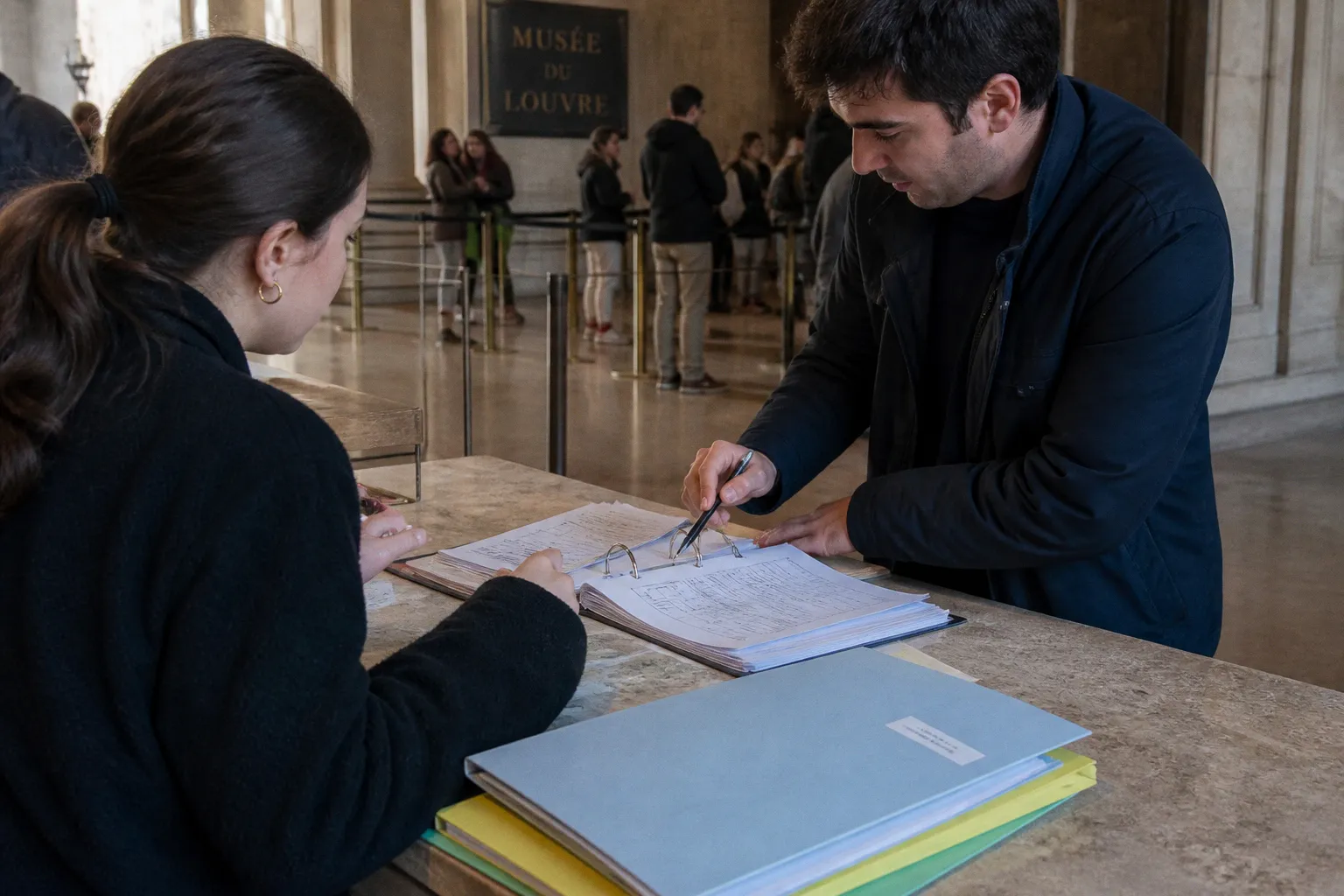
Louvre Museum Filming Permits: Official Access vs. Creator Rules
Then the production plan meets the rules: professional equipment is restricted during public opening hours, tripods and lighting are not permitted for ordinary visitors, and footage created for commercial reuse requires express authorization from the Musée du Louvre.
Compare car rental deals in United Kingdom
See available offersPartner link — DiscoverCars comparisonThat distinction matters far beyond the museum entrance. If you are producing a hotel campaign, a Paris travel guide, a destination video, or branded content for an international tourism audience, the question is not simply whether you can record inside the Louvre. It is whether you have the right to use that recording for the purpose you have in mind.
The practical route depends on where your project sits between casual personal documentation and an official professional shoot. The two may occupy the same visual space, but they do not operate under the same access, equipment, scheduling, or intellectual-property rules.
The legal divide: personal use versus commercial production
The Louvre permits casual visitors to take photos and videos inside the permanent collections for personal use, provided they follow the standard visitor rules. That means no flash, lighting equipment, tripods, or selfie sticks. The equipment must remain unobtrusive, and the activity must not interfere with other visitors or the museum environment.
For a traveler making a private holiday video, this creates a relatively clear boundary. A handheld phone can document the visit. A visitor may capture a painting, a corridor, or the atmosphere of the galleries as part of a personal record.
The boundary becomes less comfortable when that same content is published with a commercial purpose.
A hotel group commissioning a Paris destination film, a tourism board building a campaign, or a creator producing sponsored content is not simply documenting a private visit. The footage forms part of a visual asset with an intended audience, a distribution plan, and often a commercial outcome. In that context, personal-use permission should not be treated as a production license.
This is where many otherwise polished campaigns become operationally fragile. The creative team may have secured talent, transport, insurance, styling, and a distribution calendar, yet the footage itself was made under visitor conditions that never contemplated advertising or commercial reuse.
A phone changes the size of the production package—not the purpose of the footage.
The practical difference between the two routes can be summarized like this:
| Production factor | Casual visitor access | Official professional filming |
|---|---|---|
| Intended use | Personal documentation | Commercial, editorial, branded, or professional production |
| Equipment | Handheld phone or small personal camera without prohibited accessories | Professional equipment considered through the Louvre’s filming process |
| Tripods and lighting | Not permitted under standard visitor rules | May be considered with prior approval and agreed conditions |
| Filming hours | During ordinary visitor access, within visitor regulations | Primarily Tuesdays, when the museum is closed, or during approved off-hours |
| Public commentary | Restricted inside galleries unless delivered by authorized individuals | Must be planned around museum access and authorization conditions |
| Commercial reuse | Not automatically permitted | Requires express authorization from the Musée du Louvre |
| Permit contact | Standard visitor arrangements do not create production access | Requests are handled by the Louvre’s filming department |
The table is not a substitute for a permit decision, but it gives a useful starting point: if the footage is part of a campaign, the project should be planned as professional filming from the beginning.
What counts as a professional filming request?
Professional filming is not defined only by the size of the camera. A lightweight mirrorless body can still be used for commercial production, while a phone can produce content intended for a paid campaign. The context, purpose, crew, equipment, and intended reuse all shape the request.
For destination marketers, that context should be written clearly before anyone contacts the museum. The Louvre’s filming department will need to understand what you are proposing, not simply that you would like to capture a few shots.
A useful request normally needs to make the following elements legible:
- The purpose of the film — for example, a tourism campaign, hotel brand film, editorial travel feature, social content package, or commercial advertisement.
- The locations requested — galleries, exterior courtyards, the Pyramid area, the Carrousel, or the Tuileries Gardens are not interchangeable from an access perspective.
- The production footprint — crew size, camera bodies, lenses, sound equipment, lighting, stands, cases, and any styling or set elements.
- The proposed schedule — including preferred dates, duration, load-in requirements, and whether the project can work during closure or off-hours.
- The final channels — website, paid media, social platforms, in-room hotel screens, broadcast, editorial publication, or other distribution.
- The commercial relationship — the commissioning brand, destination organization, production company, or agency responsible for the project.
- The visual treatment — observational travel content, interview, guided experience, architectural detail, branded storytelling, or a more formal campaign production.
This level of detail helps the museum assess the request in its actual context. It also helps your own team identify conflicts early. A concept that depends on a moving camera, spoken commentary, a large lighting package, or several hours in a specific gallery may not translate smoothly into a public-opening-hours plan.
Requests for public filming and permit management for the Louvre and the Tuileries National Estate are handled directly through the museum’s dedicated contact, [email protected]. That is distinct from the general Paris Film municipal process. A Paris filming route does not automatically cover filming inside the Louvre Museum or the Tuileries Garden.
Why a creative brief is part of the permit strategy
In hospitality marketing, the most effective destination films are rarely just collections of landmarks. They connect a place to a guest journey: arrival, discovery, texture, pace, and the feeling of knowing where to go next. That makes the brief particularly important when filming in a highly regulated landmark.
The museum needs to see the operational plan, but your team also needs to protect the visual narrative. If the entire concept relies on intimate gallery movement, elaborate lighting, or a presenter addressing the audience among the collections, those dependencies should be identified before the creative is sold internally.
A strong brief can also separate essential shots from optional ones:
1. Essential location footage — the images without which the campaign loses its sense of place.
2. Atmosphere and transition footage — exterior details, courtyards, approaches, architectural rhythm, and visitor movement.
3. Editorial or educational elements — commentary, interviews, or guided explanation that may require additional authorization.
4. Brand-specific moments — talent interaction, hospitality positioning, or product placement that may change the character of the shoot.
5. Fallback material — nearby estate locations or exterior sequences that preserve the campaign’s Paris context if gallery access is limited.
That hierarchy is not bureaucracy for its own sake. It allows the project to remain coherent when the museum approves only part of the original concept.
The Louvre’s filming department and the Tuesday reality
For official filming inside the museum, Tuesdays are the central scheduling point. The Louvre is closed to the public on Tuesdays, and professional shoots inside the galleries take place primarily on that day or during other approved off-hours.
This has immediate consequences for destination campaigns. A production built around a Saturday check-in, a Sunday event, or a hotel guest itinerary cannot assume that the museum will be available for a controlled shoot simply because the location is open to visitors. Public access and professional filming access follow different calendars.
Tuesday filming can be operationally attractive. The crew has a better chance of working without the visual noise and movement of normal visitor traffic, and the museum can assess equipment, staging, and crew circulation in a more controlled environment. At the same time, a Tuesday shoot may affect travel schedules, talent availability, accommodation costs, and the timing of other Paris locations.
I recommend treating the museum date as an anchor rather than a final detail. Once that date is known, build the rest of the production around it:
- Place controlled interior scenes on the approved closure or off-hours schedule.
- Schedule public-facing Paris material separately, without assuming the same permit covers it.
- Allow time for equipment movement, security procedures, and any location-specific briefing.
- Keep the crew compact unless the museum has approved a larger footprint.
- Avoid promising a particular gallery, angle, or access route before receiving written confirmation.
- Plan exterior sequences as a separate operational category, especially where the request includes the Carrousel or Tuileries Gardens.
The difference between a smooth shoot and an expensive reschedule often comes down to whether the production team has treated access as part of the creative plan rather than as a formality after the storyboard is finished.
Gear, security, and the constraints that change the shot list
The Louvre’s standard visitor rules are designed around the experience of moving through a busy museum, not around professional content production. That distinction affects everything from camera support to the size of the kit.
For casual visitors, flash, lighting equipment, tripods, and selfie sticks are not permitted. A phone or small handheld camera may be appropriate for personal documentation, but that does not create the conditions required for controlled commercial imagery. Even a compact production package can become problematic if it includes support equipment, multiple cases, or accessories that disrupt circulation.
Security also places a clear limit on what can be brought into the museum. Equipment and luggage larger than 55 × 35 × 20 cm are not permitted inside under France’s national Vigipirate security protocol. For a professional crew, that measurement should be treated as a planning constraint well before the day of filming.
It affects the kit in practical ways:
- Large rolling cases may not be suitable for interior access.
- Camera support needs to be discussed rather than assumed.
- Lighting plans should not be designed around visitor access conditions.
- The crew may need to divide equipment between approved cases and off-site storage.
- A lens, battery, sound, or media-card plan becomes more important when the team cannot freely carry a full package through the museum.
- Production vehicles and load-in arrangements should be considered separately from visitor entry.
The standard visitor entry fee in 2026 is listed as €28 per person, but that is not a filming fee and should not be used as a proxy for the cost of professional access. The Louvre’s tiered pricing schedule for private commercial filming requires direct inquiry to the dedicated filming department.
That distinction is worth placing in every production budget. A normal admission ticket may cover a visit; it does not authorize a commercial crew, a tripod, a lighting setup, or advertising reuse.
Spoken content and presenter-led filming
A presenter walking through the galleries and explaining the collections can be compelling destination content, particularly for travel brands trying to offer more than polished architecture. Inside the Louvre, however, public spoken commentary is restricted to authorized individuals.
The museum identifies permitted categories such as curators, teachers with their classes, and licensed tour guides holding authorization from the French Ministry of Culture or Ministry of Tourism. A brand’s host, influencer, or travel presenter should not be assumed to have the right to address a group or deliver public commentary in the galleries simply because the camera is small.
This does not mean educational or presenter-led content is impossible. It means the format needs to be approved and planned with the museum. In some cases, the more resilient creative choice is to capture silent visual material inside and record commentary elsewhere, using voice-over, a hotel-based introduction, or an exterior sequence to carry the editorial context.
That approach can also improve the final film. The galleries retain their visual atmosphere, while the explanation is recorded in a setting where the presenter, sound team, and brand message can work with greater control.
The estate beyond the galleries: Carrousel and Tuileries Gardens
The Louvre is not one interchangeable filming environment. Interior galleries, exterior courtyards, the Carrousel, and the Tuileries Gardens may sit within the same destination story, but they bring different operational considerations.
Filming in the Carrousel and Tuileries Gardens under the Louvre’s estate is permitted from Monday to Friday with proper approval. This can create useful flexibility for a destination marketing team. If the central concept needs Parisian movement, garden transitions, architectural context, or a sense of arrival before entering the museum, these areas may provide a stronger scheduling option than the galleries.
They can also give the campaign breathing room.
A destination film does not need to make every location carry the same narrative weight. The museum interiors can communicate cultural depth and visual prestige. The gardens can establish orientation, seasonality, walking distance, and the relationship between the landmark and the wider city. The Carrousel can help bridge architectural detail and the guest journey from hotel to attraction.
The key is to avoid treating estate-wide access as automatic. Proper approval remains necessary, and filming in the gardens is not covered by a general Paris municipal filming permit. Public authorities and the Louvre’s estate administration are separate parts of the access picture.
For a campaign with several Paris locations, build a permit map rather than a single line item:
| Location or activity | Planning question |
|---|---|
| Louvre galleries | Is the project approved for professional filming, and on which closure or off-hours date? |
| Exterior courtyards | Does the requested area fall under the Louvre’s filming administration? |
| Carrousel | Has the estate approved the proposed day, equipment, and crew activity? |
| Tuileries Gardens | Is the request scheduled Monday to Friday with the required approval? |
| Public streets and other Paris locations | Does the location require a separate municipal or local process? |
| Drone work | Is the concept dependent on aerial footage that is not legally available under standard conditions? |
This prevents a common production error: assuming that approval for one recognizable part of the Louvre estate automatically extends to every nearby space.
The drone question
Aerial footage is often proposed early in destination marketing because it provides immediate scale. The Pyramid, the Seine, the gardens, and the surrounding city can appear to belong to one connected visual system. Around the Louvre and Paris, however, standard commercial creators should not plan on drone access.
Flying drones over the Louvre area or Paris generally is strictly forbidden by French aviation authorities without rare, high-level aerial permits. A drone shot should therefore not sit in the “we will decide on the day” category of a production plan. It needs a separate legal and operational path, and for most campaigns the sensible answer is to develop a ground-based alternative.
That alternative may be more aligned with the guest journey anyway. A low, steady approach through the gardens, a controlled architectural detail, or a movement from street level toward the Pyramid can give the viewer context without relying on an aerial device. The result may feel less like a generic tourism reel and more like an invitation to understand how the destination is actually experienced.
Commercial reuse, copyright, and the cost of getting it wrong
The most serious misunderstanding is often not about the camera. It is about what happens after the footage is published.
Commercial or advertising reuse of museum footage or content without express authorization from the Musée du Louvre is strictly prohibited under the French Intellectual Property Code. That means a clip recorded during a personal visit should not be treated as a ready-made asset for a hotel advertisement, paid social campaign, booking funnel, branded travel guide, or tourism board promotion.
The same caution applies to influencer work. A creator may be filming with a handheld smartphone, but if the content is sponsored, monetized, or reused by a brand, the commercial purpose can change the permissions question. A small device does not make the use personal.
This is particularly relevant when destination content is created in stages. A creator might publish an apparently casual visit video, then later license parts of it to a hotel group or include it in a paid campaign. The original capture conditions and the later commercial use should not be collapsed into one assumption.
Before production begins, define the rights conversation in writing:
- Who is commissioning the footage?
- Where will it appear?
- Will the museum be shown in paid advertising?
- Will the content remain editorial, or will it support bookings and sales?
- Can the brand crop, cut, subtitle, translate, or boost the material?
- Is the footage being delivered to a hotel, tourism board, agency, or media publisher?
- Does the approved filming purpose match the final distribution plan?
This is where alignment matters. The creative treatment, the permit request, the contracts, and the media plan should describe the same project. If the permit is requested for editorial filming but the final asset is used as advertising, the campaign may have a permissions gap even if the images themselves are beautiful.
The permit is not only permission to enter with a camera; it is part of the chain of rights behind the finished story.
Choosing the right route for a destination campaign
The simplest way to approach Louvre museum filming permits for professional creators is to begin with intent rather than equipment.
If you are visiting privately and recording a personal memory, standard visitor rules may be the relevant framework. If you are making content for a hospitality brand, tourism organization, commercial publisher, or sponsored creator campaign, treat the project as professional from the outset and contact the Louvre’s filming department.
A practical decision path looks like this:
1. Define the final use before planning the shots.
A hotel campaign, destination advertisement, paid social series, and personal travel diary may all feature the same landmark, but they do not carry the same permissions needs.
2. Separate the museum from the surrounding estate.
Galleries, courtyards, Carrousel spaces, and Tuileries Gardens should be listed individually in the location plan.
3. Build a realistic equipment schedule.
Start with the smallest kit that can deliver the visual narrative, then ask for approval for anything beyond ordinary visitor equipment. Keep the 55 × 35 × 20 cm security limitation in view.
4. Write the filming request around the actual production.
Include purpose, crew, equipment, dates, locations, distribution, and any presenter or spoken-commentary element. Send the request to [email protected].
5. Anchor the schedule around approved access.
Professional interior shoots take place primarily on Tuesdays or during approved off-hours. Do not build the campaign around ordinary public opening hours and hope to convert it later.
6. Create a fallback visual narrative.
Exterior courtyards, approved garden locations, hotel interiors, and Paris street sequences can preserve the sense of place if gallery access, equipment, or commentary permissions are narrower than expected.
7. Keep commercial reuse visible in every handoff.
The producer, creator, agency, hotel, and media buyer should all understand what use has been authorized and what has not.
For hospitality marketers, this process is not about making the content cautious or generic. It is about protecting the guest journey from a weak beginning. When a viewer sees the Louvre in a hotel campaign, the image should do more than signal Paris. It should support the brand’s sense of place, promise a credible experience, and survive the practical scrutiny that comes with professional distribution.
The before-and-after of a well-planned shoot
The difference between an improvised landmark visit and an approved production is rarely visible in the first creative meeting. Both may begin with the same ambition: show Paris through a culturally significant place and connect that experience to a stay.
Before the access plan is resolved, the concept often carries hidden assumptions. The team expects to use a tripod, record a host in the galleries, bring a full lighting kit, film on a weekend, and repurpose the footage across paid channels. Each assumption may look small. Together, they describe a production that does not fit standard visitor access.
After the plan is aligned, the creative becomes more precise. The museum interiors are scheduled for the appropriate access window. The equipment list is reduced or formally submitted. Commentary is moved to an authorized context. Garden and exterior material are planned separately. The media plan reflects the rights actually secured.
The final film may contain fewer kinds of shots, but the visual narrative is stronger because each sequence has a clear role. The museum is not being used as decorative wallpaper. It becomes part of a carefully considered destination story—one that understands the difference between seeing a place, filming a place, and commercially using what has been filmed.
Final perspective
The Louvre can be a powerful anchor for destination marketing, but it rewards discipline. Casual visitor access is not a quiet version of a professional permit, and a smartphone is not a universal answer to commercial filming restrictions.
For creators and hospitality brands, the safest route is also the most strategically useful: define the intended use, contact the museum’s dedicated filming department, separate interior access from estate locations, plan around Tuesday closure or approved off-hours, and make commercial reuse part of the first conversation—not an afterthought once the edit is complete.
That is how a landmark becomes more than a recognizable backdrop. It becomes a credible part of the guest journey, with the access, context, and alignment needed to carry the campaign all the way to the viewer’s decision to travel.