Pre-production checklist for hotel video campaigns
A hotel video shoot rarely goes wrong because the camera operator forgot how to use a camera.
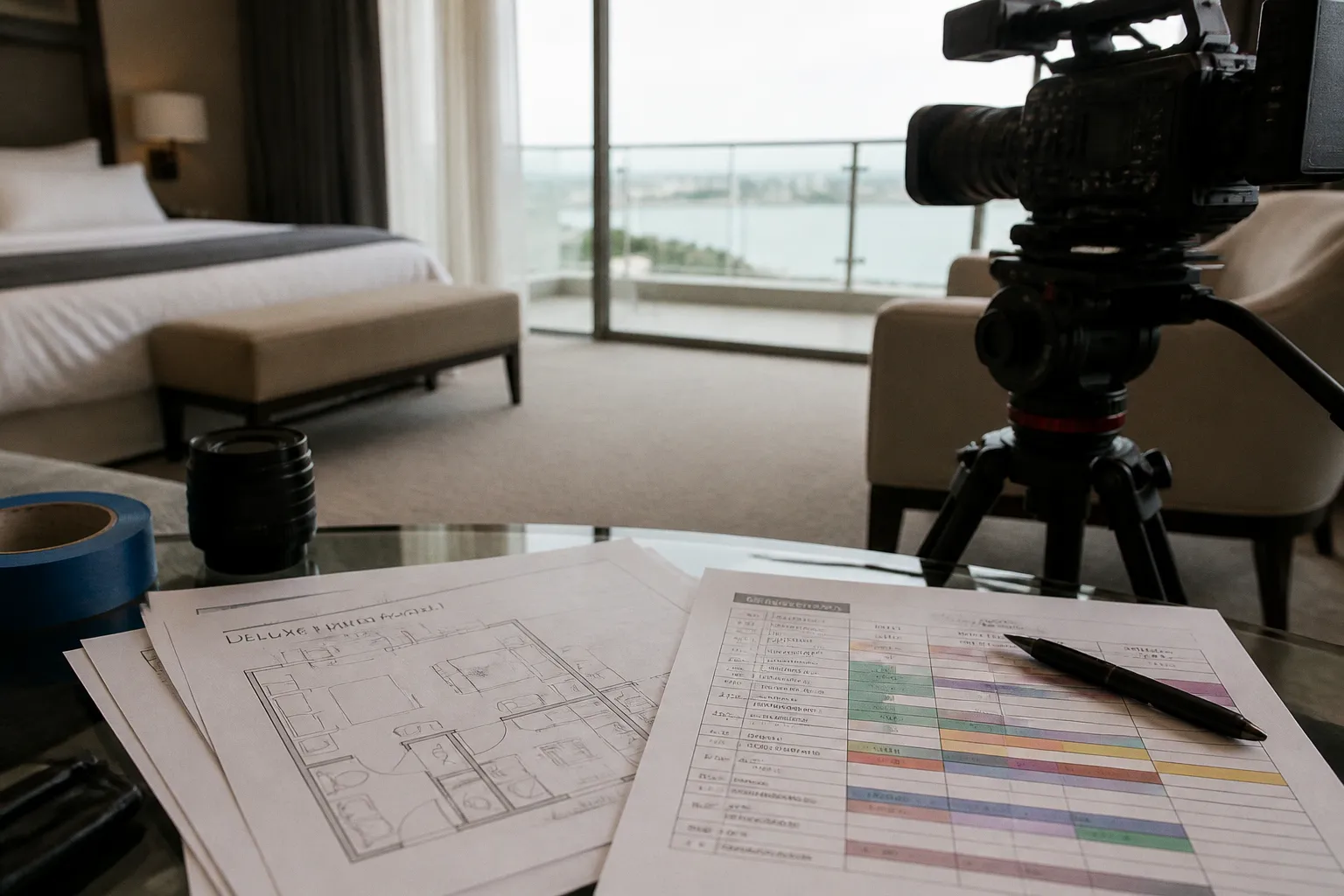
It goes wrong because the suite is still being turned over, the restaurant is at full service, the elevator is making noise, the permit has not cleared, or nobody decided which version of the property the film is supposed to sell.
That is the uncomfortable part of hospitality production: the creative brief is only one layer of the job. A hotel remains a working business while the crew is inside it. Guests arrive, rooms turn over, kitchens run, maintenance teams respond to faults, and revenue managers still need the property to perform. Your hotel video shoot preparation checklist has to account for all of that before the first frame is captured.
Pre-production is not paperwork. It is where the video either earns its budget or burns it.
This is the working document I would put in front of a hotel or resort team before booking the shoot day. Not a presentation to file in a shared drive. A practical plan for turning a live property into a controlled filming environment without making it feel staged, closed, or disconnected from the guest experience.
The pre-production myth that keeps costing hotels money
The most damaging assumption in hotel video marketing is that pre-production is creative overhead: the slide deck, the recce, the meetings, the shot list, and the calls that happen before the visibly exciting part begins.
That assumption gets the order backwards. Pre-production is where the creative work becomes possible.
The production day is an expensive place to discover that the main suite faces the wrong direction for the planned light, that the pool cannot be filmed during the intended window, or that the restaurant’s background music is routed through every speaker in the building. A camera crew can solve some of those problems. It cannot solve them cheaply, and it cannot always solve them without compromising the final film.
When pre-production is compressed, the same failures appear repeatedly:
1. The schedule runs beyond the booked hours. Natural light windows, room resets, guest traffic, and location moves take longer than the draft call sheet suggests.
2. Operational teams are asked to improvise. Housekeeping, engineering, food and beverage, spa, and front office teams discover the production requirements when they are already under pressure.
3. The shot list becomes aspirational rather than achievable. The campaign promises a complete view of the property, but the crew captures only the areas that were easiest to access.
4. Post-production turns into damage control. Editors stretch generic b-roll, hide continuity problems, and try to build a coherent story from disconnected footage.
5. The property looks less polished than it is. A visible cable, inconsistent lamp color, half-cleared service trolley, or poorly timed guest movement can undermine an otherwise strong location.
The answer is not automatically a bigger crew or more equipment. The answer is to treat the weeks before the shoot as production time. Put the recce on the calendar. Assign an owner to every department-dependent task. Set deadlines for approvals, access, insurance, styling, and guest-facing communication.
A useful planning rule is simple: if a decision affects what the crew can film, when it can film it, or how the space must look, that decision belongs in pre-production.
How a hotel video campaign actually works
A hospitality campaign usually moves through four connected phases. They overlap, but they do not have the same job.
| Phase | Main purpose | Decisions and deliverables |
|---|---|---|
| Pre-production | Turn the brief into an achievable shoot | Creative direction, audience, locations, recce, schedule, shot list, crew, talent, styling, permits, insurance, department coordination |
| Production | Capture the planned material safely and efficiently | Camera and sound, lighting, direction, room resets, guest management, continuity, data backup |
| Post-production | Shape the footage into a usable campaign | Edit, color, sound, music licensing, captions, aspect ratios, cut-downs, still-frame selections |
| Distribution | Put the right version in front of the right audience | Website placement, social edits, paid media, booking-path use, scheduling, reporting and optimization |
Pre-production is often the largest phase on a well-run project because it contains the decisions that make the shorter production phase possible. The goal is not to predict every second of the shoot. It is to remove avoidable uncertainty.
That distinction matters for hotel teams. A detailed plan should still leave room for useful discoveries on the day: a better angle in the lobby, a spontaneous service moment, or a change in weather that creates a stronger image. What it should not leave unresolved is whether the crew has access to the location, whether the room is ready, or whether the campaign has permission to show the people and spaces in front of the camera.
Start with the campaign job, not the location list
Before building the shot list, define what the film has to do.
A resort brand film may need to sell atmosphere and length of stay. A city hotel may need to communicate location, ease, and a specific type of guest experience. A restaurant-led property may need food, service, and social energy to carry more of the narrative than the bedrooms. A performance campaign may need short, immediate scenes that work without sound.
Those are different briefs, even if they all include a bed, a lobby, a cocktail, and an exterior.
Write down:
- The audience the campaign is meant to attract.
- The booking or brand problem the video should help solve.
- The primary action viewers should take after watching.
- The platforms and placements that matter most.
- The content that must be captured in horizontal, vertical, or square formats.
- The material that needs to work with sound off.
- The scenes that are essential and the scenes that are optional if the schedule tightens.
This is where many hotel video campaign prep sheets become too generic. “Capture the property” is not a creative direction. It produces a collection of attractive rooms with no hierarchy. A stronger brief identifies the feeling and the proof points: a quiet arrival, an efficient business stay, a family-friendly resort rhythm, a particular dining experience, or the relationship between the property and its setting.
The room-ready checklist: what every guest-facing space needs
The room, suite, lobby, restaurant, spa, and pool deck all need a visual inspection before the shoot. The purpose is not to make the property look artificial. It is to remove the operational clutter that guests normally ignore but cameras record with extraordinary commitment.
Do this, not that
| Room or location task | Do this | Not that |
|---|---|---|
| Lighting check | Walk every fixture and confirm that bulbs are working and visually consistent | Assume a replacement bulb will match the others because the packaging looks similar |
| Personal items | Remove staff bottles, clipboards, keys, chargers, paperwork, and stray clothing | Expect the camera team to crop or blur them later |
| Amenities and disposables | Decide which amenities belong in the story and remove the rest from view | Leave wrapped kits, plastic cups, paper doilies, and duplicate packaging in every frame |
| Technology | Hide visible cables, chargers, routers, and setup screens; test televisions before filming | Plan to fix distracting technology in post-production |
| Signage | Remove temporary notices, breakfast slips, door hangers, and internal operational signs | Treat every printed item as part of the guest-facing design |
| Bedding and soft goods | Agree the linen standard, folds, cushions, and approved styling before the shoot | Make the first styling decision while the crew is waiting |
| Service equipment | Move carts, crates, bins, replenishment stock, and cleaning equipment out of the camera path | Put them in an adjacent space without checking whether the shot sees through the doorway |
| Windows and reflective surfaces | Clean glass, mirrors, chrome, and dark screens; check them from the planned camera angle | Clean only the central area and discover fingerprints in a slow push-in |
| Exterior approach | Remove temporary barriers, bins, delivery items, cones, and maintenance notices where possible | Film the arrival sequence before checking what sits at the edge of frame |
The most obvious technical problem is often the least glamorous: inconsistent lighting. Two warm-white bulbs and one cooler replacement in the same room can make the space look unintentional. Mixed color sources from lamps, daylight, televisions, and decorative fixtures create additional work for the camera and post-production team.
Walk the space at the approximate time it will be filmed. Look at the room through the planned camera position, not only from the doorway. A lamp that appears harmless in person may dominate the frame. A reflection that is invisible during a quick inspection may reveal the entire crew once the camera moves.
If the property uses smart-room controls, test the lighting scenes in advance. Confirm who can reset them, how long the system takes to respond, and whether a control panel or voice assistant appears in frame. These details are small until they interrupt a take repeatedly.
Build a styling reference
A reference image for each hero space is more useful than a general instruction to make the room look polished. It gives Housekeeping, the stylist, the property contact, and the director a shared target.
The reference does not need to dictate every cushion. It should establish:
- Which bed or seating arrangement is approved.
- Whether curtains are open, closed, or partly drawn.
- Which amenities or food-and-beverage elements appear.
- How much of the view is visible.
- Whether the space should feel pristine, lived-in, celebratory, or ready for arrival.
- Which items are never to appear in the frame.
Take reference photographs after styling and circulate them to the people responsible for resetting the space. If several rooms are being filmed, label the images clearly. “Suite styling” is not specific enough when several suites have different layouts and standards.
The departmental recce: who needs to be in the room
A pre-shoot walkthrough is not just a creative meeting. It is an operational drill designed to expose every collision between “video is happening” and “the hotel is still open.”
The production team should not be the only group making decisions about access. At minimum, include the people responsible for the spaces, systems, and services the camera will touch.
Housekeeping
Housekeeping controls room readiness, linen standards, cleaning sequences, and the timing of room turns. Their input determines whether a room can be filmed as a static hero space, whether it needs a reset between takes, and how long the room can remain unavailable.
Confirm:
- Which rooms can be taken out of inventory and for how long.
- When deep cleaning and final styling will happen.
- Who signs off the room before the crew enters.
- What happens if a guest request or late checkout affects the schedule.
- How the room will be restored after filming.
A room that is technically blocked but not operationally protected is not actually available. The same applies to a suite reserved for talent: if the status is unclear in the property system, another team may treat it as available for sale or service.
Engineering and maintenance
Engineering knows which elevators are noisy, which HVAC zones cannot be switched off, where power is available, and which areas carry mechanical hum into neighboring spaces.
Bring them into the recce early enough to identify:
- Air-conditioning and refrigeration noise.
- Elevator movements and service windows.
- Generator, pump, laundry, and kitchen sound.
- Power loads and safe cable routes.
- Access restrictions for rooftops, plant rooms, and service corridors.
- Any maintenance work planned for the filming dates.
A refrigerator compressor, extraction fan, or pool system may not sound especially loud during a normal hotel day. On a quiet interview or room tone recording, it can become the dominant sound. The production team can work around some noise, but only if it knows about the source before the schedule is locked.
Food and beverage
Restaurants, bars, breakfast rooms, room service, pool service, and kitchens have their own rhythms. F&B can tell you when the dining room is quiet, when the kitchen is busiest, what can be staged, and which dishes can be prepared repeatedly without disrupting service.
Agree in advance:
- Which dishes are being filmed and who prepares them.
- Whether the food is for a real service, a styled scene, or both.
- How quickly a plate can be replaced between takes.
- Which staff members can appear on camera.
- Whether background service should continue or pause.
- How music, glassware, extraction, and coffee equipment will be managed.
The most attractive food shot is not always the most operationally realistic one. A good hospitality video can be aspirational without showing a dish that the property cannot serve, a bar that does not operate at that time, or a service style that conflicts with the brand.
Other departments
Spa, banquets, front office, concierge, valet, security, and recreation teams may each control a small but important part of the story. They should not be brought in only when a problem appears.
For every department represented on screen, identify:
- The department contact and an on-the-day backup.
- The spaces they control.
- The people approved to appear.
- Any privacy or guest-consent issue.
- The service activity that can be staged.
- The activity that must not be interrupted.
Every department owns a piece of the guest experience. If the camera is going to touch that experience, the department needs enough notice to protect both the scene and the operation.
Talent, guests, and privacy
Hospitality films often depend on people: a couple arriving, a family using the pool, a bartender finishing a drink, or a staff member greeting a guest. Decide early whether those people are paid talent, employees, invited guests, or members of the public who happen to enter the frame.
Do not leave consent to chance.
Create a simple on-camera plan covering:
- Who is appearing and in which scenes.
- Whether releases are required.
- Whether employees have agreed to participate.
- How minors will be handled.
- What happens when an unplanned guest enters the background.
- Whether identifiable guest information, room numbers, documents, screens, or vehicle plates may appear.
- Who can approve a substitution if talent becomes unavailable.
A busy hotel can produce natural-looking background movement, but it also produces privacy risk. The production team should know whether the property prefers to clear a space, use controlled extras, film at quieter times, or accept incidental movement with a defined review process.
The same care applies to staff. A uniform, name badge, computer screen, or department board can reveal more than intended. Check the background, not only the person delivering the action.
Shot lists that work in real properties
A shot list should be specific enough to guide the crew and flexible enough to survive hotel operations. “Lobby b-roll” is not a shot. It does not tell anyone what the viewer should notice or what format the footage needs to support.
A useful entry includes:
- Location.
- Action or visual subject.
- Camera movement or framing.
- Required time of day.
- People, props, or department support.
- Audio requirement.
- Intended use or platform.
- Priority level.
Separate the list into hero, supporting, and optional material. Hero shots carry the campaign and receive protected time. Supporting shots help with transitions, cut-downs, and social edits. Optional material is where the crew can explore if the schedule is ahead.
For example, a resort arrival sequence might include the approach to the entrance, the first greeting, luggage movement, the lobby reveal, and a room transition. Each shot has a different operational need. The entrance may require traffic control; the greeting requires a prepared staff member; the lobby reveal requires a clear sightline; the room transition requires coordinated access.
Plan for every required format
A film that looks excellent in a wide website player may not survive a vertical crop. If social placements matter, plan vertical coverage rather than asking the editor to cut a tall video out of a horizontal frame after the fact.
Mark the required capture for each key scene:
- Horizontal master.
- Vertical composition.
- Close detail for social cut-downs.
- Clean plate or background hold where useful.
- Room for captions and on-screen text.
- A version that communicates without dialogue.
This is especially important for rooms and interiors. A composition with the bed perfectly centered in a horizontal frame may lose the bed, window, and architectural context when cropped. The camera team needs to know the delivery requirements before lighting and blocking are finalized.
The shot list is not a wish list. It is a promise about what the production will deliver, in which format, and at what cost.
Insurance, permits, and the paperwork that gates the shoot
Boutique hotels and independent properties often assume that filming inside their own building requires little formal preparation. The opposite can be true, particularly when the production involves external crew, lighting equipment, drones, vehicles, public areas, or paid talent.
Requirements vary by country, municipality, venue, and contract. Treat the property’s filming policy as an approval process, not an informal conversation.
Get insurance requirements in writing
Ask the venue or ownership group what evidence it needs and when. Depending on the project, this may include public liability coverage, equipment coverage, employer-related documentation, named additional insureds, or separate requirements for drone work and special equipment.
A Certificate of Insurance should be requested early enough for the production company and venue to resolve wording issues. Last-minute insurance requests can cause permit delays or denials. They are not necessarily the only reason an approval fails, but they are an avoidable source of risk when nobody confirms the requirement until the shoot is imminent.
Keep a record of:
- The required coverage and limits.
- The certificate wording.
- Named additional insureds.
- The responsible party for submitting documents.
- The venue’s approval deadline.
- Any activity that requires separate permission.
Check permit lead times
Permit requirements differ significantly between private property, public streets, beaches, parks, rooftops, and transport areas. A hotel may approve filming inside its own rooms while a city authority controls the sidewalk, road, loading zone, or exterior establishing shot.
Confirm:
- Whether a film permit is required.
- Who applies for it.
- Whether a location manager or local film office must be involved.
- Whether parking, traffic control, or public-space use needs separate approval.
- Whether drone operations require additional permissions.
- What happens if weather forces a change of date.
Do not describe the shoot date as locked until the necessary approvals are in hand. A provisional booking is useful for planning, but it is not the same as permission to film.
Read the venue contract
The venue agreement may include restrictions that do not appear in the creative brief: areas that cannot be shown, branding rules, limits on crew movement, noise windows, requirements for guest communication, or approval rights over the final edit.
Treat the contract as a production specification. Confirm who can approve changes on the day and who has authority to make a final call if filming conflicts with hotel operations.
The schedule: build around the property, not the other way around
Hotel schedules are often built as if every location can be filmed whenever the crew reaches it. That is rarely true.
Rooms may depend on checkout and housekeeping. Restaurants may depend on prep and service. Pools may be affected by guest volume and weather. Exteriors depend on daylight, traffic, and noise. Interviews depend on quiet. A compelling schedule connects each shot to the condition it requires.
For every major scene, note:
- The earliest realistic access time.
- The latest useful light.
- The time needed to reset the space.
- Whether guests can remain in the area.
- Whether a department representative must be present.
- Whether sound needs to be controlled.
- The backup location or alternate shot.
- The consequence if the scene is missed.
Avoid building a call sheet that moves the crew through the property in a visually tidy order if that order ignores light and operations. A location-based schedule may be efficient for equipment, but a light-based schedule may be essential for the images. The best version usually combines both: group nearby setups where practical, then protect the shots that depend on a narrow window.
Protect reset time
Room resets are production time. So are wardrobe changes, food replacement, makeup adjustments, equipment moves, and clearing guests from a background.
If the plan assumes that a suite can be filmed, restyled, and returned to inventory in a short gap, confirm that assumption with the people doing the work. The camera team should not be standing by while the property tries to solve a reset that was never assigned an owner.
Include a named person for each reset. That person does not need to be on camera, but they need authority to confirm when the space is ready.
The 48 hours before the shoot
The final 48 hours are not the time to redesign the campaign. They are the time to confirm that the agreed plan still matches the property.
The day before
- Recheck the weather and confirm the timing of sunrise, sunset, and any planned golden-hour scenes.
- Confirm the indoor backup for weather-sensitive exterior shots.
- Reconfirm department contacts, talent, crew, and venue representatives through the agreed communication channel.
- Distribute the final call sheet, including parking, load-in, access routes, holding areas, and emergency contacts.
- Confirm that hero rooms are blocked, staged, and protected from new arrivals or operational use.
- Check that releases, insurance certificates, permits, and venue approvals are accessible to the person responsible on the day.
- Charge batteries, prepare media, format approved backup drives, and verify the equipment list.
- Confirm catering, crew holding, restrooms, and areas where cases and personal belongings can be stored.
- Review the priority shot list and identify the first material to drop if the schedule slips.
The morning of the shoot
- Walk every hero space with the director of photography before the crew begins the main setups.
- Check the room from the actual camera positions, including reflections and sightlines through open doors.
- Confirm that signage, service items, staff belongings, and temporary notices have been cleared again.
- Complete a final room-readiness check with the Housekeeping lead.
- Test audio in spaces near elevators, kitchens, refrigeration, HVAC, pumps, and public-address systems.
- Confirm that the front desk, security, valet, and guest-relations teams know when filming is taking place.
- Check that the agreed guest route and crew route do not interfere with one another.
- Verify that the data-management plan is active before the first important take.
The repeated walk-through may feel excessive. It is not. Hotels change between the recce and the shoot. A room can be restocked, a sign can be placed, a maintenance task can begin, or a television can return to its default screen. The final check catches changes that were not visible when the plan was written.
The shoot day is not the day to make basic decisions. It is the day to execute decisions that were made early enough to be useful.
Contingency planning without turning the shoot into a bunker
A backup plan should be specific. “We will work around the weather” is not a plan. Decide which scenes can move indoors, which can be rescheduled, and which can be replaced with detail shots, service moments, or architectural coverage.
Build contingencies for:
- Rain, strong wind, heat, or poor visibility.
- A room becoming unavailable.
- A key staff member or talent member calling in sick.
- A location being noisier than expected.
- A permit or access restriction changing.
- A delayed setup reducing the available light.
- A guest or event taking over a shared space.
- Equipment failure or corrupted media.
Not every risk deserves a second full production plan. Protect the campaign’s essential promise first. If the film must communicate a coastal setting, preserve a credible sense of place. If the campaign is built around dining, protect the signature dish and service sequence. If the property is selling calm, do not let a rushed schedule turn every scene into hurried movement.
A practical contingency list names the trigger, the decision-maker, and the replacement. That keeps the crew from debating the entire campaign while the light disappears.
Wrapping up: the pre-production line that matters
If there is one operational change to make, book pre-production before booking the camera days. Lock the recce, department coordination, access windows, styling, approvals, and contingency decisions before the production schedule becomes a promise to the client or property.
The order matters because every later decision depends on earlier ones being settled. A shot list depends on the brief. The schedule depends on the locations and light. The locations depend on hotel operations. The permit and insurance process depends on the venue and jurisdiction. The final deliverables depend on how the footage is captured in the first place.
Hotels that work this way do more than protect a single shoot budget. They build a usable content library. One properly planned production can generate a hero film, shorter edits, vertical social cuts, room and amenity sequences, service details, paid-media variations, and still frames for future campaigns. That only happens when the team captures deliberately instead of hoping the edit will find a campaign inside a pile of footage.
The camera is the visible part of hotel video production. The quality of the campaign is usually decided earlier, in the rooms, calendars, approvals, department calls, and practical choices that make those frames possible.