Should city hotels invest in drone video?
Stop paying for hero shots you cannot legally fly. Drone video marketing for city hotels sits in an awkward legal and visual space that most agency decks glide over.
The cinematic coastline pull-away works because a resort usually has room to reveal itself: water, gardens, pools, mountains, a long driveway, a horizon.
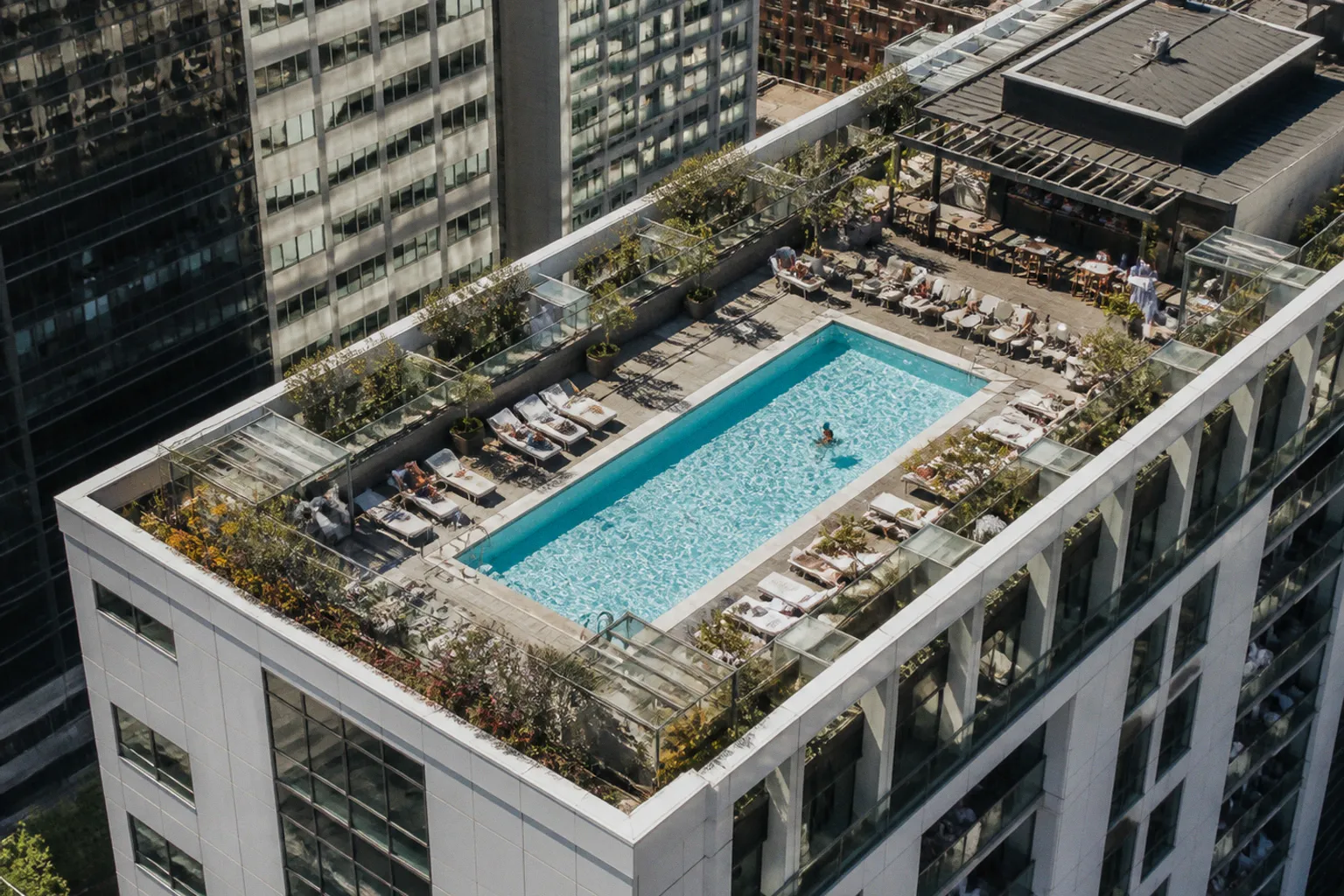
A 14-story hotel wedged between a bank tower and a parking garage has a different problem. The same shot may be impossible to capture, expensive to authorize, or visually underwhelming even when everything goes right. Worse, a technically polished video can still fail to give a guest any reason to book.
A drone reel without a flight plan is just expensive b-roll.
Before approving a drone budget, three questions matter more than the camera model. Can the operator legally conduct the flight at this address? Is there something in the shot that a guest cannot already understand from street-level footage or a map? And where will the finished video appear after the shoot?
Those questions separate a useful aerial campaign from a resort-style reel pasted onto an urban property.
The suburban reel is not your reel
Drone video is a format built around scale, horizon and distance. That makes it a natural narrator for the suburban resort story: sprawling lawns, infinity pools, private beaches, mountain ridges and buildings surrounded by space. When the property itself is the destination, aerial footage can explain the product in a few seconds.
City hotels rarely sell that kind of space. They sell a room, a lobby, a rooftop bar, a breakfast service, a view, a neighborhood and the convenience of being close to something guests came to see. Those things do not automatically improve when filmed from above. Some become less attractive.
A top-down view of an HVAC roof, a service entrance or a parking podium is not a location story. It is an inventory check. Pull back too far and the hotel disappears among taller buildings. Fly too close and the footage becomes an expensive version of a façade shot.
This is why the same drone package that performs well for a coastal resort can stall for a hotel in a dense downtown district. The visual narrative is doing most of the work, and the narrative is wrong for the property.
Urban hotel drone footage is strongest when it can establish a meaningful relationship between the building and its surroundings:
- a riverfront position that is difficult to understand from the street;
- a rooftop pool or sky bar that is genuinely visible from above;
- a landmark, park or waterfront immediately adjacent to the hotel;
- a distinctive building whose shape is part of the brand;
- grounds large enough to make the property feel like a destination rather than one address in a block.
If none of those relationships exists, an aerial shot may add movement without adding meaning. That is not the same thing as adding value.
The city setting can still be an advantage. An aerial camera may show how quickly a guest reaches a stadium, convention center, beach, financial district or cultural quarter. But that requires a deliberate location story, not simply a drone rising above the roof. The camera has to reveal access, context or identity. Otherwise, the hotel is paying for altitude.
Aerial footage should answer a guest question
The most useful test is simple: what does the shot explain?
A good urban aerial might answer, “Is this hotel actually on the waterfront?” It might show that the property sits beside a large park, that the rooftop has an unobstructed skyline view, or that the building occupies a prominent corner in a recognizable district.
A weak aerial answers only, “What does this building look like from the sky?”
That distinction matters because guests do not book camera movement. They book a stay. The footage has to connect the movement to a decision: location, atmosphere, access, views or the character of the property.
What it costs — and what can block it
Production pricing varies by city, crew size, aircraft, editing requirements and the complexity of the flight. The following ranges are useful as planning references, not as a test of whether an operator is legitimate.
| Service tier | Indicative scope | What is usually included |
|---|---|---|
| Standard commercial drone shoot | Hourly or half-day production | Pilot, aircraft, basic capture and selected raw or lightly processed clips |
| Real-estate-style drone package | Single property, planned shot list | Pre-flight planning, several exterior angles and edit-ready footage |
| Luxury or commercial campaign | Custom production | Multiple setups, creative direction, full edit, music licensing, sound design and color grade |
| Indoor FPV production | Choreographed interior sequence | Route planning, practice runs, specialist pilot, safety coordination and more intensive post-production |
A quote below or above a familiar market range does not, by itself, tell you whether the operator is licensed, experienced or suitable. A commercial pilot may quote below a typical rate for a short local assignment, while a specialist crew may charge more because the job involves an FPV team, complex insurance requirements, multiple locations, extensive post-production or a difficult schedule.
The useful questions are about scope and compliance:
- Who is operating the aircraft?
- What credentials and insurance does the operator carry?
- What aircraft and camera package are included?
- Is the rate for flight time, a half-day, a full production day or a finished deliverable?
- Does the quote include airspace research and authorization work?
- Who pays for permits, location fees, music licensing and rescheduling?
- How many edited versions will the hotel receive?
- Are the files intended for paid advertising, social platforms, websites or only organic use?
A very low quote may still be perfectly reasonable if the assignment is short and simple. It may also exclude the work that makes an urban shoot possible. Price is a prompt for questions, not proof of a licensing status.
The legal line is address-specific
In the United States, commercial drone work is generally conducted under the FAA’s Part 107 rules, with the remote pilot required to hold the relevant certificate. That is the baseline, not a universal permission to fly anywhere.
The property address, nearby airspace, the proposed flight path, the aircraft, the time of day and the operation itself all matter. Controlled airspace may require specific authorization, often through LAANC where available or through another FAA process. That authorization is not the same thing as a Part 107 waiver.
A waiver addresses a specific rule or operating limitation when the operation qualifies for that process. Airspace authorization is about permission to operate in controlled airspace. One does not automatically replace the other. A competent production team should be able to explain which issue applies to the proposed shoot rather than using “waiver” as a catch-all word for paperwork.
Other constraints can include temporary flight restrictions, airport proximity, heliports, stadium restrictions, federal or military facilities, local launch rules, building ownership, privacy concerns and restrictions on flights over people or moving vehicles. A hotel may control the roof and still have no authority to launch into surrounding airspace.
Outside the United States, the terminology and approval process will differ. The principle remains the same: the operator must review the jurisdiction, the exact location and the planned operation before promising a shot. The hotel should not treat an agency’s production schedule as evidence that the flight is authorized.
The license is not the whole plan. It is the starting point for a legal one.
Urban conditions add practical complications even after the regulatory question is addressed. Tall buildings create unpredictable wind, GPS can become unreliable in built-up areas, reflective surfaces can complicate navigation, and pedestrians may enter the frame or flight area. A shot that looks simple in a pitch deck may require a closed rooftop, a spotter, a street-management plan or a different launch point.
The hidden costs are usually not dramatic individually, but they accumulate:
- airspace and site assessment;
- permits or building access;
- additional crew and safety personnel;
- insurance documentation;
- weather rescheduling;
- traffic or pedestrian control;
- music and commercial usage rights;
- editing for different aspect ratios;
- captions, sound design and color work;
- a second shoot if the first day produces only partial coverage.
A rained-out shoot in controlled urban airspace can consume a production day before a usable frame is recorded. That is not necessarily poor planning; weather and authorization windows are part of the medium. It is poor planning when the proposal pretends those variables do not exist.
The indoor FPV escape hatch that often makes more sense
Urban luxury hotels have a strong alternative to the exterior pull-back: bring the drone-style movement indoors.
First-person-view, or FPV, drones can move through a lobby, travel down a corridor, enter a suite, pass a restaurant or rise through an atrium. When choreographed well, the sequence gives a guest a sense of the property’s layout and rhythm that a series of static photographs may not provide.
For many city hotels, this is a better visual argument than showing the roof from above. The interior is the product. The lobby atmosphere, the transition from arrival to room, the relationship between the bar and terrace, and the scale of a public space are all things an indoor sequence can communicate directly.
Indoor production also removes some outdoor variables. Weather is no longer the limiting factor, and the hotel can control access to the filming area. That does not mean indoor FPV is automatically simple or exempt from all applicable rules. Depending on the jurisdiction, aircraft, operation and crew, aviation requirements may still apply. The property also has to manage people, fixtures, guests, staff, fire-safety procedures and equipment risks.
The legal and operational review is often more manageable because the environment is controlled, but it should still be documented. “Indoors” is not a substitute for a safety plan.
The creative trade-off is substantial. FPV pilots are a smaller talent pool than standard camera operators, and the route usually has to be rehearsed. The flight itself may last only a short time, but the team may spend much longer clearing furniture, timing staff movement, setting lights, testing exposure and repeating the path.
Interior lighting can be difficult as well. A fast-moving camera passing from a bright lobby into a darker corridor can produce distracting exposure changes. Practical lights, mirrors and glossy surfaces can reveal the operator or crew. A shot that appears effortless usually depends on careful blocking and a post-production process that is more involved than a straightforward gimbal walk-through.
For a boutique property, that work can be worth it. Aerial video for boutique hotels is most persuasive when it makes the hotel feel like a coherent experience rather than a collection of rooms. Indoor FPV can connect those spaces in a way that standard room-by-room coverage cannot.
Three practical choices for urban visual content
| Option | Best for | Main operational concern | Likely marketing role |
|---|---|---|---|
| Outdoor drone | Landmark-adjacent properties, riverfront hotels, distinctive rooftops and lower-density urban settings | Airspace authorization, people and traffic, weather and launch permissions | Establishes location, scale or an external feature |
| Indoor FPV | Boutique hotels, urban luxury properties, lobby-led brands and atrium spaces | Choreography, safety, lighting and specialist production | Demonstrates the guest journey and interior experience |
| Handheld cinematic or gimbal production | Most urban hotels, especially room- and service-led properties | Requires strong direction to avoid generic hospitality footage | Provides flexible, reusable content for website, social and paid campaigns |
The right option is not always the most technically impressive one. A carefully directed gimbal film can show breakfast service, check-in, a room view and a neighborhood walk with far less legal complexity. It may also produce more usable variations for advertising.
The question is not whether a drone can be included. It is whether the camera format makes the property easier to choose.
Engagement without distribution is just noise
Travel marketing decks often cite strong engagement from video. One set of figures used in industry pitches says campaigns using drone footage saw engagement rise by roughly 47% within two weeks. Another commonly cited figure says that as many as 66% of travelers watch video while planning a trip.
Those numbers can support an investment in video, but they do not establish what will happen for one city hotel. Results vary by audience, platform, creative quality, media spend, season, offer and the strength of the booking path. Resort footage and urban boutique footage are not interchangeable categories, and an engagement increase is not the same as an increase in profitable direct bookings.
The more useful evidence is case-specific. The research cited around this subject includes a campaign in which drone video was associated with a spike in direct hotel bookings. That is important because it shows that drone content can contribute to conversion. It does not mean that every aerial video will do so, or that the footage caused the result by itself.
No package guarantees bookings. At the same time, it is wrong to conclude that drone content cannot convert. The outcome depends on how the footage is positioned and distributed.
Engagement without distribution is just traffic with nowhere to go.
A drone reel sitting on the homepage, embedded in a business listing and posted once to Instagram is not a distribution strategy. It is a file with several places to live. The campaign needs a reason for each placement.
A city hotel might use the same production across:
- paid social ads aimed at travelers searching for a specific destination or trip type;
- short vertical edits for mobile discovery;
- a website hero sequence that demonstrates the property’s location or atmosphere;
- email to past guests during a seasonal offer;
- landing pages for weddings, meetings or leisure packages;
- refreshed listings on booking and destination platforms where video is supported;
- PR around a renovation, rooftop opening or rebrand;
- sales material for corporate and group accounts.
The edit should be planned around those uses. A wide cinematic film may be effective on a website but unusable in a vertical placement. A beautiful 60-second sequence may not provide enough short hooks for paid testing. If the hotel wants measurable performance, the production brief should include cutdowns, captions, aspect ratios and a clear destination for the click.
The booking path matters too. A video showing a rooftop bar should lead to a page where the guest can understand access, opening hours, views and the relevant room or package. A neighborhood flyover should support a location claim that the booking page can reinforce. Without that connection, the film may earn attention while leaving the commercial decision untouched.
When to fly — and when to walk away
Drone video genuinely makes sense for a narrower group of urban properties than agencies usually imply.
The strongest use cases
- A distinctive external feature. A rooftop pool, sky bar, unusual architectural form or elevated terrace gives the drone a job beyond decoration. The camera reveals something a guest would otherwise struggle to understand.
- A meaningful relationship with the surroundings. A hotel beside a river, park, beach, landmark or major cultural district can use aerial footage to establish context that street-level filming cannot capture as efficiently.
- A workable operating environment. The airspace, launch location, local permissions and proposed flight path can be assessed and authorized in the relevant jurisdiction. The visual story must justify the effort.
- An urban resort with real grounds. A property with gardens, beachfront, private roads or substantial open space may function more like a resort than a conventional city hotel. The resort format can work because there is something to reveal.
- A brand or launch campaign. A rebrand, new rooftop, major renovation or flagship opening can justify a more expensive production because the footage becomes part of a wider paid, owned and earned campaign.
- A property with a clear audience for visual discovery. If the hotel competes on atmosphere, design and destination identity rather than only price and convenience, a strong visual asset may have a longer useful life.
If none of these applies, be cautious with any pitch built around a generic roof reveal.
Warning signs in the proposal
- There is no address-specific airspace review, and the proposal treats a Part 107 certificate as permission to fly everywhere.
- The document uses “waiver” as a vague promise without explaining whether the operation needs airspace authorization, a waiver, local permission or some combination of approvals.
- The price is presented as proof of licensing. A low quote may be under-scoped, but a high quote is not automatically compliant or skilled. Ask for credentials, insurance, scope and deliverables instead.
- The agency promises a pull-back before checking whether the building can be safely and legally filmed from the proposed position.
- The package includes production but says nothing about editing for platforms, media spend, landing pages or the booking path.
- The creative reference is a coastal resort, while the actual hotel has no coastline, open grounds, visible landmark or distinctive roof.
- The proposal guarantees booking conversion. Content can support conversion; no production package can guarantee it on contact.
- The team cannot explain what happens if weather, airspace or a local restriction cancels the flight.
- The hotel is expected to obtain every permission itself, even though the agency presented the project as turnkey.
Ask the operator to describe the fallback plan. A serious team should know what can still be captured if the exterior flight is delayed or denied: ground-based establishing shots, rooftop detail, interior FPV, neighboring-location footage with permission, or a revised story built around the guest experience.
A better decision process
Run the decision in three moves, but make each one more specific than a yes-or-no check.
Move one: establish the legal route
Give the operator the exact property address, proposed launch point and a rough description of the shot. Ask what authorization is required in that jurisdiction, who will obtain it and what limitations apply. In the United States, that may involve controlled-airspace authorization through LAANC or another FAA process, alongside compliance with the applicable Part 107 rules. It may also require site permission, insurance documents or additional local coordination.
Do not approve the creative concept until this review exists in writing. A legal route may change the shot, the schedule or the budget. That is normal. Discovering the problem on the shoot day is not.
Move two: define the visual story
Name the thing the camera is meant to reveal. It could be the hotel’s relationship to the waterfront, the scale of a garden, the architecture of the roof, the view from a terrace or the journey through a design-led interior.
Then ask whether a drone is genuinely the best tool. If a gimbal operator can communicate the same idea more clearly, use the gimbal. If the visual value depends on movement through a lobby and suite, consider indoor FPV. If the building disappears when the camera pulls back, keep the camera closer and rethink the concept rather than forcing a wide aerial.
Move three: build the distribution path
Decide where the footage will appear before production begins. Identify the audience, the edit length, the format, the call to action and the landing page. If the hotel plans to run paid social, reserve enough budget to test the asset. If the goal is direct bookings, track the path from exposure to booking rather than stopping at views or likes.
The campaign may use several versions:
- a short vertical cut for discovery;
- a longer website film for consideration;
- room- or amenity-specific edits for retargeting;
- a captioned version for silent autoplay;
- still frames extracted for listings and display placements;
- a version focused on meetings, weddings or events if those segments matter.
This is where production becomes marketing infrastructure instead of a one-off portfolio piece.
If all three moves work, start with the format that best serves the story. For many urban hotels, that means indoor FPV or a ground-based cinematic film first, with outdoor drone footage added only when the exterior context earns its place. If the legal route fails, the visual feature is weak or the distribution plan is absent, spend the budget elsewhere: a stronger photo library, a room-and-service film, neighborhood content, paid social creative or landing-page improvements.
The drone is not the strategy. It is a tool for revealing scale, context or movement. Most city hotels do not need that tool in the sky. The ones that do usually need a very specific shot — and the ones that need the strongest visual lift may find it inside the building.