Interactive video maps vs linear tours for resorts
A resort film can look impeccable and still leave the most important booking questions unanswered.
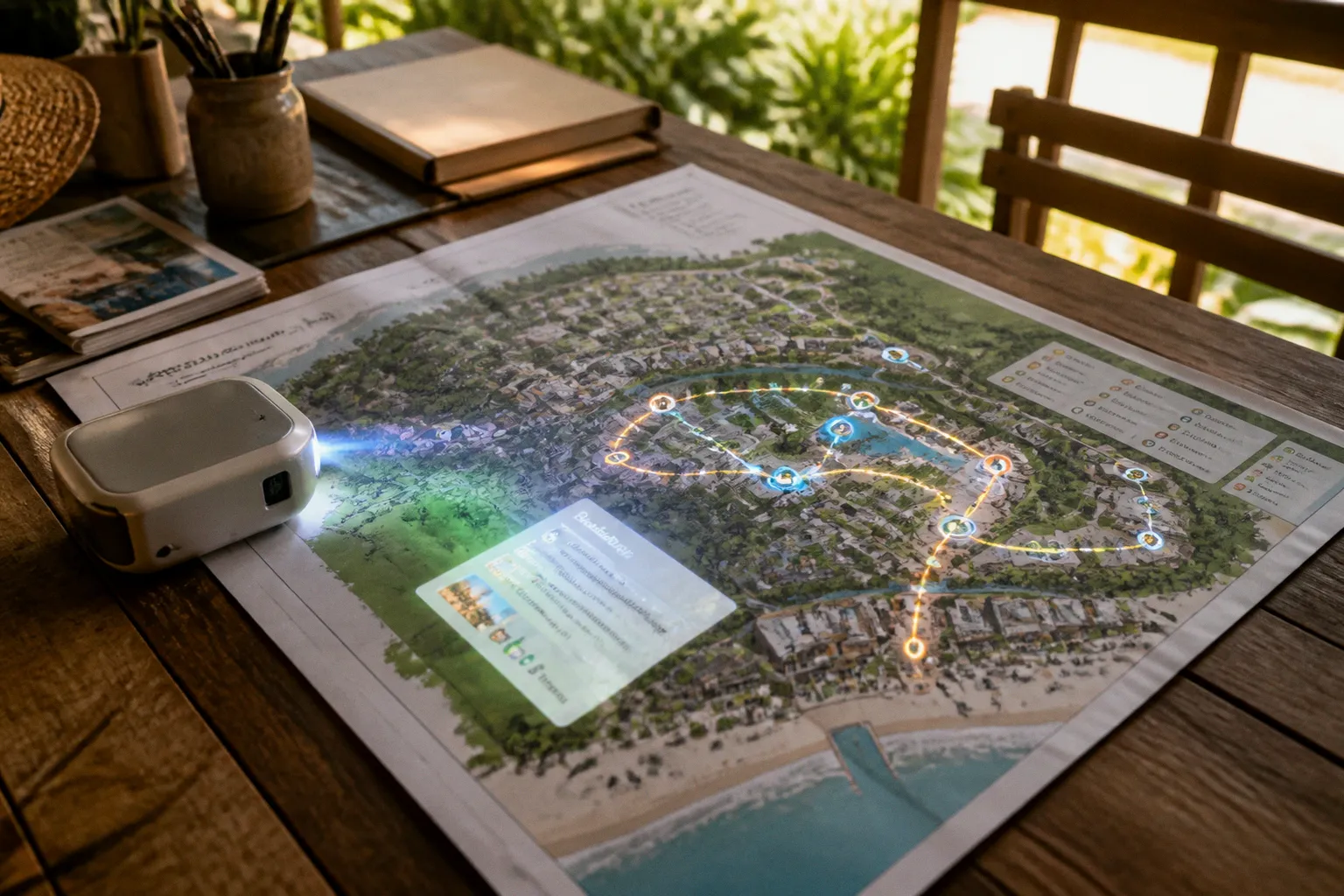
A guest sees the infinity pool, the spa suite, the sunset restaurant—but not whether that room is a three-minute walk from the beach, whether the family suite connects to the kids’ club, or how to move from dinner to the lobby without losing the sense of arrival the property worked so hard to create.
That is the practical fault line in the resort interactive video map vs video tour decision. A linear video gives the property control over pace, sequence, and emotional storytelling. An interactive map gives the guest control over routes, context, and comparison. The strongest resort experience usually needs both: the feeling of the place, followed by the confidence to choose it.
From passive viewing to active exploration
I use a simple before-and-after audit when I assess a resort’s digital content. In the “before” version, a polished tour sits at the top of the page, plays beautifully, and then stops. The guest may remember the lobby or the ocean view, but must leave the visual narrative to search for room locations, amenities, distances, and availability.
In the “after” version, the video still creates desire—but the map answers the questions that desire creates. The guest can open a room, see where it sits, jump to the beach or restaurant, understand the route, and continue toward a room selection or booking action.
This is not a choice between storytelling and utility. It is an alignment between two different stages of the guest journey:
- Linear video creates mood, establishes identity, and shows the property at its most compelling.
- Interactive media creates orientation, supports comparison, and reduces the uncertainty behind a high-consideration booking.
- A hybrid experience lets the property lead with emotion while allowing the guest to determine how deeply—and in which direction—to explore.
The distinction matters because a resort is not simply a collection of beautiful rooms. It is a spatial experience. The relationship between the room, pool, restaurant, spa, beach, event spaces, and surrounding landscape helps a guest imagine a stay. Once that relationship becomes clear, the property has moved beyond isolated images and into a coherent sense of place.
| Decision factor | Linear video tour | Interactive video map |
|---|---|---|
| Primary control | The hotel controls the sequence | The guest controls the route |
| Main strength | Emotion, pacing, atmosphere | Context, comparison, orientation |
| Typical guest question | “What would it feel like to stay here?” | “Which room, route, and amenities fit me?” |
| Best role | Brand introduction and emotional proof | Planning, discovery, and booking support |
| Production demands | Filming, editing, music, voiceover, color finishing | Mapping, georeferencing, 360° media, interface design, 3D modelling or custom integration |
| Main risk | A beautiful story without a next step | A clever tool that feels disorienting or incomplete |
A standalone linear tour remains valuable. It works especially well as a concise arrival sequence, a social-media introduction, a room-category story, or a quick brand touchpoint for a small property with few decision points. It can communicate texture through light, movement, sound, human activity, and the rhythm of a carefully edited day.
But a large resort produces dozens of spatial questions. An interactive map can connect those answers without making the guest watch an eight-minute film three times to find the adults-only pool.
A resort video should make the guest want to arrive; an interactive map should make the guest feel confident choosing where to go next.
Reported benchmarks reinforce the behavioral difference, although they should be treated as directional rather than guaranteed. Interactive video formats have achieved up to 591% higher engagement than linear media, while other benchmarks place engagement at 60% to 80%, compared with 2% to 5% for traditional video. Viewers interacting with video ads have spent an average of 47 seconds with the experience, versus 18 seconds for linear ads. The exact percentages are not directly additive, and the figures come from different definitions of engagement—but the direction is consistent: active participation holds attention longer.
Solving the “lost in space” problem in virtual tours
A 360° panorama can make a resort feel immediate, yet it can also isolate a guest inside an image. Turn toward the ocean and the room disappears. Select a villa and there is no indication of whether it faces the restaurant, the service road, or the quietest side of the property. After several immersive jumps, the guest is technically inside the resort but spatially lost.
The common complaint around standalone virtual tours is therefore not that the imagery is weak. It is that the experience lacks a navigation plan.
A useful interactive map restores context. Pins, room polygons, routes, orientation markers, and georeferenced media let the guest understand both where the camera is located and what surrounds it. GPS georeferencing can also support real-time navigation on a mobile device without requiring a separate app. The important point is not the novelty of the technology; it is the reduction of mental effort.
I would look for six elements in a well-designed resort map:
1. A clear overview before immersion. The guest should see the whole property, its major zones, and a visible “start here” state before being dropped into a 360° view.
2. A consistent orientation system. North, route lines, labeled entrances, floors, beaches, buildings, and amenity icons should remain understandable as the guest moves.
3. Clickable points of interest. Rooms, restaurants, pools, spas, event venues, and navigation stops should be easy to identify without crowding the interface.
4. A persistent route or return path. The guest should always know how to return to the map, change categories, or move to the next logical step.
5. Mobile behavior designed deliberately. Controls should work with touch, labels should remain legible, and the interface should not depend on forced motion, sound, or precise dragging.
6. An accessible alternative to visual navigation. Keyboard operation, readable text, meaningful image descriptions, captions, and reduced-motion settings are part of a complete guest journey—not optional polish.
The map should also answer practical questions. A label saying “Spa” is not enough if the guest cannot tell whether the spa is inside the main building, adjacent to the gym, or reached through the lobby. A pin that leads to a beautiful video is useful; a pin that also explains opening hours, access, suitability, and the route to the reception is commercially useful.
| Mapping weakness | Guest reaction | Better experience |
|---|---|---|
| A panorama opens without an overview | “I do not know where I am.” | Show the property, route, and selected point first |
| Every amenity uses the same icon | “What does this pin represent?” | Group categories and provide a clear legend |
| The map is visually accurate but not commercially connected | “Nice—now what?” | Link rooms and amenities to relevant booking paths |
| Controls are too small on mobile | “I cannot use this cleanly.” | Design touch targets and labels for the smallest supported device |
| Hours or seasonal details become outdated | “Can I trust the rest of this information?” | Establish ownership and an update schedule before launch |
| The map loads only after several actions | “This is costing time.” | Prioritize a lightweight overview and progressive media loading |
The hospitality-specific lesson is important: orientation is a form of reassurance. A guest may tolerate a slightly imperfect photograph, but uncertainty about room position, access, or distance can weaken confidence at the exact moment a booking decision is being made.
The best virtual tour does not simply place someone inside a room; it places that room clearly within the guest’s imagined stay.
What stronger engagement can mean for booking performance
Interactive media produces more than novelty. It changes how long guests explore, what they inspect, and whether they continue through the booking journey. The strongest evidence is not a single dramatic percentage; it is the consistency of the pattern across attention, website behavior, and booking-related outcomes.
| Performance signal | Reported comparison | What it suggests for a resort |
|---|---|---|
| Interaction time | 47 seconds for interactive video vs. 18 seconds for linear ads | Active exploration earns more of the guest’s attention |
| Memorability | Interactive video has produced 32% greater memorability | The resort is more likely to remain available during comparison |
| Website duration | Listings with 360° tours receive 5 to 10 times longer sessions | Guests use immersive media as part of active consideration |
| Booking conversion | Virtual-tour listings have reported 4.8% conversion vs. 2.1% without them | Greater spatial confidence can support the final decision |
| Direct booking rate | Hotels with virtual tours have reported 62% direct booking vs. 34% without | Richer content can help the property’s owned booking journey compete more effectively |
| Content engagement | Interactive video has ranged from 60% to 80%, vs. 2% to 5% for linear video | Participation changes the depth of the experience |
| Reservation impact | Hospitality uses of virtual tours have produced increases ranging from 16% to 67% | Outcomes vary substantially with implementation, traffic, inventory, and booking flow |
These figures should not be read as additive promises. They measure different things: engagement, memory, interaction, listing conversion, and reservations. A resort should not expect 591% more engagement plus 11 times the conversion and then multiply that result by its current direct-booking rate.
Interactive video has, however, reported conversion rates more than 11 times higher than traditional linear media during viewing. That is a meaningful distinction: it describes a conversion occurring through the interactive experience, not an automatic 11-fold rise in room reservations after installing a map.
The same caution applies to the 4.8% versus 2.1% booking-conversion comparison. It is a useful benchmark, not a guarantee that every property will achieve a 129% increase. The effect depends on traffic quality, mobile performance, room inventory, property type, the quality of the tour, and how well the experience connects to the booking engine.
Airlines provide a useful adjacent signal. Travelers who engaged with an interactive map on Southwest Airlines vacation-package pages booked at a 27% higher rate than travelers who did not view the map. Southwest is not a resort, and vacation packages are not hotel rooms—but the principle travels well: giving people spatial context can help them complete a more complicated purchase.
For a resort, measurement should therefore go beyond views:
- How many guests open the map rather than only play the introductory film?
- Which room categories and amenities receive meaningful interaction?
- Do map users examine more than one room before entering the booking flow?
- Does a mapped room receive more selections, lower abandonment, or a higher booking completion rate?
- Does the experience influence average booking value or length of stay?
- Are those bookings coming directly through the resort’s owned channel?
- Does the benefit persist across mobile and desktop traffic?
A proper test compares guests with similar arrival sources, room availability, dates, and booking conditions. A comparison between all map users and all non-users can be distorted by seasonality, campaigns, or device mix. The question is not simply whether people enjoy the tool. It is whether the tool helps the right guests make a more informed decision.
Mapping amenities to a revenue path
A resort map earns its place in the marketing stack when it connects guest questions to commercial decisions. The goal is not to decorate the page with more pins. The goal is to give each amenity a role in the guest journey.
| Guest question | Interactive response | Commercial or service signal |
|---|---|---|
| “Is this room close to the pool?” | Show the room, distance, route, and relevant views | Fewer location objections and greater room-selection confidence |
| “Which option suits our family?” | Compare connecting rooms, suites, floors, and nearby facilities | More relevant upgrades and package attachment |
| “Can I plan dinner, spa, and beach time?” | Connect bookable amenities into an itinerary | More considered and potentially higher-value stays |
| “How do wedding or event guests move around?” | Map entrances, ceremony spaces, accommodation, parking, and service routes | Stronger event inquiry and planning experience |
| “Is the premium view worth it?” | Link the premium category to mapped orientation, privacy, and amenities | Better understanding of differentiated room value |
| “What is near the lobby or accessible route?” | Provide clear wayfinding and accessibility information | Greater trust for families, groups, and guests with access needs |
This is where an interactive map can become more than an awareness asset. Iberostar’s 2024 My Room Suite 3D room-selection map offers a useful hospitality example: 14% of guests used the tool, and it generated 19% of bookings. Bookings made through the mapped room-selection journey were also associated with a 10% higher average bill and a longer length of stay.
Those results matter because the map was not operating as a detached virtual-tour feature. It was connected to a high-intent decision: selecting the right room. That alignment is more valuable than placing an impressive map where the guest is only browsing.
A practical revenue sequence can be built in five moves:
1. Begin with orientation. Let the guest understand the property’s major zones and the selected room’s position.
2. Reveal differentiated value. Show what makes a room, suite, villa, or package worth its price rather than relying on a generic “upgrade” message.
3. Connect the map to selection. Preserve the selected room or relevant amenity as the guest moves into the booking flow.
4. Offer a useful next action. Depending on the property, that could be room selection, package enquiry, spa planning, event information, or availability search.
5. Measure progression through the experience. Track interest separately from the final booking so the team can see where context creates action.
Amenity placement should also reflect how the property is actually used. A beachfront resort may need a route from room to shoreline, shade, dining, and evening access. A mountain resort may need to clarify elevation, walking paths, valet access, wellness facilities, and the relationship between private and communal spaces. An urban hotel may have a smaller footprint, but it can still use an interactive floor map to clarify room configuration, connecting-room options, meeting spaces, and neighborhood context.
For a bed-and-breakfast, a fully custom GIS system may be unnecessary. A lighter interactive floor or property map could answer the limited number of questions that matter: where the room sits, how guests arrive, what is included, and how the common areas relate. The principle remains the same: build only the spatial depth the property and guest decision require.
The direct-booking opportunity appears when the experience remains useful after the emotional first impression. An introductory video can lead into the map, the map can lead into room selection, and room selection can lead into availability. If the guest must restart the journey—or return to a generic list after selecting a mapped room—the alignment breaks.
Curated storytelling still belongs in an interactive experience
The strongest recommendation for most resorts is not to replace linear video with a map. It is to give each format a defined job.
A linear video should own the arrival. It can show a morning beginning, the movement of staff, the texture of materials, the sound of water, the transition from a quiet room to an animated restaurant, and the emotional reveal of a signature view. Its sequence is an advantage when the resort needs to establish pace and brand character.
The map should own the exploration. It can let the guest find a room, compare orientation, follow a route, inspect an event venue, or assemble a stay. Its openness is an advantage when the guest needs information rather than atmosphere.
In practice, the hybrid experience can follow three layers:
- A guided route: The resort creates a curated sequence with a visible map path and a small number of compelling video stops.
- An open exploration layer: The guest leaves the guided route to inspect buildings, rooms, amenities, and surroundings.
- A planning layer: Relevant room, package, event, or amenity information connects the spatial experience to a next decision.
The opening should remain curated enough to create a clear first impression, but the depth of the experience should be user-led. That balance protects the hotel’s visual narrative without trapping the guest inside someone else’s order of viewing.
| Property or campaign need | Best primary format | Recommended role |
|---|---|---|
| Brand launch or emotional introduction | Linear video | Establish tone, style, service, and signature experiences |
| Large resort with many amenities and routes | Interactive map | Support orientation, comparison, and planning |
| High-value room-selection journey | Interactive map with connected booking flow | Explain category differences and preserve selection intent |
| Short social or email introduction | Linear clips | Create recognition and lead guests into the deeper experience |
| Wedding, group, or event enquiry | Hybrid map and video | Show atmosphere, capacity, access, and event flow |
| Small B&B with a simple footprint | Linear video or light interactive map | Keep the experience focused and easy to maintain |
| SEO-led property page | Hybrid, supported by crawlable copy | Add rich media without expecting interactive media alone to create rankings |
Production complexity deserves an honest place in the decision. Interactive maps often require specialized software, 3D modelling, or custom GIS and GPS integration. The available research does not establish a dependable average cost difference between a custom interactive map and a standard linear tour for a mid-sized resort, so the lower-cost option cannot be assumed. Scope, property size, media volume, interface requirements, connectivity to the booking engine, and ongoing maintenance all affect the answer.
A sensible implementation process starts with the guest’s decision rather than the technology:
1. Define the primary job: inspiration, orientation, room selection, amenity discovery, event planning, or booking completion.
2. Audit the property’s spatial truth: room inventory, building relationships, routes, closures, access, and seasonal changes.
3. Choose the lightest map experience capable of answering that job; a complex 3D product is not automatically a better one.
4. Capture enough visual coverage to support the intended route, including transition views that explain how spaces connect.
5. Connect selected rooms, packages, or amenities to the relevant commercial path.
6. Test on the devices, browsers, connection speeds, and accessibility settings used by actual guests.
7. Assign ownership for menus, hours, closures, room names, renovations, and seasonal content.
8. Compare the mapped journey with the previous journey using matched audience and inventory conditions.
Linear video is also not dead. It is faster to consume, easier to distribute across campaigns, and often more effective for a short emotional story. The mistake is using it to answer a spatial question it was never designed to answer. In the same way, an interactive map should not be asked to carry the entire emotional identity of the resort when a well-shot sequence of arrival, texture, service, and place can do it more naturally.
Interactive media also does not replace sound hospitality SEO. The page still needs crawlable descriptions, useful room and amenity copy, accurate metadata, and a clear information hierarchy. A map can deepen engagement, but it should support the property’s discoverability rather than be treated as a ranking strategy by itself.
The decision becomes much simpler when it is framed correctly. If the main obstacle is emotional—if guests understand the resort but do not yet feel its appeal—lead with linear video. If the obstacle is practical—if they need to understand location, route, room choice, or amenity relationships—lead with an interactive map. If the goal is a direct booking, build a connected journey in which video creates desire, the map supplies confidence, and the booking flow preserves the guest’s intent.
Start with the question the guest is asking at that point in the journey. Then choose the format that answers it with clarity, texture, and alignment.