Trabi Museum tickets: booking traps that waste creator time
The Trabi Museum displays 14 historic Trabant vehicles. That is the usable content inventory. The booking failure is elsewhere.
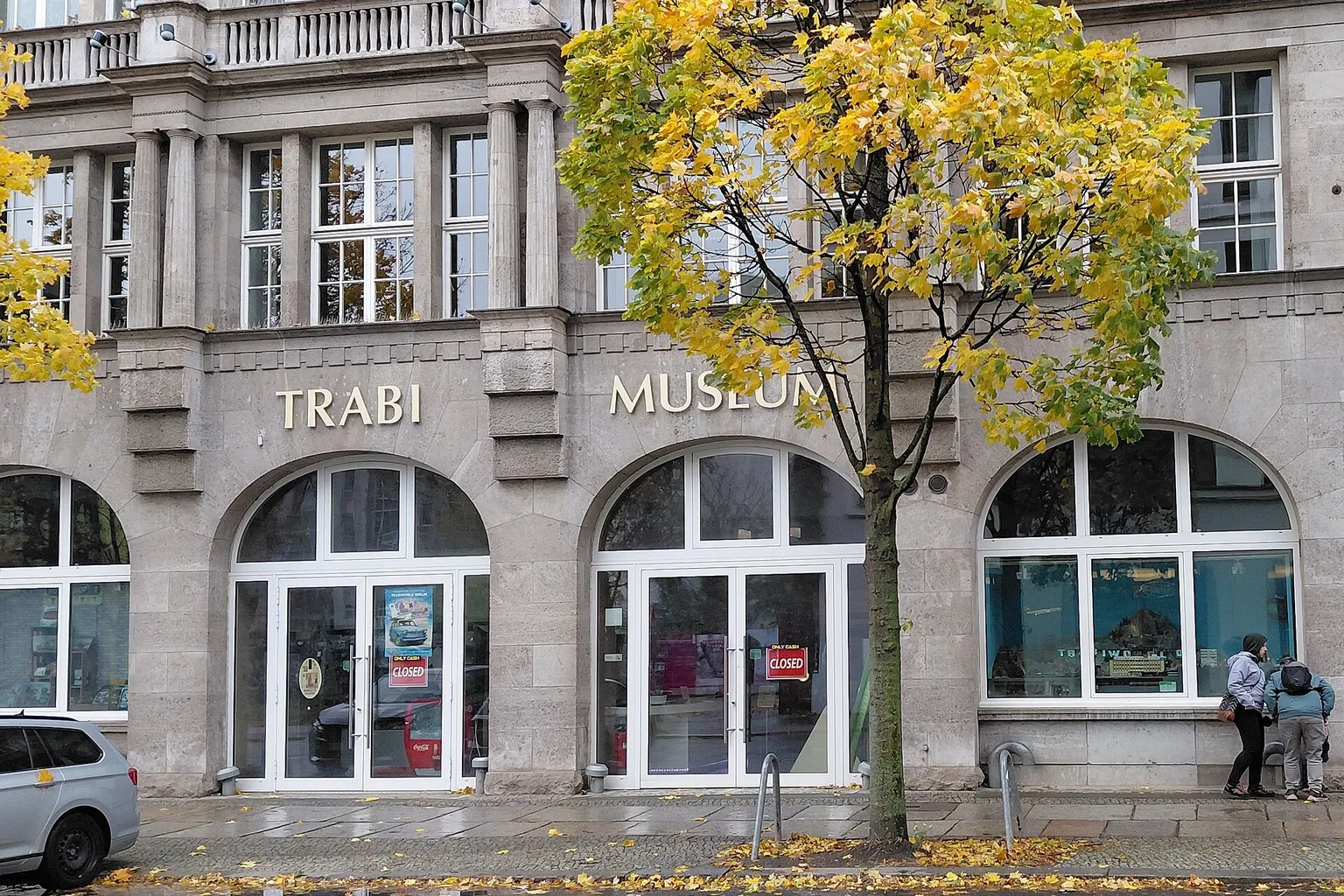
Visitors often confuse standard museum admission with the separate Trabi Safari driving experience. One gets you into the exhibition near Checkpoint Charlie. The other involves driving a Trabant through Berlin and requires a separate booking, a valid driving licence, and a minimum age of 18. Treating them as the same product creates the wrong itinerary, the wrong expectations, and a preventable loss of production time.
 Berlin
Tickets and prices
Trabi Museum
Entry ticket · Day ticket
from€9
Book onlineOfficial ticket · Normal rate
from€9
Book onlineFor creators, the distinction is operational. A museum ticket gives access to the static exhibition. It does not grant driving privileges. A safari reservation does not automatically replace the need to understand the museum’s own entry terms. These are different products with different constraints.
Start with the product, not the reseller
The phrase “Trabi Museum tickets” covers more than one booking path. The first task is to identify what the booking actually includes.
Standard entry is designed for visitors who want to inspect the exhibition. The museum is located at Zimmerstraße 14–15, close to Checkpoint Charlie. The visit is compact and content-dense: 14 Trabant vehicles, several rare variants, and a concentrated record of East German automotive production.
A Trabi Safari is a driving tour. It is not an upgraded museum ticket. Driving requires:
- A separate reservation for the safari experience.
- A valid driving licence.
- A minimum driver age of 18.
- Compliance with the tour operator’s own booking and cancellation terms.
- A reserved time slot or activity window, depending on the selected product.
The distinction matters when a shoot has multiple deliverables. A museum visit can support interior footage, detail shots, presenter segments, and short-form B-roll. A safari adds moving exterior footage and road coverage. The two formats have different timing, permissions, weather exposure, and equipment requirements.
Do not build a driving sequence around a standard museum admission. The ticket category will not convert into a vehicle reservation at the door.
A museum ticket gives access to the cars. A safari booking gives access to the driving experience. The two products should never share one line in your production plan.
Third-party platforms can make the distinction less obvious. Search results often place museum day tickets and driving tours beside one another. Product titles may use similar wording. Images may show the same Trabant models. The visual similarity is not a contractual similarity.
Read the inclusion field. Check whether the booking describes museum admission, a guided driving tour, a vehicle-driving activity, or a combination. If the wording is unclear, assume the product is narrower than the headline suggests and verify before payment.
What the ticket price does not tell you
The museum’s standard admission is positioned as a low-friction attraction for visitors already in the Checkpoint Charlie area. Children under 12 enter free. Berlin WelcomeCard holders receive a 50% discount on museum admission.
That discount applies to museum entry. It should not be treated as a blanket reduction for every Trabi-related activity. A driving tour is a separate commercial product. The pricing structure, availability, and cancellation terms may differ.
For planning purposes, separate the budget into two lines:
| Booking element | What it covers | Production implication |
|---|---|---|
| Museum admission | Access to the indoor exhibition | Suitable for vehicle details, static B-roll, and exhibition coverage |
| Trabi Safari | Guided driving activity with a Trabant | Requires a separate booking, eligible driver, and reserved activity time |
| Berlin WelcomeCard reduction | Discount on museum admission | Check applicability before assuming it covers a safari |
| Third-party day ticket | Entry sold through an external booking platform | Review refund terms, inclusions, and redemption instructions |
| Professional filming setup | Tripods, lights, audio, or commercial production | Confirm permission directly; standard admission terms do not establish production rights |
The practical issue is not the headline ticket price. It is scope.
A low-cost museum admission can be the correct choice for a 30-minute editorial stop. It can be the wrong choice for a campaign that needs a moving vehicle, exterior sequences, or a controlled driving route. The booking must match the shot list.
Creators should also distinguish ticket availability from access permission. A ticket may be available for today or tomorrow through a booking platform. That confirms a retail transaction. It does not confirm that the venue permits a monetized production, a tripod, a light stand, or a multi-person crew inside the exhibition.
The available evidence does not establish specific rules for professional video equipment or commercial filming authorization. Do not infer permission from the ability to buy entry online. Ask the museum or relevant operator before arriving with production equipment.
Third-party bookings: the cancellation clause is the real product detail
External ticket platforms can reduce friction. They can also introduce a second set of terms.
Some third-party listings offer day tickets with full-refund cancellation up to 24 hours before the activity. That condition is useful only if the booking is cancelled within the stated window and the selected product carries that policy. It should not be generalized to every ticket or every safari reservation.
Check four fields before confirming:
1. Activity type
Establish whether the listing is for museum admission or a driving experience. Similar photographs do not make the products interchangeable.
2. Redemption instructions
Determine whether the ticket is scanned at the museum, exchanged for another voucher, or tied to a specific time. A voucher that requires a separate redemption step adds friction to a compressed shoot day.
3. Cancellation deadline
Note the exact cutoff in local time. A 24-hour policy is not a general right to cancel at any point before arrival.
4. Inclusions and exclusions
Look for language covering guide services, vehicle use, driving eligibility, museum entry, and transport. If an item is not listed, do not build a shot around it.
A booking confirmation is not a production brief. It contains the commercial terms, not necessarily the operational details your crew needs.
The most common failure pattern is predictable:
- The creator searches for a Trabant experience.
- A reseller displays museum entry and safari products together.
- The creator books the cheaper or earlier option.
- The shot list assumes driving footage.
- The error is discovered at the venue, where the schedule has no recovery window.
This is a conversion problem caused by category ambiguity. The booking page may have high click-through and still create a poor customer outcome. The decisive test is not whether the visitor completed checkout. It is whether the purchased product matches the intended visit.
Berlin Trabi Museum opening hours and location logistics
The museum operates daily from 10:00 am to 5:00 pm. That schedule is straightforward. The production implications are not.
The location at Zimmerstraße 14–15, near Checkpoint Charlie, places the museum inside a high-traffic central Berlin itinerary. This helps ordinary visitors. It creates constraints for crews.
The surrounding area can generate useful contextual footage, but it is not a controlled set. Foot traffic, street noise, changing light, and pedestrian movement will affect both audio and continuity. The museum itself is the controlled content zone, but the available control may be limited by visitor density and venue rules.
Build the visit around the museum’s operating window rather than assuming the full day is usable. A practical plan should account for:
- Transit from the previous location.
- Ticket retrieval or scanning.
- Time to locate the correct entrance.
- A pre-shoot check of visitor density.
- Camera and audio setup.
- Interior movement between vehicles.
- Buffer before the 5:00 pm closing time.
- A contingency if commercial filming equipment is restricted.
The museum’s daily opening does not imply all-day freedom to shoot. The first hour may offer cleaner frames and lower background interference, but do not present that as a guaranteed condition. Visitor volume is variable.
For fast-turn content, use a compact capture plan. The exhibition contains enough technical variety to produce a complete short feature without needing a long setup. A creator can prioritize:
- Wide establishing footage of the exhibition.
- Front, rear, and side profiles of selected vehicles.
- Badge, grille, wheel, dashboard, and instrument details.
- Material and construction details on unusual variants.
- Presenter footage explaining the Trabant’s historical position.
- Slow tracking shots that preserve vehicle geometry.
- Cutaways for transitions between history, design, and visitor information.
The camera strategy should protect spatial legibility. A wide lens can make the room appear larger while stretching the car’s proportions at the frame edges. A moderate focal length is safer for vehicle profiles and dashboard details. Keep the camera axis controlled. If each shot uses a different perspective, the edit will produce visual discontinuity.
Dynamic range is another constraint. Dark interiors and reflective paint create competing exposure demands. Protect highlights on body panels and windows. Do not expose for the deepest shadow and then attempt to recover bright reflections in post. The result is usually clipped detail on the vehicle surface.
Audio requires separate planning. Museum interiors are not silent. Visitor movement, hard surfaces, and nearby speech can damage the intelligibility of a presenter segment. A small directional microphone placed close to the speaker is more useful than a wide room recording. If the venue does not permit an external audio setup, record concise voice-led material elsewhere and use the exhibition for visual coverage.
The 14 vehicles are not interchangeable B-roll
The collection includes 14 distinct Trabant vehicles. That number should change the editorial plan.
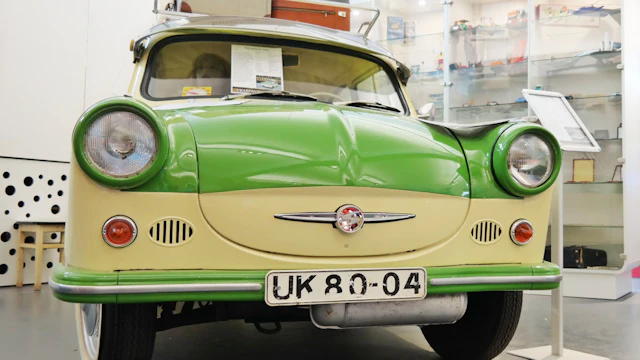
A weak video treats the exhibit as a row of similar compact cars. A stronger one uses the variations to create a visual argument about the vehicle’s role in East German automotive history. The museum includes rare and specialized examples, including a wooden-chassis Trabant P70, military models, camping versions, and racing cars.
These variants give the editor different surfaces, silhouettes, and use cases. They also prevent repetitive coverage.
Use vehicle differences as a shot taxonomy
The wooden-chassis Trabant P70 is valuable because its construction differs from the standard visual expectation of a small postwar compact. It should receive detail coverage rather than only a wide shot. Capture the material transition, body lines, and any explanatory context available in the exhibition.
Military models support a functional comparison. Look for changes in body configuration, equipment, seating, and exterior hardware. Avoid inventing technical specifications that are not displayed or verified. The visual evidence is enough to establish that the vehicle was adapted for a different operational role.
Camping versions provide a different content route. Use them to explain how the Trabant was positioned within domestic travel and leisure. The frame should show the conversion or equipment clearly. A close-up without spatial context creates a catalogue image, not useful editorial footage.
Racing cars create the strongest contrast with the standard road-going vehicle. Their value lies in the modification logic: the same base identity presented for speed, competition, or specialized performance. Shoot the full profile first. Then collect the components that explain the transformation.
A practical capture order:
1. Establish the room and route
Record a wide sequence that shows where the visitor enters and how the vehicles are arranged.
2. Capture the standard visual reference
Choose a conventional Trabant and film it from consistent front, side, and rear angles.
3. Move to the rare variants
Prioritize the P70, military examples, camping models, and racing cars.
4. Collect repeatable detail shots
Use the same shot types across multiple vehicles: badge, wheel, cabin, control layout, and body surface.
5. Record explanatory context
Film signage only where permitted and legible. Do not assume every label can be reproduced commercially without approval.
6. Finish with visitor-scale footage
Show the relationship between the vehicle and the exhibition space. This is useful for navigation content and prevents the edit from becoming a sequence of isolated object shots.
Fourteen cars do not automatically produce fourteen useful sequences. The footage needs a taxonomy, or the final edit becomes repeated profile shots with no information hierarchy.
Focal length and framing: avoid making the cars look wrong
Architectural and automotive coverage fail in similar ways. The camera can record a technically sharp image that misrepresents the space or object.
Ultra-wide lenses are efficient in tight interiors. They also introduce barrel distortion, stretched corners, and exaggerated foreground proportions. A Trabant photographed too close with a wide focal length can look longer, taller, or more curved than it is. That may create visual impact. It damages accuracy.
Use the widest lens only when the room context is the subject. For vehicle documentation:
- Keep the car away from the extreme frame edges.
- Maintain a level horizon for profile shots.
- Avoid placing the nearest corner of the vehicle too close to the lens.
- Use a moderate focal length for front three-quarter views.
- Shoot details from a stable distance rather than pushing the lens into the object.
- Repeat the same camera height across comparable vehicles.
Camera height affects perceived mass. A low angle makes a compact vehicle appear more aggressive. A high angle emphasizes the roof and reduces the visual weight of the body. Neither is wrong, but the choice must be deliberate.
For a visitor guide, neutral geometry is more useful than dramatic distortion. The audience needs to understand what is on display and how the exhibition is organized. Save stylized movement for transitions and social clips.
A heatmap of viewer attention on a booking page would likely prioritize the ticket type, opening hours, location, and cancellation terms. The same logic applies to the video. Put the information-bearing frames first. Decorative details should not displace the content that helps a visitor decide whether the museum fits the itinerary.
Booking for a shoot: build the itinerary around failure points
A visitor can absorb a minor booking error. A crew cannot. Every incorrect assumption multiplies across people, transport, equipment, and publishing deadlines.
Use a two-stage booking process.
Stage one: classify the visit
Write one sentence describing the intended product:
- Museum-only visit for exhibition coverage.
- Museum visit with presenter and compact camera kit.
- Trabi Safari for driving footage.
- Combined itinerary involving both static and driving content.
If the sentence contains the word “drive,” standard museum entry is not enough. If it contains “commercial filming,” a retail ticket is not a permissions document.
Stage two: test the booking against the shot list
Match each required scene to the product:
| Required footage | Museum admission | Trabi Safari |
|---|---|---|
| Interior exhibition coverage | Yes, subject to venue rules | Not the primary purpose |
| Static Trabant detail shots | Yes, subject to venue rules | Not guaranteed |
| Driving footage | No | Yes, if separately booked |
| Presenter segment inside the museum | Potentially, with permission considerations | Not implied |
| Exterior road sequence | No | Part of the driving activity, subject to tour conditions |
| Professional lighting or tripod setup | Not established by standard entry | Not established by safari booking |
| Driver participation | No | Requires licence and minimum age of 18 |
This table is not a substitute for operator confirmation. It is a way to expose mismatched assumptions before they become schedule failures.
Keep the production kit small unless permission has been confirmed. A handheld camera, compact microphone, and minimal support equipment create less friction than a full lighting package. That does not mean the venue permits the smaller kit. It means the smaller kit is easier to adapt if restrictions apply.
For paid or monetized content, treat authorization as a separate workstream. Standard visitor admission and commercial filming rights are different questions. The available ticket information does not establish that monetized filming is included.
What to verify before arriving
The museum’s location, daily schedule, collection size, and basic admission structure are clear. The production-specific rules require direct confirmation.
Contact the relevant venue or operator about:
- Tripod and monopod use.
- LED panels, light stands, and other artificial lighting.
- External audio equipment.
- Crew size.
- Presenter recording.
- Commercial or monetized publication.
- Reproduction of exhibition labels.
- Restrictions on blocking visitor circulation.
- Advance press or filming authorization.
- Whether a separate safari reservation includes any museum access.
Do not use a vague message. Send a concise production brief with the date, time, crew size, camera body, lens count, audio equipment, support equipment, and intended distribution. The more specific the request, the less room there is for a generic answer that fails on the day.
The wording should also distinguish editorial documentation from advertising. A hotel campaign, destination video, YouTube feature, and news-style guide may not be treated identically by the venue. Do not assume that a small crew is automatically exempt from commercial restrictions.
The clean route through the Trabi Museum
For most visitors, the route is simple:
1. Confirm whether the booking is for museum admission or a Trabi Safari.
2. Check the opening window of 10:00 am to 5:00 pm.
3. Use the Zimmerstraße 14–15 location near Checkpoint Charlie to plan transit.
4. Apply the Berlin WelcomeCard discount only to the product for which it is valid.
5. Verify reseller redemption, cancellation, and refund terms.
6. If driving is required, confirm the separate reservation, licence requirement, and minimum age.
7. If filming is commercial or equipment-heavy, obtain permission before arrival.
8. Build the shot list around the 14 distinct vehicles rather than treating the collection as repetitive B-roll.
9. Leave buffer before closing and avoid assuming that every interior setup will be permitted.
10. Save the confirmation and the operator’s instructions offline.
The museum opened near Checkpoint Charlie in 2013. Serial production of the Trabant began in 1958 and ended in 1991. Those dates provide a clean editorial frame: production history, political context, vehicle variation, and the museum’s current role as a compact Berlin attraction.
The booking page is where the practical risk sits. The cars are not the confusing part. The product labels are.
A correct plan separates admission from driving, visitor access from filming permission, and ticket availability from operational certainty. That separation removes most of the avoidable friction before the camera leaves the bag.
Practical info
Currency: EUR
Driving: on the right
Emergency number: 112
FAQ
Can I drive a Trabant with a standard museum ticket?
Does the Berlin WelcomeCard discount apply to the Trabi Safari?
Are tripods and professional lighting allowed in the Trabi Museum?
What are the opening hours of the Trabi Museum?
Are children allowed to enter the Trabi Museum?
Photo: Wiki LIC / CC BY 4.0 — Wikimedia Commons