Walking tour videos vs curated highlight routes
A hotel can sit within walking distance of a market, a historic quarter, three independent restaurants, and a waterfront promenade — and still fail to communicate any of that online. The problem is rarely a lack of things to show.
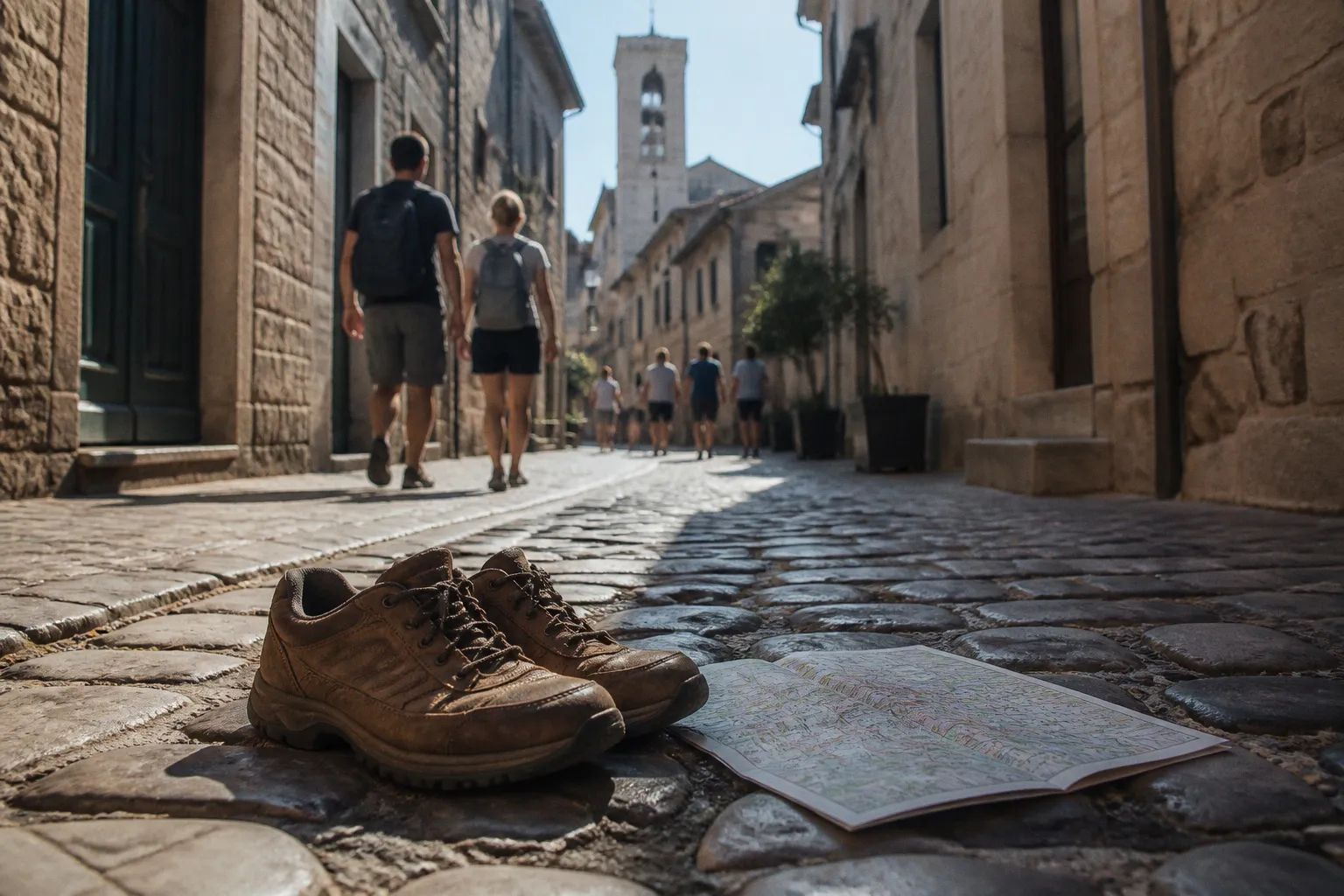
Walking Tour Videos vs. Curated Highlight Routes: Choosing the Right Format for Destination Marketing
More often, the destination content has no clear point of view: either an unedited walk that asks viewers to stay far longer than they intended, or a beautiful highlight reel that makes the neighborhood look appealing without helping anyone understand how to experience it.
That is where the neighborhood video guide route comparison becomes useful. Walking tour videos and curated highlight routes are not competing versions of the same asset. They answer different guest questions, create different kinds of attention, and belong at different stages of the travel decision journey.
I have seen this distinction reshape the way hospitality brands plan destination video. Before the shift, a property may publish a long walk through the surrounding streets and a handful of atmospheric clips, hoping that the sheer volume of footage will create confidence. Afterward, the content is organized around intent: one format builds a sense of place, while the other turns interest into a practical next step.
The most effective strategy is usually not choosing one and discarding the other. It is designing the two formats as parts of the same visual narrative.
The psychology of an immersive walking tour video
A continuous walking tour gives viewers something that a polished montage cannot: time to inhabit a place. The camera moves at a human pace. A turn reveals the relationship between the hotel and the street outside. The sound of traffic, footsteps, café conversations, church bells, or water against a harbor edge adds texture that a sequence of five-second clips tends to smooth away.
For destination marketing, this matters because travelers are not only assessing attractions. They are imagining their own movement through the destination.
Can I walk from the hotel to the old town? Does the route feel lively in the evening? Is the waterfront connected to the restaurant district, or will I need transport? Does the neighborhood feel intimate, energetic, historic, relaxed? A walking tour video can answer these questions without spelling them out in a sales-heavy voice-over.
That immersive quality is particularly valuable for:
- Travelers who are still choosing between destinations and want to understand the atmosphere of a place.
- Guests who care about walkability, local texture, and the relationship between landmarks.
- Viewers using YouTube or a hotel website to research an area in greater depth.
- Properties whose strongest differentiator is not a single attraction, but their position within a distinctive neighborhood.
Travel videos play a meaningful role across the decision journey: 63% of leisure and business travelers watch them when selecting destination activities. That does not mean every viewer wants a 30-minute uncut walk. It does mean that video is often doing more than creating awareness. It is helping travelers decide what a destination will feel like — and whether it fits the trip they want to have.
Where the long format begins to lose people
Immersion becomes less useful when the route lacks editorial purpose. A camera that records every crossing, pause, traffic light, and visually similar block may preserve reality, but it does not necessarily preserve attention.
This is the central weakness of the walking tour video versus highlight reel debate: a continuous route can be authentic while still being difficult to use. Viewers may enjoy the atmosphere but struggle to extract an itinerary. They may understand that the neighborhood is charming but remain unclear about what to do there, how long the route takes, or which stops deserve priority.
Long-form walking content also asks for a commitment from the audience. Someone planning a day in an unfamiliar city may want to see the route in detail, but someone scrolling during a short break may only be looking for one compelling idea. The same footage cannot serve both moments equally well.
For that reason, I encourage hospitality teams to think of the walking tour as an orientation layer rather than a complete conversion asset. Its job is to create confidence, context, and a sensory understanding of the destination. It should help the viewer picture the journey — not necessarily make the booking decision on its own.
A walking tour sells the feeling of moving through a place; a curated route sells the confidence that the viewer knows what to do next.
Why curated highlight routes convert more directly
A curated highlight route is shorter, more selective, and more deliberate. Instead of showing everything between the hotel and the destination’s best-known landmarks, it arranges the experience into a manageable sequence: coffee here, architecture there, a local shop around the corner, a viewpoint before lunch, and a practical return path.
The format is especially effective when a traveler has already expressed interest but needs help translating that interest into an itinerary. The visual narrative becomes more actionable because each stop has a role.
A good curated route answers four questions quickly:
1. What is worth seeing?
The route identifies places with genuine relevance to the guest experience rather than simply collecting recognizable landmarks.
2. Why do these stops belong together?
The sequence creates a coherent neighborhood story — culinary, architectural, historical, creative, coastal, or seasonal.
3. How much time should the guest allow?
The viewer receives a realistic sense of pace without being buried in logistical detail.
4. What can happen next?
A hotel booking, restaurant reservation, attraction ticket, or saved itinerary becomes the natural next step.
This is why curated routes are powerful for landing pages, hotel neighborhood video guides, social campaigns, and destination partnership content. They reduce friction. A viewer does not have to build a day from scattered clips; the brand has already done the editorial work.
Video on landing pages can increase visitor conversion rates by up to 80%, while social video has generated up to 1,200% more shares than static text and image posts combined. Those figures should not be treated as a universal promise — performance depends on execution, audience, and placement — but they point to a practical truth: video earns attention most effectively when it gives that attention somewhere useful to go.
The route must feel curated, not manufactured
Curation is not the same as polishing away all local character. A destination route can be structured and still feel specific. In fact, the strongest ones usually include small details that are not obvious from a generic travel search: the side entrance to a market, the best time for soft light on a square, the short detour that reveals a residential lane, or the independent business that gives the neighborhood its personality.
This is where spatial styling and destination branding meet. The route should look considered, but not staged beyond recognition. Guests are sensitive to alignment — between what they see in the video and what they encounter after arrival. If the content presents a quiet, intimate district but the recommended route depends on crowded peak-hour stops, the promise begins to unravel.
A practical curated route often includes:
- Six to ten stops, so the itinerary feels rich without becoming exhausting.
- A clear geographic relationship between the stops.
- Commentary that stays under roughly 180 seconds per stop.
- A visible beginning and end — ideally connected to the hotel or a useful transport point.
- At least one genuinely local experience rather than a sequence of only headline attractions.
- A reason for the order: geography, time of day, meal pacing, light, or narrative progression.
The objective is not to show the maximum number of places. It is to create a route a real guest would happily follow.
The 1.5-kilometer question: designing for completion
Route planning is where many destination videos become either too vague or too ambitious. A neighborhood may contain dozens of attractive locations, but a digital guide does not need to represent the whole map. It needs to offer a route that feels achievable.
Engagement-driven walking route design commonly recommends keeping a digital tour within a 1.5-kilometer radius, with six to ten stops and commentary under 180 seconds at each stop. These limits are not a rigid law of travel behavior. They are useful editorial boundaries — a way to protect the viewer from fatigue and keep the experience coherent.
The distance is important because perceived effort shapes conversion. A hotel guest may be delighted by the idea of exploring a historic district, but less enthusiastic when the suggested route quietly requires a long transfer, a steep climb, and an evening return through an unfamiliar area. The video should make the route feel possible, not merely attractive.
A practical comparison
| Planning factor | Immersive walking tour video | Curated highlight route |
|---|---|---|
| Primary purpose | Build atmosphere and spatial understanding | Turn interest into an actionable itinerary |
| Typical viewer intent | Research, orientation, sense of place | Planning, saving, sharing, booking |
| Editing style | Continuous or lightly edited movement | Selective clips with clear transitions |
| Route scope | Can cover a longer journey when context matters | Best kept compact and geographically coherent |
| Commentary | Broader context and observational detail | Short, specific explanations at each stop |
| Strongest channel | YouTube, destination pages, trip-planning content | Reels, short-form video, landing pages, campaign pages |
| Main risk | Viewer drop-off caused by repetition or length | Aesthetic polish without enough practical context |
| Best conversion role | Develop confidence in the destination | Provide the next step toward an activity or stay |
The comparison is not about which format is superior in the abstract. It is about matching the route to the question the traveler is asking.
If the question is, What does this place actually feel like?, the walking tour has the advantage. If the question is, How can I spend a good afternoon here?, the curated route is usually the stronger answer.
Make the hotel a credible starting point
For a hotel, the route should not feel like an advertisement awkwardly attached to a travel guide. The property earns relevance by being a useful base.
That might mean beginning at the lobby and showing the first two blocks on foot. It might mean ending near the hotel after a loop through the market and waterfront. It could involve a practical note about the best departure time, an accessible alternative, or the distance to a partner attraction.
The hotel’s role should be contextual rather than intrusive. Viewers want a destination experience, not a prolonged tour of branded surfaces. The property becomes more persuasive when it demonstrates local fluency — when it understands how guests will actually spend their time beyond the room.
From social attention to booking intent
A destination video can perform well on social platforms and still have little influence on bookings. Shares, saves, and completion rates tell us that a concept has earned attention. They do not automatically show that a traveler has moved closer to choosing a hotel, booking an activity, or committing to a destination.
This is why I prefer to map each video to a specific stage of the guest journey before production begins.
For awareness: lead with atmosphere
Short-form clips are effective when the goal is to make a destination recognizable and desirable. A sequence of sensory moments — morning light across stone façades, a market opening, a local dish being prepared, a street musician in a plaza — can create a strong first impression.
The content should have a visual point of view. “Beautiful city” is not enough. The viewer should understand what kind of experience is being offered: slow and culinary, energetic and creative, coastal and restorative, historic but easy to explore.
Destination Marketing Organizations are investing heavily in this format: 76% use short-form video, while 55% use YouTube for long-form content. The channel split reflects a useful distinction. Short-form content introduces the destination quickly; long-form content can provide depth and orientation once curiosity has been established.
For consideration: give the route a shape
At the consideration stage, a curated highlight route can turn atmosphere into planning. The viewer should be able to save the video and understand the order of the experience without reconstructing it from captions.
This is also where local attraction video mapping becomes valuable. A destination brand, hotel group, or tourism board can connect multiple partners through one coherent route — not as a list of sponsors, but as a guest-centered day. The market leads naturally to lunch; the gallery sits near the afternoon coffee stop; the viewpoint makes sense before sunset.
Partnerships work best when the traveler benefits from the relationship. A route assembled only to include every participating business will feel crowded and commercially motivated. A route assembled around time, geography, and guest energy feels like advice.
For conversion: remove the final uncertainty
The strongest booking-oriented videos do not shout their call to action. They resolve the concerns that delay a decision.
Where does the route begin? How far is it from the hotel? Is it suitable for a short stay? Can the guest complete it before dinner? Does the property provide maps, reservations, bicycles, or local recommendations? Which attraction should be booked ahead?
These details can sit beside the video on the landing page, in the caption, or in a linked itinerary. The visual content creates desire; the surrounding context makes the experience feel attainable.
Campaigns built around visual storytelling have recorded substantial increases in traveler booking intent — in one cited example, up to 195%. The lesson is not that every influencer-led video will generate the same result. It is that a compelling sense of place can influence commercial behavior when the content is connected to a clear travel decision.
The before-and-after of a destination content strategy
In consulting work, the most revealing change is often not cinematic. It is organizational.
Before, a hotel may have a folder filled with attractive footage: a promenade at sunset, a restaurant interior, a landmark, a room with a view. Each clip is individually usable, but the collection does not form a route or answer a guest question. The content team keeps producing more images while the underlying guest journey remains unclear.
After, the same visual resources are grouped around distinct purposes:
- A longer walking tour establishes the hotel’s relationship to the neighborhood.
- A short highlight route gives guests a practical half-day itinerary.
- Individual stop clips support social distribution and partner promotion.
- Landing-page video connects the local experience back to the property.
- Updated route information keeps the promise aligned with current access, opening times, and seasonal conditions.
The difference is not simply quantity. It is alignment.
A destination video strategy becomes much easier to manage when each asset has a defined job. The walking tour should not be forced to behave like a Reel, and the Reel should not be expected to provide the complete orientation of a 20-minute route. One builds depth; the other creates momentum.
Matching format to guest intent
The final decision should begin with the audience, not the camera.
Choose an immersive walking tour when:
- The destination’s appeal depends on atmosphere and spatial relationships.
- Guests need reassurance about walkability or neighborhood character.
- The content will live on YouTube or a detailed destination page.
- The route itself is part of the experience — a waterfront, historic quarter, or connected cultural district.
- The brand has enough context to make the walk feel purposeful rather than repetitive.
Choose a curated highlight route when:
- The audience is browsing quickly on social platforms.
- The destination has several nearby attractions that can form a coherent day.
- The campaign needs saves, shares, itinerary clicks, or partner referrals.
- The hotel wants to demonstrate practical local knowledge.
- The viewer is likely to be choosing between activities rather than discovering the destination for the first time.
Use both when the booking journey requires both reassurance and action. A traveler may discover a 45-second route through social video, watch a longer neighborhood walk on YouTube, and then return to the hotel’s landing page to book. These are not separate audiences in neat boxes. They are often the same person at different moments.
The best destination marketers respect that movement. They do not ask one video to carry the entire burden of inspiration, orientation, planning, and conversion. They build a visual system in which each format does its own work — and hands the guest naturally to the next step.
A walking tour video gives the destination breathing room. A curated highlight route gives it direction. When the two are planned around the real guest journey, the result is more than attractive footage: it is a credible invitation to arrive, explore, and stay.